Hedge funds are supposed to be the part of the market that does not fall in unison. On Thursday, October 22, they did.
“For the first time since Covid-19, all three broad equity strategies fell more than 1 per cent on the same day,” Goldman Sachs’ prime brokerage desk told clients, according to a Bloomberg report published by The Business Times. The note covered fundamental long/short managers, systematic long/short managers and the multi-strategy platforms, the so-called pod shops, that have become the industry’s centre of gravity.
The numbers, by strategy, according to the Goldman note as reported:
- Global fundamental long/short managers fell 1.4 percent, their worst day since July 16. Funds focused on technology, media and telecoms fell an average of 2.7 percent.
- Global systematic long/short managers fell 1.3 percent, their third-worst day since December 2023.
- Multi-strategy platforms slid 1.9 percent, their second-worst day since the April 2025 tariff selloff.
“Based on estimates from our prime book, more than two-thirds of hedge funds finished down on the day, as concentrated shorts were squeezed further in the second half of the session,” the prime brokerage said.
What happened on Thursday
The trigger was a heavy selloff in American technology shares, driven by mounting doubts over whether the enormous spending on artificial intelligence will pay off. The Nasdaq 100 fell 2.9 percent, its biggest drop since June, as worries about oil-driven inflation compounded the pressure.
What made the day unusual for hedge funds was not the size of the market move, which was large but not historic, but the way it hit both sides of their books. Long positions in technology fell. At the same time, the most crowded short positions rose in the afternoon, a squeeze that punished managers who had hedged by betting against weaker companies. When longs fall and shorts rise together, a market-neutral book stops being neutral.
The multi-strategy figure is the most striking. The pod shops are built specifically to avoid firm-wide drawdowns: dozens or hundreds of portfolio managers run small, tightly risk-managed books, and the platform cuts any team that loses too much. A 1.9 percent loss in a day is not a crisis for such a fund, but it is the kind of number the model is designed to make rare. It was the second-worst day for the group since April 2025.
The pain was not limited to New York. Goldman said Asia-focused fundamental long/short managers were down 9.3 percent for the month to date, though still up 14.2 percent for the year.
Later in the week, Reuters reported, also citing Goldman’s prime data, that losses had deepened as the technology selloff continued, leaving fundamental long/short funds down 3.8 percent for October but still up 8.8 percent for the year.
The record that arrived the same day
By coincidence, October 22 was also the day HFR published its third-quarter industry report, and its headline was the opposite of a crisis. Total hedge fund industry capital ended September at $5.64 trillion, a narrow increase that HFR said marked the 16th consecutive quarterly gain.
The detail beneath the headline anticipates Thursday’s trouble. HFR estimated that investors put a net $34.5 billion of new money into hedge funds in the third quarter, which more than offset $27.4 billion of performance-based declines. In other words, the industry grew because clients kept writing cheques, not because the funds made money.
Those losses were concentrated in exactly the places that hurt on Thursday. The HFRI Equity Hedge (Total) Index fell 2.1 percent in the quarter, with the Fundamental Growth and Technology sub-indices down 4.3 and 3.3 percent. Equity Hedge assets fell by an estimated $31.6 billion, to $1.72 trillion, with Technology and Healthcare funds accounting for a $30.3 billion decline. Event-driven strategies fell 1.9 percent, with Special Situations down 4.4 percent.
The winners were the funds that bet on rates, currencies and trends rather than on stock-pickers’ conviction. The HFRI Macro (Total) Index rose 4.3 percent in the quarter. Trend-following CTA funds gained 5.7 percent, taking their return for the year to 15.7 percent through September. Total macro capital rose to an estimated $897.4 billion.
The big get bigger
HFR’s figures also show where the money is going, and it is not to the little guy. Firms managing more than $5 billion took in an estimated $36.6 billion of net inflows in the third quarter. Mid-sized firms, those with $1 billion to $5 billion, saw a net outflow of $2.3 billion, while smaller firms took in $190 million.
Over the first nine months of the year, the largest firms received $113.7 billion of net inflows, against $8.0 billion for mid-sized managers and $2.4 billion for small ones. Multi-strategy funds, by HFR’s count, ended the quarter at a record $900 billion in assets.
That concentration is the bridge between the two October 22 reports. Investors are paying the multi-strategy giants to deliver steady returns that do not move with the market. A day on which the pod shops lose almost 2 percent alongside everyone else is precisely the day those investors will remember when the next allocation meeting comes round.
What the industry is saying
HFR’s president, Kenneth J. Heinz, framed the quarter as a test that the best managers passed. “Through this environment, investors continued to allocate to strong performing funds which have effectively navigated the rapidly shifting rate, technology and geopolitical environment, providing defensive portfolio protection while also accessing opportunities created by the volatility and dislocations,” he said in the report.
He also looked ahead to the calendar. “Heading into the US midterm elections, hedge funds are positioned for a wide range of possible policy outcomes with significant financial market impact, including the potential of additional volatility, disruption and dislocations based on the election outcomes,” Heinz said.
In written answers to questions from The City Politic, provided through a spokesman, Heinz said the turbulence could help rather than hurt the industry. “Recent volatility is likely to increase flows from investors interested in defensive, opportunistic approaches to lower portfolio beta,” he said. Nor does he see the concentration in the biggest platforms reversing: “The trend toward allocations to large multi strategy & podshop firms continued in 3Q and is likely to accelerate in 4Q.” On the midterms, he said funds “are positioned for possible policy changes with focus on AI growth & guardrails, data center demand, capacity and costs, and resolution of the Iran military conflict.”
HFR cited the Iran military conflict among the geopolitical pressures managers were navigating, alongside a sharp rise in interest rates during the quarter.
What to watch
The midterms are today, November 3, and the third-quarter earnings season for the largest technology companies is under way. October month-end performance figures, due in the first days of November, will show whether Thursday was the worst of it or the start of a longer run of losses.
For New York’s hedge fund industry, which is concentrated in Midtown and increasingly in the largest platforms, the most important number may turn out to be the inflow figure in HFR’s fourth-quarter report. A record asset total built on client money rather than returns is only as durable as clients’ patience.
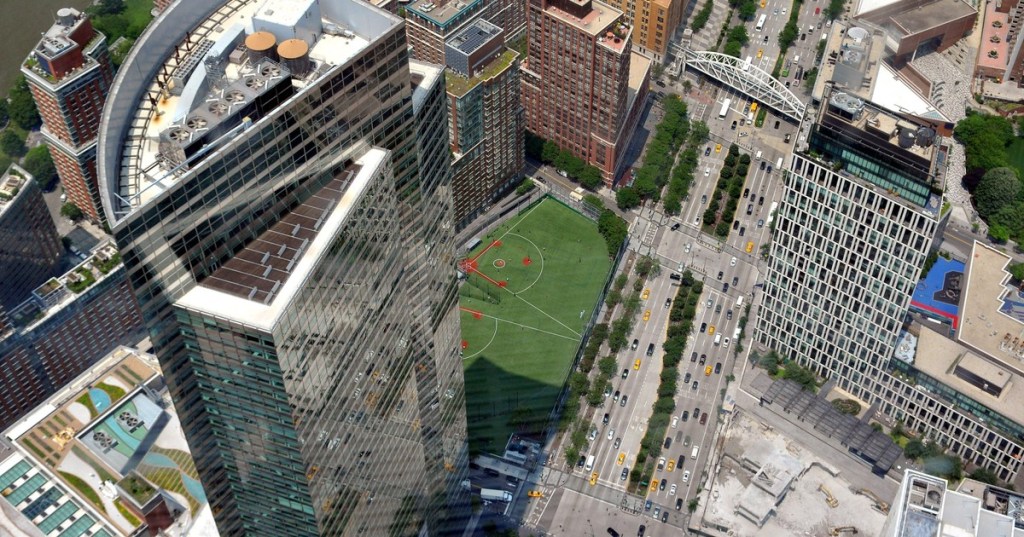
Featured image: 200 West Street, Goldman Sachs’ headquarters in Lower Manhattan, seen from One World Observatory. Photo by Pixel.la via Wikimedia Commons, CC0.



Leave a Reply