Every October, Harvard publishes a financial report that most of its students never read. This year’s deserves a closer look. It describes a university that is at once richer than ever and noticeably smaller, and its two most senior financial officers did not try to hide the tension.
“Those two facts — a surplus, and a smaller community — sit uneasily together,” Chief Financial Officer Ritu Kalra and Treasurer Timothy R. Barakett wrote in the fiscal 2026 financial report. “Yet they cannot be separated.”
The good news
The endowment grew by more than $11 billion to nearly $68 billion in the year ended June 30, after a 27.1 percent investment return, according to the report and coverage by The Harvard Crimson and Harvard Magazine. That is the second-best return of the past decade, behind only fiscal 2021’s 33.6 percent. Among peers that have reported, only Stanford, at 31.7 percent, did better. MIT returned about 10 percent.
Harvard Management Company chief executive N.P. “Narv” Narvekar credited venture capital, public equities and hedge funds. The portfolio has also shifted decisively toward private markets. Private equity is now 46 percent of the portfolio, and venture and growth venture investments within that category rose from 24 percent to 31 percent. The best-known holding is a $2.2 billion stake in SpaceX, which Harvard disclosed in August after the company’s June initial public offering. By the Crimson’s count, the position was worth more than all of the endowment’s other reported public holdings combined.
Narvekar also gave a measured warning. “Outsized returns can sometimes portend subdued, or even negative, returns in the near term,” he wrote. He has told HMC’s board he plans to retire as early as 2027, so his successor will likely inherit both the gains and that caution.
The university also posted a $100 million operating surplus on about $6.7 billion in revenue, a 1.5 percent margin, after a $113 million loss in fiscal 2025. Gifts for current use hit a record $684 million.

The harder news
The surplus is less comfortable than it looks. Harvard ran a $78.7 million deficit in unrestricted funds, the money that pays for general operations. Restricted gifts produced the overall surplus. Kalra and Barakett called the headline figure “an insufficient measure of Harvard’s financial health.”
The budget balanced because of spending cuts, not new revenue. Salaries and wages, Harvard’s largest expense, fell $104 million, or 3.8 percent, which the report attributed to “a hiring freeze, attrition and restructurings.” Non-union staff had a wage freeze. Soon after the fiscal year closed, the Faculty of Arts and Sciences eliminated 165 positions, a move Dean Hopi E. Hoekstra has said could save about $20 million a year.
Federally sponsored research revenue fell about 20 percent. Harvard Magazine notes that the real decline is steeper, close to a third, if you strip out $116 million in grants that were terminated in 2025 and restored in fiscal 2026 after court rulings. Legal costs also rose sharply. Legal fees were $126 million in fiscal 2025. A university spokesperson told Harvard Magazine that ongoing and one-time legal fees in fiscal 2026 were roughly $210 million, a figure that includes Harvard Medical School’s $53 million settlement in the body-parts theft case. President Alan M. Garber has called the costs “mind-boggling.”
The tax
Then there is the endowment tax. Under the law Congress passed in July 2025, the excise tax on Harvard’s net investment income rises from 1.4 percent to 8 percent starting in fiscal 2027. Even at the old rate, Harvard’s investment-income taxes for fiscal 2026 more than quadrupled, to roughly $207 million, because it realized more gains. The new rate is expected to cost about $300 million a year. Accounting rules required Harvard to book the change now. Its tax liability rose from $317 million to $1.9 billion, “most of it deferred,” as Kalra and Barakett put it, an estimate of future taxes on gains not yet realized.
Harvard’s response is to hold the endowment payout flat in fiscal 2027, with zero increase, to cover the bill. Whatever one thinks of the tax as policy, its supporters see it as a fair charge on very large untaxed fortunes, and its critics see it as a penalty on research and financial aid. Its effect on Harvard is now measurable: the tax takes much of what a payout increase would normally provide.
Why the paradox holds
The report’s most useful passage explains how a 27 percent return and layoffs can happen in the same year. “The University deliberately smooths distributions so that operating support does not rise and fall with the markets,” Kalra and Barakett wrote. Strong returns “neither create immediate flexible resources nor, on their own, resolve structural gaps between recurring revenues and expenses.”
That is sound endowment management. A university that spent windfalls as they arrived would also have to cut when markets fell. It is also a hard message for the staff members who lost jobs in a record year. Harvard’s leaders are betting that discipline now protects what they call the university’s enduring commitments: teaching, research and financial aid, which reached more than $775 million this year.
The question for Cambridge is how long that discipline lasts. The university now faces a tax that grows with its success, federal research support that has not recovered, and a 46 percent private-equity portfolio whose manager warns the good years may not last. Harvard is still very rich, but its flexibility is smaller than the $68 billion figure suggests.
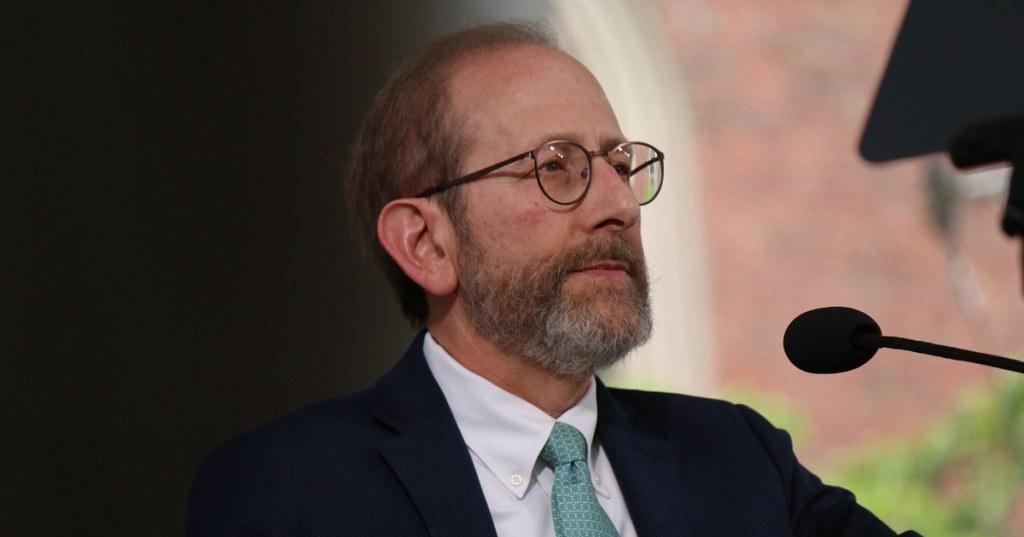
Featured image: Harvard President Alan Garber at Harvard Alumni Day in Tercentenary Theatre, June 2025. Photo by Xuthoria via Wikimedia Commons, CC BY-SA 4.0.




Leave a Reply