In New York real estate, the rent freeze was always going to be argued twice: once at the Rent Guidelines Board, and again, more quietly, in a loan committee. The second argument is now under way, and the loan committee belongs to the federal government.
Fannie Mae has tightened its underwriting for the city’s rent-regulated buildings since the freeze passed in June, and Freddie Mac has put new loans on “pause” while it studies the impact, The City Reporter reported on Nov. 2. Greg David’s story, built on interviews with landlords, advocates and nonprofit housing executives, many of whom asked not to be named, says the new rules are making it “impossible or extremely difficult” for owners of older stabilized buildings to refinance.
The detail is the story. Fannie Mae now assumes, according to the report, that stabilized rents will not rise for four to eight years. That covers Mayor Zohran Mamdani‘s current term and a possible second one. It also assumes expenses rise at least 5 percent a year. Put those two lines in a spreadsheet and the building’s operating margin shrinks every year, and so does the loan.

“Fake News,” says the regulator
Bill Pulte, director of the Federal Housing Finance Agency, which oversees both companies, disputes the account. In a series of posts on X, Bisnow reported, he called the report “Fake News.” He posted a statement from Fannie Mae: “We continue to be an active source of financing for New York City’s multifamily housing, including rent-stabilized properties. We apply a consistent credit framework to every loan we purchase nationwide, which looks at each property’s actual financial picture, including the local rules that affect its income and operating costs.”
In another post, quoted by Bisnow and the Fiscal Policy Institute, he wrote: “It is false to report Freddie Mac has frozen lending on those properties in NYC, and in fact we continue to quote and lend on those properties.” Freddie Mac told The City Reporter that it “continuously reviews market conditions and makes real-time adjustments to offer responsible, risk-adjusted lending aligned with mission-driven objectives.”
The two accounts are less opposed than they look. A “consistent credit framework” that counts “the local rules that affect its income” is, in plain English, a framework that counts a rent freeze. The real dispute is over degree: whether Freddie has stopped or merely slowed, and whether Fannie’s assumptions are prudence or a penalty.
The underwriter’s case
Rafael Cestero, chief executive of the Community Preservation Corporation, a nonprofit lender, offered the bluntest defense of the new math. “I don’t think the new underwriting standard should be a surprise or controversial to anybody, because underwriting anything other than operating in a rent-freeze environment wouldn’t really be factually accurate,” he told The City Reporter.
His own shop is doing the same. CPC is assuming no rent increases for four years, 5 percent annual expense growth, and a doubled collection loss of 10 percent, and it will make half as many loans to all-affordable projects in the city as it did two years ago. “It’s one thing to have a freeze when interest rates are at 3%,” he said, recalling the de Blasio-era freezes. “It’s another when they are at 7%.”
Bisnow added context from a CPC report: expenses rose 27 percent between 2020 and 2024 while rents grew 11 percent. Origination volume tells the rest. Per Atrium Data figures cited by Bisnow, lenders wrote $27.6 billion of mortgages on mostly regulated buildings in 2019 and less than $11.3 billion in 2025. Signature Bank is gone, and New York Community Bank has left the business. That is how two federally chartered companies became, in David’s phrase, the lender of last resort.
The tenant advocates’ case
The Fiscal Policy Institute, a progressive think tank based in Albany, answered on Nov. 6 with a paper by housing analyst Elizabeth Cooper. Her argument is that the freeze “has predictably lowered expected income” but “is not the primary driver of financial stress.” She puts more of the blame on the lenders. “At the heart of the problem is a pattern of GSE lending to high-risk buildings at high interest rates,” the paper says, lending that “pushed landlords to defer maintenance and raise rents rapidly.” Before 2019, it argues, stabilized buildings were valued as if they would one day become market-rate, and the agencies lent against that hope. The 2019 Housing Stability and Tenant Protection Act ended the hope. The freeze, on this view, merely confirms it.
That is a serious argument, and it is also a convenient one for the freeze’s supporters. It does not change what happens next. A loan written in 2017 against a deregulation story still has to be refinanced in 2027 against a freeze.
What the city says
Deputy Mayor for Housing and Planning Leila Bozorg told The City Reporter that the city’s housing finance agencies support “tens of thousands of affordable homes each year amidst a variety of ever-changing macroeconomic factors — including higher interest rates that are partially driven by federal monetary policy.” She said the city is “always prepared to work with our financing partners and explore new lending practices.” She pointed to a city-backed insurance program and faster permitting, most of which, the outlet noted, are still being planned or rolled out.
Who gets hurt
The pain is not evenly spread. Mixed buildings with market-rate units are fine, The City Reporter said, thanks to soaring market rents. So are old-line families who bought decades ago and borrowed little. Jon Estreich, a veteran loan broker, named Rudin Management and the Litwins’ Glenwood Management as owners who can still get money. The squeeze falls on buildings that are entirely rent-regulated and were bought, with borrowed money, on the old math.
The first test case is already in court. Last month a lender filed to foreclose on a $103 million loan tied to Cunningham Apartments, 22 buildings in downtown Jamaica owned by A&E Real Estate Holdings, The City Reporter reported. A&E put in $3 million to bring the loan current. Nonprofits are feeling it too. “The risks to rent-stabilized housing is endangering the whole affordable housing mission,” said Michelle de la Uz of Brooklyn’s Fifth Avenue Committee, which has lent money to some of its own projects to keep them out of default. “It is not sustainable.”
Landlords, meanwhile, are challenging the freeze in court, claiming the administration improperly influenced the board, Bisnow noted. That case may decide the next two years of rents. The underwriters have already decided the next eight.
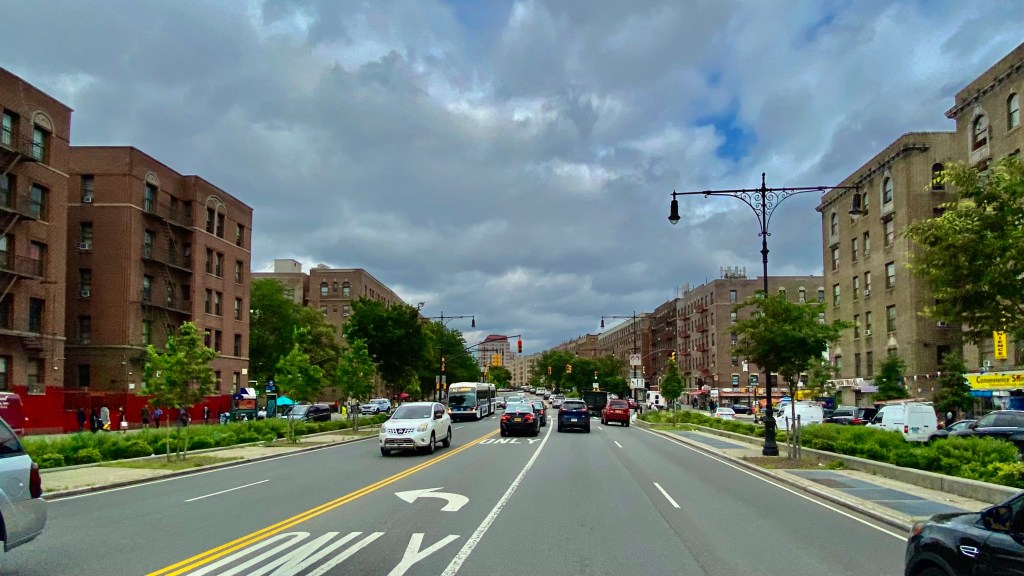
Featured image: Apartment buildings along the Grand Concourse in the Bronx, home to much of the city’s rent-stabilized housing. Photo by Andre Carrotflower via Wikimedia Commons, CC BY-SA 4.0.




Leave a Reply