
One of the first criminal cases to treat a prediction-market bet as insider trading is headed for trial. Late on Monday, Oct. 26, U.S. District Judge Margaret Garnett of the Southern District of New York denied a motion to dismiss the indictment of Master Sgt. Gannon Ken Van Dyke, a soldier stationed at Fort Bragg. Prosecutors accuse him of using classified information about the U.S. operation against Venezuela’s Nicolás Maduro to place bets on Polymarket, Courthouse News reported.
Van Dyke has pleaded not guilty. He is presumed innocent, and the ruling decides only whether the government’s legal theory can go to a jury, not whether he did what is alleged.
What the government alleges
According to the U.S. Attorney’s Office, Van Dyke, 38, was involved in planning for Operation Absolute Resolve from about Dec. 8, 2025. Prosecutors say he opened a Polymarket account on Dec. 26. Between Dec. 27 and Jan. 2, he is alleged to have placed about 13 bets, totaling about $33,034, on contracts tied to Maduro’s fate. Maduro was captured on Jan. 3. The government says the bets earned about $409,881 in profit, which was moved to a foreign cryptocurrency vault. On Jan. 6, prosecutors say, Van Dyke asked Polymarket to delete his account.
He faces three counts under the Commodity Exchange Act, each carrying up to 10 years in prison, along with a wire fraud count that carries up to 20 years and an unlawful monetary transaction count that carries up to 10. The Commodity Futures Trading Commission brought a parallel civil action. Prosecutors have said that Polymarket’s operator cooperated with the investigation.
When the charges were announced in April, U.S. Attorney Jay Clayton’s statement began, “Prediction markets are not a haven…”
The legal question
The defense, from Geragos & Geragos and Agnifilo Intrater, made the argument that much of the prediction-market industry has been watching for. The Commodity Exchange Act’s insider-trading provisions apply to swaps, and the defense said a bet on whether a foreign leader stays in power is not a swap. The definition at issue, Section 1a(47)(A)(ii), was amended by the Dodd-Frank Act. It covers contracts whose payoff depends on whether an event occurs that is “associated with a potential financial, economic, or commercial consequence.”
Garnett did not decide what that phrase means. “But the court need not wade into the thicket of the parties’ interpretive dispute at this stage,” she wrote, “because Van Dyke’s motion can succeed only if the event contracts alleged in the indictment cannot be swaps as a matter of law, and Van Dyke has failed to make that showing.”
That is a narrow ruling, but an important one. An indictment survives a motion to dismiss if the charges, as alleged, could amount to a crime. Whether the specific Polymarket contracts had enough of a financial or commercial consequence to qualify as swaps is a factual question, and the government will have to prove it at trial. The defense will be able to raise the argument again, either during trial or after.
Garnett also rejected, for now, the argument that the law is unconstitutionally vague as applied to Van Dyke. She called the challenge premature “given the focus on factual analysis.” Calling it premature leaves room for the defense to raise it again once the facts are on the record.
Why the industry is watching
Prediction markets have grown quickly, and the legal framework has not kept up. If event contracts are swaps, the federal rules on fraud and insider trading in derivatives apply to them, and people with nonpublic information face real criminal exposure when they trade on it. If they are not swaps, the government would have a harder time prosecuting this kind of case under commodities law, though wire fraud charges would still be available.
The case also raises a basic national-security question. A market that lets people bet on military operations gives anyone with advance knowledge an incentive to trade, and sometimes the people with advance knowledge are in uniform. Prosecutors have presented the case as a misuse of classified information as much as a market crime.

What’s next
Trial is tentatively scheduled for Dec. 7. Courthouse News reported that prosecutors have asked that witnesses from the Department of Defense be allowed to testify using “pseudonyms and light disguises,” and that courtroom sketch artists not draw them. In deciding it, Garnett will have to weigh the security concerns against the defendant’s right to confront the witnesses against him.
Whatever the jury decides, this ruling means the question of whether a prediction-market bet can be insider trading will be decided on a full trial record, not on the indictment alone.
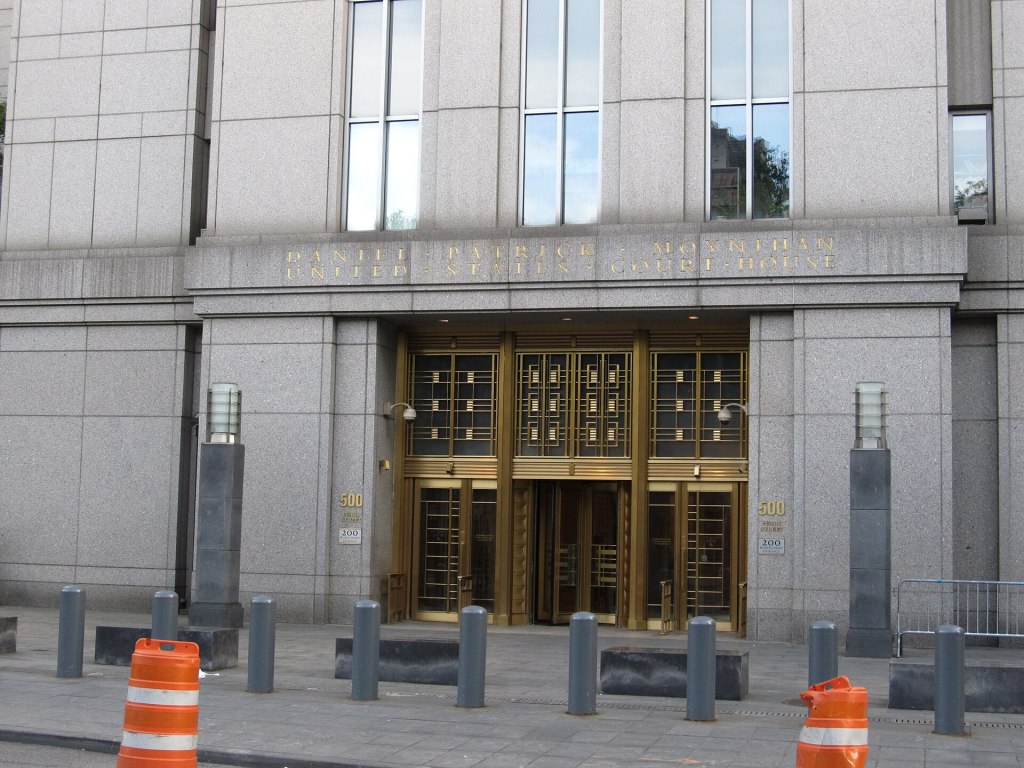
Featured image: The Thurgood Marshall United States Courthouse at 40 Foley Square in Manhattan, 2024. Photo by Kidfly182 via Wikimedia Commons, CC BY 4.0.






Leave a Reply