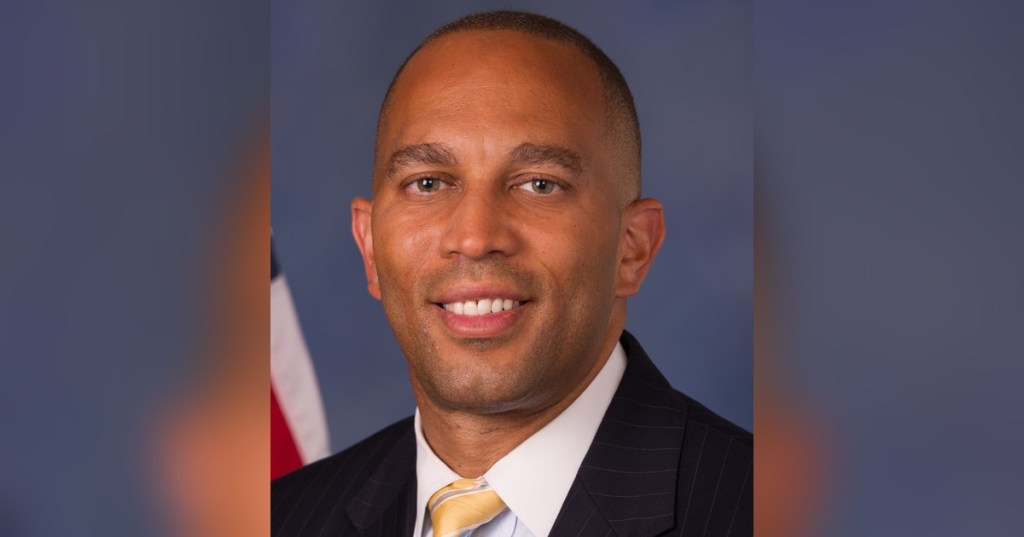
Come January, both chambers of Congress could be run by New Yorkers, and both of them from Brooklyn. Voters gave Democrats control of the House and the Senate on Nov. 3, and Rep. Hakeem Jeffries and Sen. Chuck Schumer are poised to lead them, Nexstar’s Albany bureau reported.
Poised is not elected. And the fight over whether they get there is, to a striking degree, a fight about money.
The arithmetic
Jeffries needs to win an internal Democratic caucus election on Nov. 18, then 218 votes on the House floor in January. At a press conference on Monday, Nov. 9, he projected that Democrats will hold more than 260 seats. The day after the election, he sent House Democrats a letter outlining a 100-day agenda that includes extending the Affordable Care Act tax credits and repealing President Trump’s tariffs.
Most of the New York delegation has already signed on. Reps. Grace Meng and Gregory Meeks of Queens back him, as do Pat Ryan of the Hudson Valley, Joseph Morelle of Rochester and Representative-elect Cait Conley, who unseated Mike Lawler. So does Brooklyn’s Yvette Clarke. “Having Brooklyn represented in congressional leadership will only serve to benefit our communities, and I’m excited to cast my vote for the first Black Speaker of the House and a true Brooklynite,” she said.
The holdouts
The resistance is concentrated among people who have not yet been sworn in. Axios reported that members of an informal progressive “Bloc” of incoming Democrats have declined to commit. They include two New Yorkers, Representatives-elect Darializa Avila Chevalier and Claire Valdez, and Adam Hamawy of New Jersey.
“I haven’t committed yet,” Valdez, a member of the Democratic Socialists of America, told Nexstar. “People are angry, and delivered a mandate last Tuesday to lower their costs, end the war, rein in ICE, and take on the most corrupt and powerful oligarchy this world has ever seen.”
Some freshmen have named a price, and it is a campaign-finance rule. Representatives-elect Don Leonard of Ohio and Richard Ojeda of North Carolina want Jeffries to commit to a ban on corporate PAC contributions before they vote for him, Axios reported. “We need a 28th Amendment in the year 2028 or before to shut down Elon Musk and corporate money and Israeli lobby money, for that matter,” Leonard said. Ojeda put it more simply: “It’s time for us to stop allowing the billionaire class to buy our elections.”
The pressure runs in both directions. Leonard said in a social media post that senior House Democrats had warned him his life would become “a living hell,” and that they would try to oust him in 2028, if he did not back Jeffries, Politico reported. He has also tied his vote to a constitutional amendment overturning Citizens United and to ending U.S. support for Israel’s military campaigns. A viral claim that Jeffries himself had threatened to withhold committee assignments from holdouts was not supported by any evidence, Snopes found.
Not every newcomer is holding out. Rebecca Bennett, who beat Tom Kean Jr. in New Jersey’s 7th District, is among the freshmen supporting Jeffries. So is Zack Mullock of New Jersey, who ran without national-party help. “You’re going to have pretty strong support for Hakeem, and I’ll be part of that support,” Mullock told Axios. And Jeffries’ left flank in the current House is solid. “There is one candidate in this race, Hakeem Jeffries,” said Rep. Alexandria Ocasio-Cortez, who has spent years calling for new leadership.
Schumer’s version
Schumer’s challenge looks similar but works differently. The majority leader is chosen by a closed-door vote of the Democratic caucus, not on the floor. The progressive group RootsAction has launched a campaign to replace him with Maryland Sen. Chris Van Hollen. “As Democratic leader, Chuck Schumer has been a devoted servant of corporatism, Big Tech, go-slow status-quo economics, and Israel-right-or wrong policies,” the group said. “And he has the receipts (in the form of campaign cash) to prove it.”
Several incoming senators have said they want new leadership, and Sen. Bernie Sanders of Vermont said he did not think Schumer had been leading toward “an economy that works for all.” Sen. Kirsten Gillibrand, who ran the Democratic Senatorial Campaign Committee during the sweep, defended him, as did Gov. Kathy Hochul.
The case for the PACs
The corporate-PAC pledge is popular in a primary. The argument against it deserves a careful hearing, and Republicans have made it for years. A corporate PAC does not give corporate treasury money. It pools voluntary contributions from employees and shareholders, its giving to a candidate is capped at $5,000 per election under federal limits, and every dollar is disclosed. Banning the most regulated, most transparent kind of political money does not make money leave politics. It pushes it toward super PACs and outside groups, which can raise and spend without limit. A speaker who swears off PAC checks could leave his members more dependent on the very independent spenders the freshmen say they oppose.
There is a governing point as well. Jeffries’ 100-day agenda starts with health-care subsidies and tariffs. A caucus that spends its first weeks fighting over its leaders’ donor lists gives Republicans an easy opening to argue that Democrats won on affordability and are talking about themselves.
New York’s Republicans, in the minority
The change in power reaches New York’s Republicans directly. Rep. Andrew Garbarino of Long Island chairs the House Homeland Security Committee. In January the gavel is expected to pass to Rep. Bennie Thompson of Mississippi, the panel’s ranking Democrat, and with it the power to issue subpoenas, Project Salt Box noted. Within hours of the result, committee Democrats posted a message on X to Homeland Security Secretary Markwayne Mullin: “clear your calendar.”
Garbarino’s GOP colleagues from the region, Nicole Malliotakis of Staten Island and Nick LaLota of Long Island among them, will spend the next two years arguing from the minority. They will be watching closely to see whether a speaker from Brooklyn governs from the middle of his caucus or from its edge.
What to watch
Nov. 18 is the first test. A comfortable caucus margin would make the January floor vote a formality. A visible bloc of no votes would show how much leverage the freshmen really have. The more interesting signal is whether Jeffries says anything about corporate PAC money at all. A pledge would buy votes on the left. Saying nothing would keep faith with the members, many of them from swing seats, who raised that money to win the majority in the first place.
Featured image: Rep. Hakeem Jeffries of Brooklyn, who faces a Democratic caucus vote for speaker on Nov. 18 (official portrait). Photo by U.S. House of Representatives via Wikimedia Commons, public domain.





Leave a Reply