The first court to rule against New York City’s tax on luxury second homes was a trial court on Staten Island. The first appellate court to look at that ruling has now thrown it out, and it did so without deciding whether the tax is fair, wise or even lawful. It decided that the people who sued had not been hurt.
In Matter of O’Brien v. City of New York, No. 2026-10762, the Appellate Division, Second Department, on Nov. 4 reversed a Sept. 29 judgment by Justice Wayne M. Ozzi of State Supreme Court in Richmond County (Index No. 85217/26). The panel of Justices Mark C. Dillon, Francesca E. Connolly, Deborah A. Dowling and Phillip Hom ordered the petition denied and the case dismissed. The case was argued on Oct. 28.

The tax and the rollout
The surcharge was created by the State Legislature in May as part of the budget. It applies to one-, two- and three-family homes, co-ops and condos in the city that are not their owners’ primary residences and that exceed market-value thresholds. Through July 2028, those are $5 million for small homes and $1 million for co-op and condo units, measured by the city’s own valuation rather than by sale price.
The rollout is what drew the lawsuit. In July, the city’s Department of Finance posted a supplemental roll of covered properties, which the petitioners said listed some 900,000 owners’ names. Later that month it sent “initial determination” notices to about 17,000 owners it had concluded were not using their properties as primary residences. Those owners could then submit proof that they were.
The petitioners, represented by Randy Mastro of Dechert, argued that the roll invaded their privacy and caused “mass confusion,” and that the notices were sent using the wrong year’s tax data and pushed onto owners the cost of proving where they live. Justice Ozzi agreed and granted injunctive and declaratory relief.
What the panel held
The city lost two of its three arguments. The court said the case was not moot, even though some petitioners had since been exempted, because they were challenging the rollout itself. It also rejected the city’s claim that owners could only challenge the tax after a final determination by the city’s Tax Commission.
But the panel found no injury, and without injury there is no standing. On the published roll, it said that “confusion has been held to be too generalized, tenuous, and ephemeral to constitute a cognizable injury-in-fact,” and that fears of stalking or fraud were not backed by any affidavit or evidence. It noted that the city’s ordinary assessment rolls already publish owners’ names and market values for every property.
On the notices, the court reached for an analogy from consumer law. “The receipt of debt collection letters, standing alone, does not rise to the level of an injury-in-fact,” the panel wrote, and neither does a tax notice. The cost of proving residency did not count either. “All taxpayers incur time, effort, and costs in determining and complying with their various tax obligations,” the court said, adding that the petitioners had not documented or quantified any actual costs.
The panel’s sharpest line went to the design of the statute. “In providing owners of covered properties the right to provide evidence of primary residency, the State Legislature must have anticipated that the list of notice recipients would not be exact or flawless,” it wrote; “otherwise, there would be no purpose to providing an exemption procedure at all.”
The court also noted that the petitioners’ expert, Martha E. Stark, a former city finance commissioner, had said the department should have used 2025 tax data. When that data became available, the department used it, and told several hundred owners that they did not owe the surcharge after all.
The two sides
Mayor Zohran Mamdani celebrated. “Today, an appeals court rejected an attempt by the ultrawealthy to avoid paying their fair share,” he said in a statement reported by amNewYork. Mastro called the levy an “unconstitutional surcharge altogether.”
The owners’ complaint is not frivolous, and the court’s ruling does not answer it. A government that publishes a list of people it suspects of owing a new tax, then asks them to prove otherwise with documents that do not carry the confidentiality of a tax return, is shifting a burden. The panel noted that the department concedes such documents would not enjoy statutory tax secrecy. The court did not say that this is good policy. It said that receiving the letter is not, by itself, the kind of harm a court can remedy.
What comes next
Two more lawsuits are pending, Ross v. State of New York and Friedman v. State of New York, and they make bigger claims. Both argue that the surcharge is invalid on federal and state constitutional grounds, Mark A. Limardo of Herrick, Feinstein wrote in a client alert. One argues that the tax discriminates against people who live outside New York, according to amNewYork. Neither case is seeking an injunction while it proceeds, and both are at an early stage.
That leaves the tax in full effect. Limardo notes that the testing date for the 2027-28 property-tax year is Jan. 5, 2027, so owners who want to claim an exemption, for instance by restructuring ownership or bringing in a tenant, have weeks, not months. If a court later strikes the tax down, owners who paid will have to seek refunds. The O’Brien petitioners could still try for further appeal. For now, the city has the money, and the burden of proof sits with the owners.
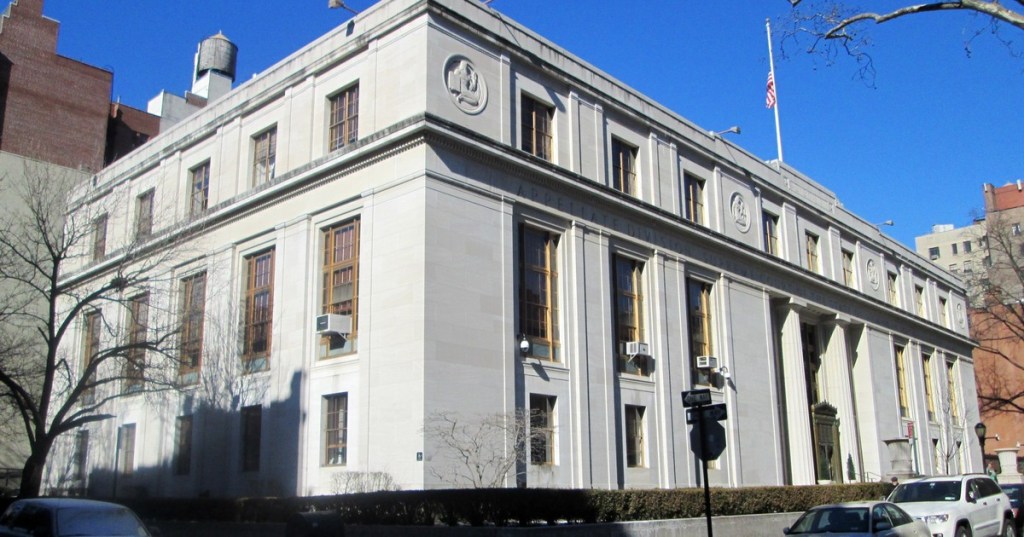
Featured image: The Appellate Division, Second Department, courthouse at 45 Monroe Place in Brooklyn Heights. Photo by Beyond My Ken via Wikimedia Commons, CC BY-SA 4.0.




Leave a Reply