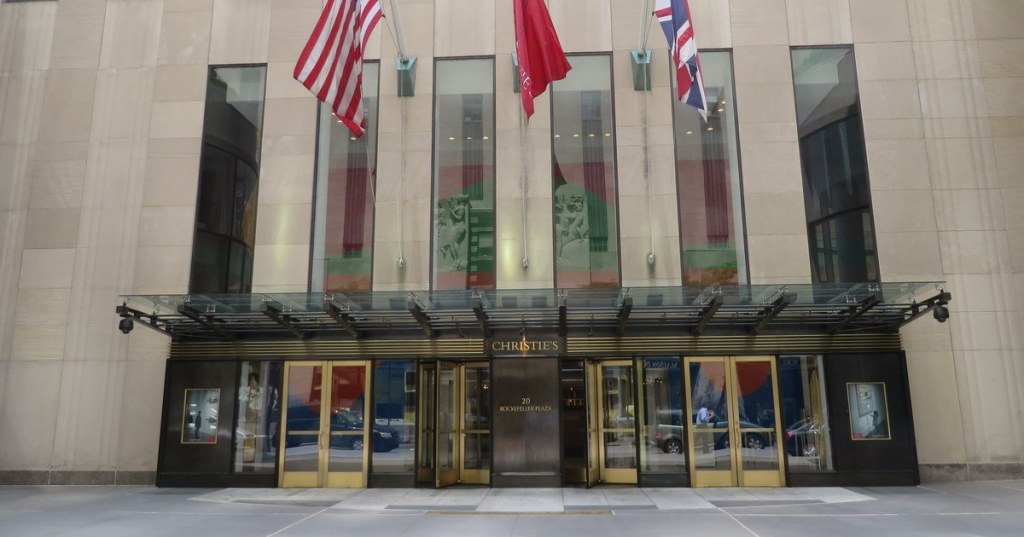
The fall auctions in New York have a way of announcing which way the market thinks the wind is blowing. This November, Christie’s is betting on two old certainties: a Klimt landscape and a Kandinsky abstraction, each estimated at $60 million to $80 million. Both will be offered in its 20th Century Evening Sale at Rockefeller Center on Nov. 17.
They are very different pictures with very different stories. What they share is a pedigree that runs through the founders of two of New York’s great museums, and a chance to rearrange the record books.
The Lake at Litzlberg
The Klimt is “Litzlbergkeller,” painted in 1915 and 1916. It shows a brewery and inn on the north shore of Lake Attersee, where the artist had spent his first summers in the area from 1900 to 1907. By the time he painted it, he had moved to a cottage on the southern shore. According to Christie’s, he composed the view from across the water with a telescope and postcards, and erased every sign of the inn’s summer bustle.
The picture is a square of tapestry-like greens with a semi-abstract reflection below. That reflection is the passage the auction house is selling hardest. Giovanna Bertazzoni, chairman of Christie’s Europe, described the work as reading “like a lyrical composition in three stanze – the forest with majestic, whispering oak trees; the house embraced by their foliage; the shimmering reflection in the lake.”
Max Carter, the house’s global chairman of 20th- and 21st-century art, went further. “The inn of Litzlbergkeller sits at the water’s edge,” he said, “between Klimt’s allover technique and abstraction, form and dissolution, prewar certainties and the unknown.”
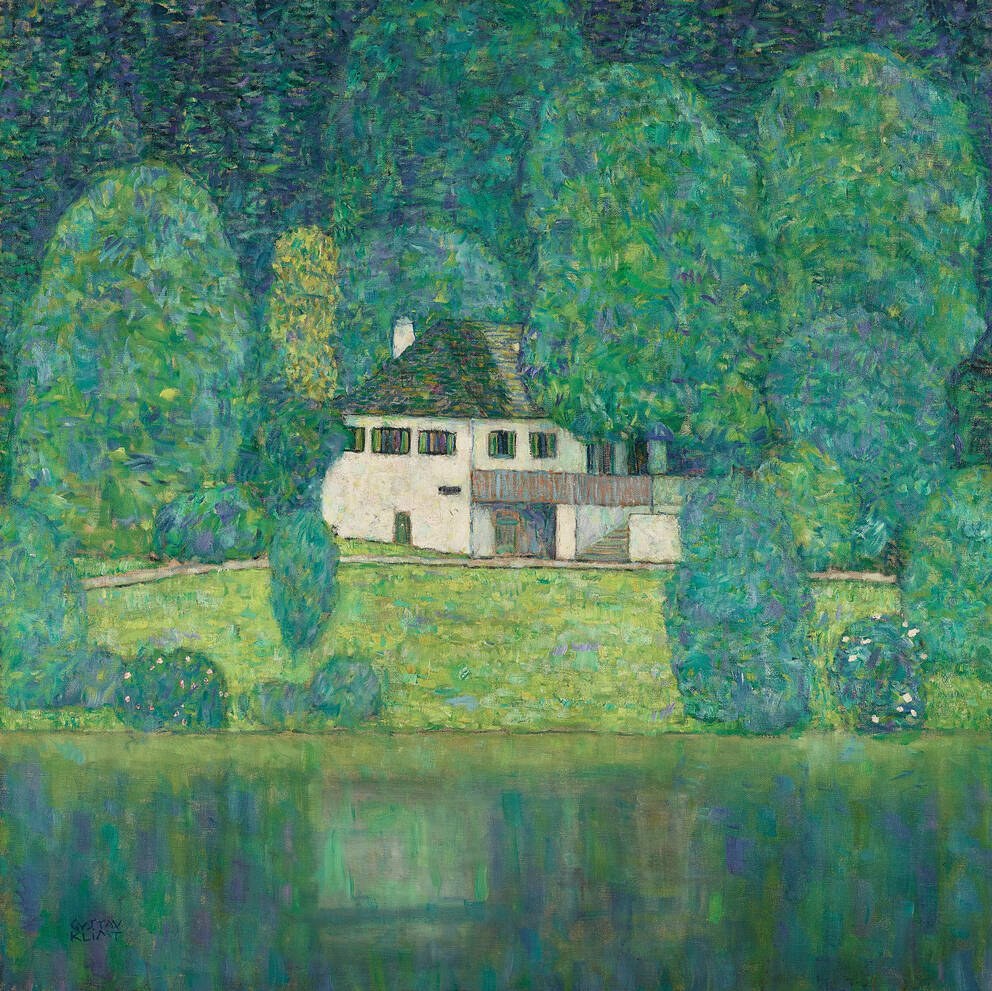
The provenance is a small history of Klimt collecting. The painting was commissioned by Otto Primavesi, the banker from Olmütz who was among Klimt’s most important patrons. It later belonged to the Austrian photographer and anthropologist Hugo Bernatzik and then to Kurt Wieser. Eventually it reached Serge Sabarsky, the dealer who co-founded the Neue Galerie with Ronald Lauder.
When Sabarsky’s estate sold it in May 1997, it set a world auction record for Klimt. Artnet News put the price at $14.7 million, or roughly $30.9 million in today’s money. The same family has owned it for nearly 30 years, and lately it has been on long-term loan to Vienna’s Leopold Museum.
The timing is deliberate. Christie’s notes that the sale falls just days after the reopening of the Neue Galerie, the Fifth Avenue shrine to Viennese modernism that Sabarsky helped found.
Carter told Artnet the picture “more or less has everything,” and called the estimate “the most conservative estimate for one of Klimt’s mature landscapes in nearly 10 years.” Whether that is modesty or marketing is for the room to decide.
The comparables cut both ways. Klimt’s auction record now belongs to his portrait of Elisabeth Lederer, which sold at Sotheby’s last year for $236.4 million from the Lauder collection. His landscapes have brought $68.3 million for “Waldabhang,” $86 million for “Blumenwiese” and more than $104 million for “Birch Forest” at Christie’s in 2022. By that measure, $60 million to $80 million is a number designed to get the paddles up early.
The Guggenheim’s Kandinsky
The Kandinsky is “Betonte Ecken,” or “Emphasized Corners,” painted in Weimar between December 1922 and January 1923. That was the start of the artist’s years teaching at the Bauhaus.
Christie’s is marketing it as a direct predecessor to “Composition VIII,” the 1923 masterpiece that hangs at the Solomon R. Guggenheim Museum. In it, the auction house says, Kandinsky mapped “melody, rhythm and harmony onto the canvas through the pure forms of color, line and geometry.”
The picture’s American history is its strongest selling point. It was the first Kandinsky ever acquired by Hilla Rebay, Solomon Guggenheim’s art adviser and the first director of what became the Guggenheim Museum. Guggenheim bought it from her and in 1941 gave it to the Museum of Non-Objective Painting, where it stayed until the mid-1960s. It has since been lent to the Museum Barberini’s 2025 Kandinsky exhibition in Potsdam and to a Calder exhibition in Paris this year.
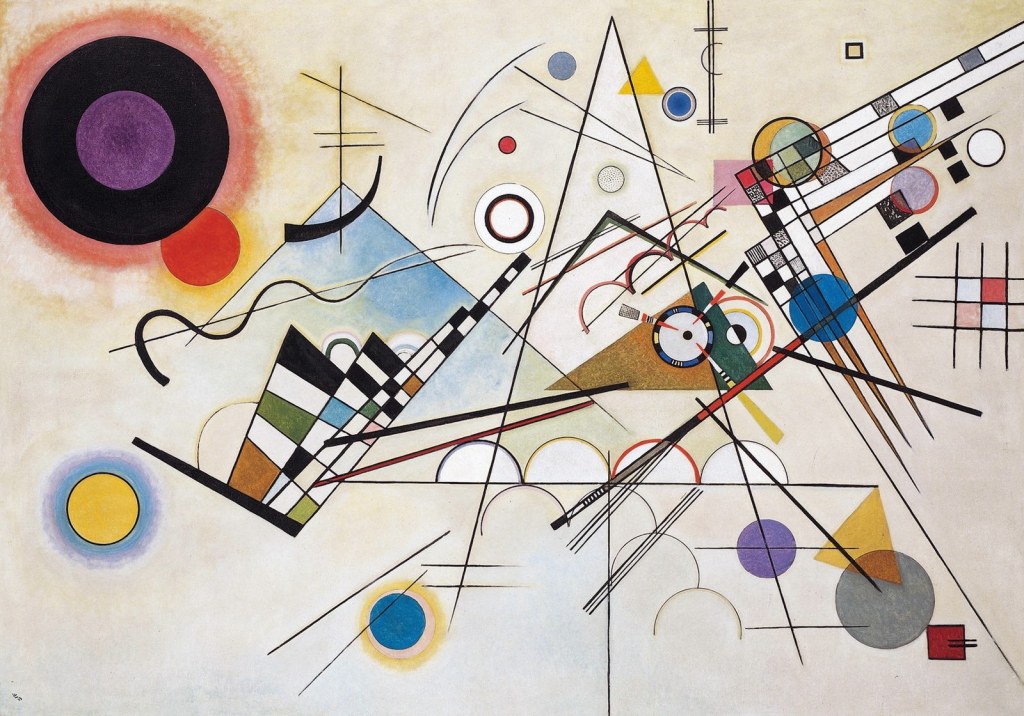
Christie’s is not hedging. The painting carries a guarantee, and the house says outright that it expects a new record. “This exceptional work will deservedly establish a new auction record for Kandinsky,” said Paige Kestenman, co-head of the 20th Century Evening Sale. She credited the work with realizing “Wagner’s notion of the Gesamkunstwerk.”
The bar is real. Kandinsky’s record is “Murnau mit Kirche II,” which sold at Sotheby’s in London in March 2023 for £37.2 million, then about $45 million, as The Guardian reported. Christie’s has a recent data point of its own. In October its London evening sale sold Kandinsky’s 1907 “Das bunte Leben” for £31.56 million, about $42 million, as the season’s top lot.
To clear its low estimate, “Betonte Ecken” would have to beat the record by about a third. For a geometric abstraction rather than a Murnau landscape, that is a genuine test of how deep the market for early-20th-century abstraction now runs.
The Supporting Cast
The two $60 million lots will not carry the evening alone.
The William I. Koch Collection is expected to bring more than $40 million across several sales. In the evening sale it offers:
- Monet’s “Champ d’avoine et coquelicots” of 1890, estimated at $12 million to $18 million;
- Cézanne’s “Tasse, verre et fruits” of about 1877, also $12 million to $18 million;
- Matisse’s 1929 “La bayadère,” at $5 million to $7 million;
- a Degas ballet scene in pastel over monotype, at $3 million to $5 million.
“The masterpieces in this sale are among my favorites,” said Koch, the industrialist and America’s Cup winner.
Then there is Heroes and Lovers. Christie’s calls it a collection of nine works estimated in the region of $100 million, consigned by “a Distinguished Private Collection.” The New York Times identified the consignor as Jeff Koons, and Galerie and others repeated the report.
Seven of the nine are in the Nov. 17 sale. Those include four Picassos, led by “Le Baiser” of 1969 and “Tête de femme (Dora Maar)” of 1941, along with a Manet pastel, a Cornelis van Haarlem and a sculpture by Tilman Riemenschneider. A Le Moyne and a Fragonard are being held for Classic Week in 2027. An artist known for pushing kitsch into the museum is, it seems, a collector of the most classical sort.
What It Means
The viewing opened at Rockefeller Center on Nov. 7, ahead of the Nov. 17 sale. The sale itself will be watched as a referendum on a market that has spent two years recalibrating.
A Klimt that has already set one record and a Kandinsky expected to set another are the art world’s version of blue-chip bonds. If they sell well, the trade will call it a return of confidence at the top. If they stall, it will call it discipline.
Either way, the provenance tells a New York story. Sabarsky and Lauder, Rebay and Guggenheim built the city’s taste for Viennese modernism and for abstraction. Two of the pictures they once handled are coming back to Rockefeller Center to find out what that taste is now worth.
Featured image: Christie’s at 20 Rockefeller Plaza, where the 20th Century Evening Sale takes place Nov. 17. Photo by Leonard J. DeFrancisci via Wikimedia Commons, CC BY-SA 3.0.






Leave a Reply