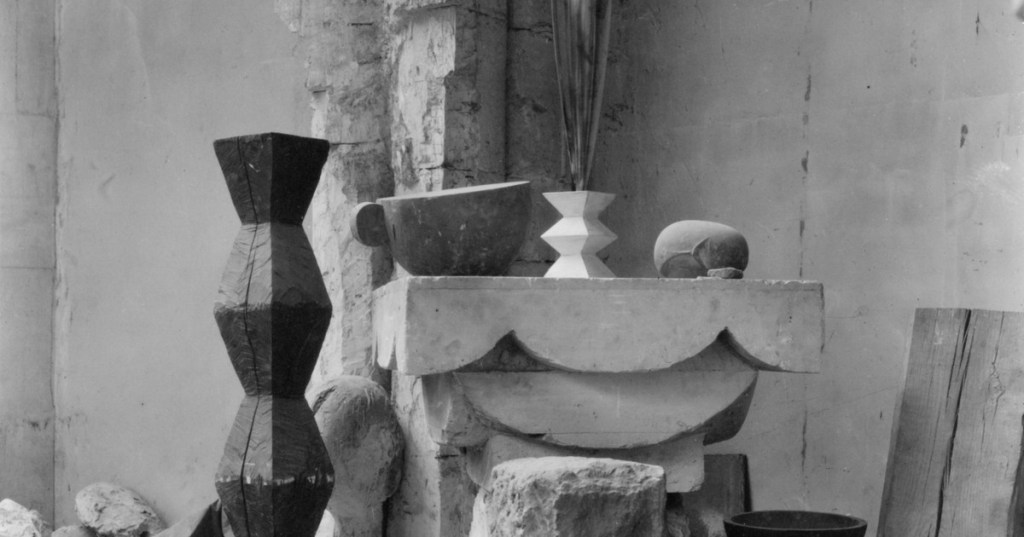
In 1926, taking in the skyline of New York, Constantin Brancusi is said to have remarked, “Why, it is my studio.” It was a compliment. The Romanian sculptor had spent a decade turning a workshop at the impasse Ronsin in Montparnasse into a city of pedestals, columns and polished heads, and he knew a city of towers when he saw one.
A century later the Museum of Modern Art has taken him at his word. “Brancusi: The Artist and His Studio,” which opened on October 25 and runs through February 27, 2027, fills the museum’s entire sixth floor with about 210 objects. The sculptures are here, and so are the bases he carved for them. So are his photographs, his films, his gouaches and the tools he left on the workbench when he died in 1957.
Brancusi’s Brancusis
The show’s real coup is a matter of logistics. Brancusi worked in the impasse Ronsin studio from 1916 until his death, and he bequeathed its contents to the French state. They are kept today at the Atelier Brancusi, the reconstruction that belongs to the Centre Pompidou. The Pompidou is closed for a long renovation, and its loss is Midtown’s gain. Many of these works rarely travel.
“These are Brancusi’s Brancusis,” the curator Anne Umland told B Scene’s J. Scott Orr. She means these are the pieces he kept, repolished, rearranged and photographed for forty years, the works he would not sell. Umland, a former MoMA curator, returned to organize the exhibition as guest curator with Mia Matthias and Samantha Small. Their partners from the Pompidou, Ariane Coulondre and Valérie Loth, organized the 2024 Paris survey “Brancusi: Art Is Just Beginning.” The show is sponsored by Hyundai Card, with support from the Romanian Cultural Institute.
Umland told Galerie’s Ted Loos that this is the first major museum retrospective of Brancusi since 1995.
No Separation
The argument of the exhibition is one sentence long, and Umland gave it to Galerie: for Brancusi, there was “no separation between sculpture and what supports it.” The bases are not furniture. A rough-hewn oak block under a polished bronze is part of the composition, and so is the limestone drum under that, and so is the light. Brancusi moved things around his studio constantly and photographed every new arrangement. The studio itself was the work, a sculpture you could live in.
MoMA makes this point without dioramas. At the heart of the show stands what Umland calls a “ghost studio,” a room sketched out in translucent fabric that suggests the dimensions of the impasse Ronsin without pretending to recreate it. Around it, the works arrive in clusters, the way he kept them.
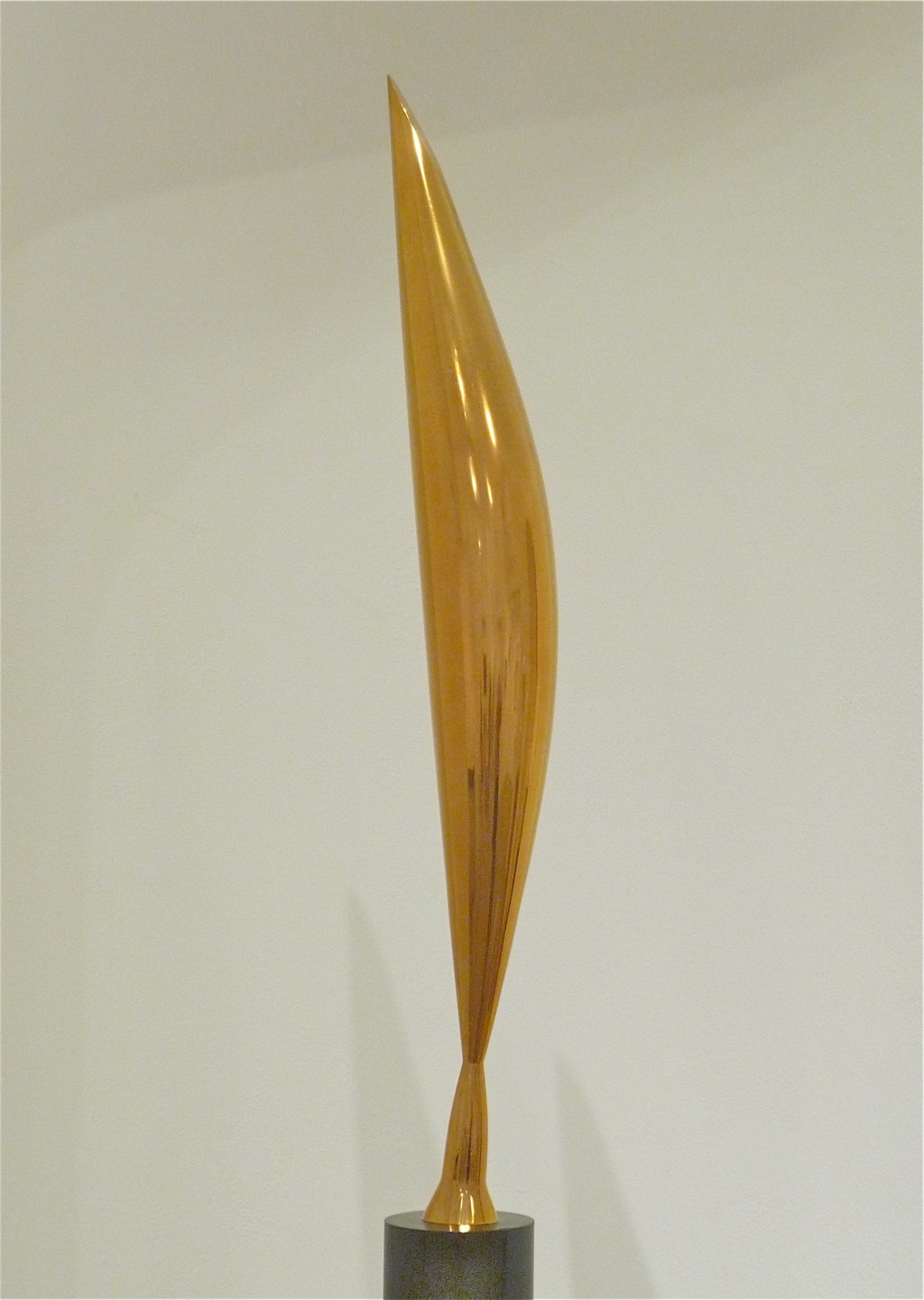
There are three versions of Bird in Space, the form that once baffled United States Customs. In 1926 officials refused to accept one as art and taxed it as a manufactured object. The resulting suit, decided in Brancusi’s favor in 1928, helped make it legal to call an abstraction a sculpture. Seen together, the three birds argue that a form can be repeated without being copied.
There is Leda (1926), the polished bronze in which a woman and a swan become one gleaming form. There are Exotic Plant, Timidity, Newborn II and Sleeping Muse, the egg-shaped head that lies on its side as if dreaming of being the egg. There are the Mlle Pogany heads, the series in which a Hungarian painter’s big eyes and neat bun become a single curve. There is the Portrait of Nancy Cunard, a sleek, upright form with a topknot that seems to have opinions. And there is MoMA’s own Endless Column, version I, home from the permanent collection for the occasion.
Three Kisses
For anyone who thinks of Brancusi as the sculptor of bright, birdlike speed, the surprise is how much stone there is, and how much of it is about two bodies becoming one. The show has three late versions of The Kiss: a 1919 medallion, a sculpture from 1923–25 and one from 1940. The two lovers, locked in a block, barely change. Over twenty years, the block gets wiser.
The smaller things may move you more. There is a 1918 gouache, View of the Artist’s Studio, in which the workshop already looks like a painting of itself. There are the tools, the chisels and saws of a man who did his own cutting. And there are the photographs, many of them by Brancusi himself, that show his works turning and catching the light like actors who know where the camera is.
The Market Is Watching
It would be naive to pretend nobody is thinking about money. In May, a Brancusi Danaïde sold at Christie’s for nearly $108 million, B Scene reported, and each new auction record changes how people see what used to be studio furniture. A museum show that treats the bases as part of the work has implications well beyond Fifty-third Street. Do not expect the dealers to say so out loud.
Not everyone agrees on the details of the past. Some of the coverage calls this Brancusi’s first solo show at MoMA, while at least one account also refers to a MoMA solo in 1954. We will leave that one to the archivists. One magazine misprinted the year of his death as 1947. He died in Paris in 1957, still at work at the impasse Ronsin. These are small things, but Brancusi, who spent decades polishing the same bronzes, would have wanted them right.
The early critical reaction has been warm. In The New York Times, Deborah Solomon’s review ran under the headline “If You Think You Know Brancusi’s Sculptures, Step Into His Studio.” That is about right. The objects are familiar from textbooks and auction catalogues. The way they lived together is not.
The Takeaway
Go early in the day, before the sixth floor fills up, and walk the ghost studio twice: once for the sculptures, once for the bases. Then go to the window and look out at the towers of Midtown. Brancusi was right a hundred years ago. It is his studio. For the next four months, he has the run of it.
Featured image: Edward Steichen’s 1920 photograph of Constantin Brancusi’s studio in Paris, with a carved wooden column, stone bases and sculptures arranged together. Photo by Edward Steichen via Wikimedia Commons, public domain.




Leave a Reply