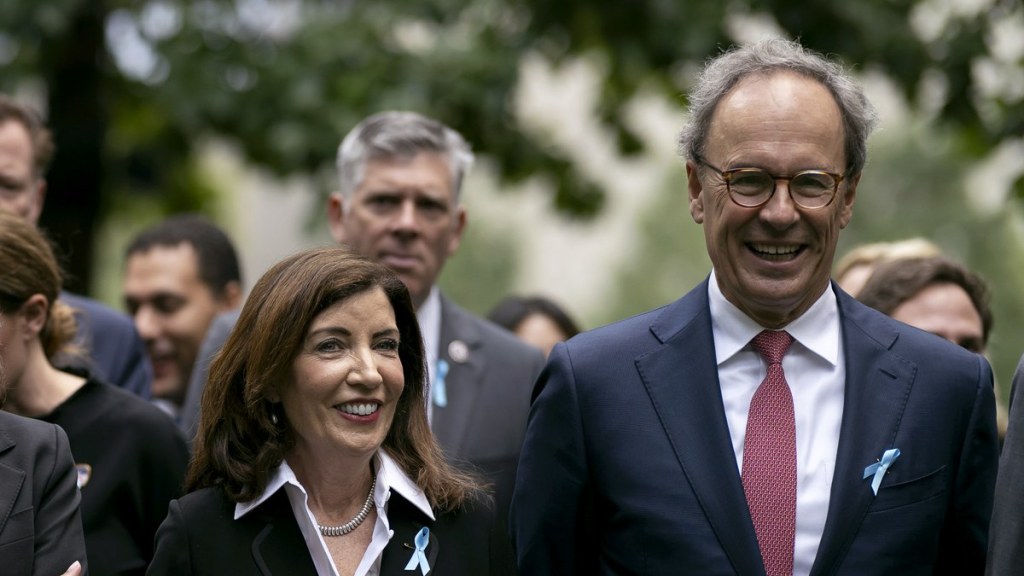
Top: Gov. Kathy Hochul and her husband, William J. Hochul Jr., at the 9/11 anniversary ceremony at Ground Zero, Sept. 11, 2023. Photo: Tia Dufour/U.S. Department of Homeland Security, via Wikimedia Commons (public domain)
For two decades the Seneca Nation of Indians paid New York State a quarter or more of what its slot machines took in. It paid for one thing: the promise that no one else would run that kind of gaming across a broad swath of Western New York. Read against the federal law that governs Indian gaming, the record shows the Nation did not get what it paid for, and then was made to keep paying anyway. By any fair reading of federal Indian law, the Senecas were defrauded of what they bargained for.
That is this newspaper’s analysis, not a court’s finding. An arbitration panel ruled for the state in 2019, the U.S. Court of Appeals for the Second Circuit affirmed in 2021, and no tribunal has found that anyone committed fraud. The case the Nation’s side makes is about what the law promised, and it runs in five steps:
- What the Senecas paid for. Exclusive rights to casino-style gaming machines in a zone west of Route 14, the only thing New York gave in the 2002 compact.
- What the state did to undercut it. Beginning in 2004, it put video lottery terminals at racetracks inside the zone, two of them run by Delaware North, the Buffalo company of the Jacobs family.
- What the state compelled after the schedule ran out. The compact’s payment schedule ended after 14 years. The state demanded and won seven more years of payments, $564.8 million of it collected after it froze the Nation’s bank accounts, though federal law bars states from taxing tribal gaming without giving something real in return.
- Who was not there. The federal trustee, which had said New York needed to offer more to keep collecting, withdrew from the fight, and the courts never applied the rule that ambiguities in Indian agreements are read in the tribe’s favor.
- Who was earning. While the state collected, the governor’s husband was general counsel of the company running the competing machines.
1. What the Senecas paid for
The Indian Gaming Regulatory Act of 1988 lets tribes and states sign compacts for casino gaming, but it fences in what a state can take. Section 2710(d)(4) says nothing in the act gives a state “authority to impose any tax, fee, charge, or other assessment upon an Indian tribe” to engage in such gaming. A tribe’s payment to a state is lawful only as a price for something real, not as a tax.
The Seneca deal was built exactly that way. Under the 2002 compact, the Nation got what the Second Circuit called “exclusive rights to maintain certain gaming machines in a large portion of Western New York.” In exchange it paid 18, then 22, then 25 percent of the net drop from its machines. “New York received no other consideration in the Compact,” the court observed. Exclusivity was the whole bargain.
The federal government has since written down the test such a bargain must pass. Interior’s 2024 compact regulations, which the department describes as codifying its “longstanding test,” start “with the presumption that a Tribe’s payment to a State” beyond regulatory costs “is a prohibited ‘tax, fee, charge, or other assessment’” (25 C.F.R. § 293.27). Revenue sharing passes only “in exchange for a State’s meaningful concessions resulting in a substantial economic benefit for the Tribe,” and only if “the Tribe is the primary beneficiary of the gaming.” The concession must span “the life of the compact” (§ 293.2). Payments not so justified “may be considered evidence of a violation of IGRA.”
The leading court case points the same way. In Rincon Band of Luiseño Mission Indians v. Schwarzenegger (2010), the Ninth Circuit affirmed that California’s demand for a share of tribal revenue for its general fund was “a poorly disguised tax, which is impermissible under IGRA,” and held that “where, as here, the State demands significant taxes and fails to offer any ‘meaningful concessions’ in return, a finding of bad faith is the only reasonable conclusion.” Rincon does not bind New York’s federal courts, but it states the rule.
2. What the state did to undercut it
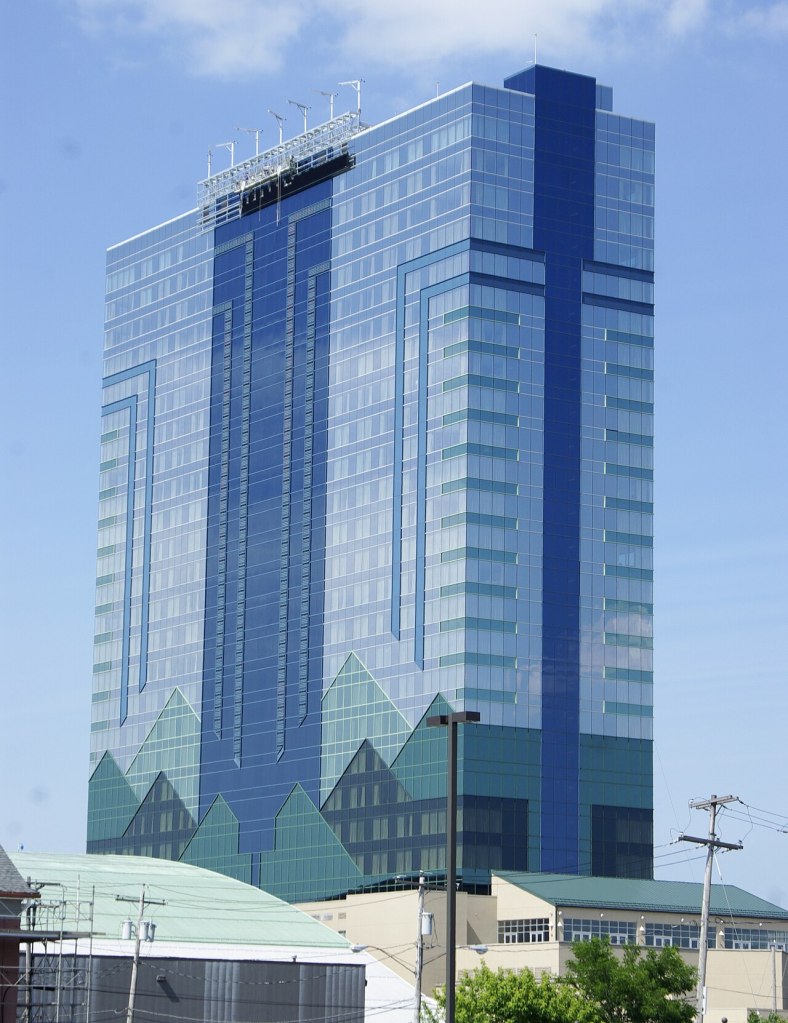
Within two years, the exclusivity began to leak. Starting in 2004, the state put video lottery terminals at harness tracks inside the zone, at Hamburg, Batavia and Farmington, Buffalo Toronto Public Media reported. Two of them, Hamburg Gaming at the Erie County Fairgrounds and Finger Lakes Gaming & Racetrack, are run by Delaware North. The compact itself lists “video lottery games” among the devices it covers. Albany’s position was that the terminals are lottery games run by the state, authorized before the compact, and not “slot machines” under state law, as a state court had held.
To the Nation, that is a distinction without a difference to the gambler in front of the screen. If exclusivity was the “meaningful concession” that turned an unlawful tax into a lawful price, every terminal licensed in the zone was the state taking back part of what it had sold. The Nation withheld payments starting in 2009. In a June 2013 settlement with Gov. Andrew Cuomo, the state “reconfirm[ed]” the exclusivity, the Nation resumed payments and kept $209 million, and the Nation “recognizes the right of the existing video lottery facilities at racetracks in Western New York to continue to operate.”
What Cuomo’s spokesman says
Rich Azzopardi, a spokesman for former Gov. Andrew Cuomo, said in an email that Cuomo “inherited the exclusivity issue, resolved it in 2013 and then the Senecas played games with the agreement, losing at every level of court and in arbitration — the format to resolve compact disputes that the Senecas had previously agreed to use. After each loss they dragged their feet with endless appeals. Meanwhile, agreed-upon and much-needed revenue for poor host communities in Western New York was held hostage, forcing the state to backfill so those local governments could keep the lights on.”
“By the way, Governor Cuomo signed exclusivity agreements with two other Native American tribes in 2013 and they both held,” he wrote. Responding to a question about campaign contributions, he said Cuomo “settled a longstanding dispute that he inherited, and that the Senecas agreed to, clearly to the detriment of Delaware North’s operations. So no, no campaign contribution ever impacted this, nor any other position taken during Governor Cuomo’s administration. It’s insulting for anyone to suggest otherwise.”
Azzopardi sent a timeline. It notes that the Senecas had withheld payments since 2009 over the terminals at Hamburg, Batavia Downs and Finger Lakes, before Cuomo took office. It says the 2013 settlement sent about $140 million in withheld payments to host communities, including $89 million to Niagara Falls, and kept the zone out of commercial casino bidding while letting the existing racetrack terminals continue under marketing limits. It recounts the 2016 renewal, the Nation’s 2017 halt, the state’s arbitration demand, a $12.3 million state advance to Niagara Falls in 2018, and the state’s wins before the panel, the district court and the Second Circuit.
Much of that is accurate, and the host communities’ losses were real. But the record cuts against the larger claim. The 2013 deal did not restore the exclusivity the Senecas bought in 2002; it reconfirmed a zone that still held competing machines, two of them at Delaware North tracks, and asked the Nation to accept them. A settlement that preserves a competitor’s business while the tribe keeps paying full freight is not obviously “to the detriment of” that competitor. And the 2017 fight was not the Senecas “playing games.” It was a dispute over whether payments that the compact scheduled for 14 years ran for 21, a reading the federal government itself had shared.
3. What the state compelled after the schedule ran out
The compact set out payments for years one through 14. It then renewed for seven more. Nothing in its text said the payments continued. After year 14, the Nation stopped. The Interior Department initially agreed: shortly before the initial term ended, it sent a technical assistance letter that, as the Second Circuit recounted, “stated that DOI understood that the Compact contained 14 years of revenue sharing in exchange for 21 years of exclusivity and suggested that New York would need to make additional economic concessions benefiting the Nation to justify extending the revenue sharing provision to cover the renewal period.”
New York offered no new concession. It demanded arbitration. In January 2019 a three-member panel ruled 2 to 1 that the compact was ambiguous and ordered 25 percent payments through the renewal, with an award including $255.9 million for 2017 and 2018. The dissenter, Kevin Washburn, a former Assistant Secretary for Indian Affairs and the Nation’s appointee, wrote in his dissent that the Nation’s 14-year obligation was “crystal clear,” and that the majority “has essentially written a new provision into the Compact. The new provision creates a term that benefits the State, but it is not a term for which the State bargained.” Of the majority’s “Years 15-21 – 25%,” he wrote: “It is, however, entirely made up.”
Washburn also noted that when the federal government reviewed the compact in 2002, the state’s explanation to the Interior Secretary did not mention revenue sharing in the renewal period, payments the state now valued at hundreds of millions of dollars. “To me, this omission is compelling,” he wrote.
Put in the terms of federal law, the state collected seven years of payments its own trustee had said required “additional economic concessions,” and gave none. Under § 2710(d)(4) and Interior’s test, that is the definition of a payment that is not a price.
4. The trustee stepped aside, and the courts did not apply the Indian canons
The United States is not a neutral party between tribes and states. The Supreme Court in Cherokee Nation v. Georgia (1831) described the relationship as one that “resembles that of a ward to his guardian,” and in Seminole Nation v. United States (1942) said the government’s conduct “should therefore be judged by the most exacting fiduciary standards.” IGRA builds that duty into compact review: the Secretary may disapprove a compact that violates “the trust obligations of the United States to Indians” (§ 2710(d)(8)(B)(iii)).
The canons of construction follow from it. “Statutes are to be construed liberally in favor of the Indians, with ambiguous provisions interpreted to their benefit,” the Court said in Montana v. Blackfeet Tribe (1985). In County of Oneida v. Oneida Indian Nation, a New York case the same year, it called it “well established that treaties should be construed liberally in favor of the Indians.” In McGirt v. Oklahoma (2020), it concluded: “Because Congress has not said otherwise, we hold the government to its word.” Washburn applied Oneida directly: “A compact is, in essence, a treaty between a state and a tribe,” he wrote. “Thus, if the Compact is ambiguous, then the Nation should prevail.” The majority found the compact ambiguous, then resolved the ambiguity for the state.
The trustee did not step in. In December 2017, after New York demanded arbitration, Interior withdrew its letter, saying it “did not provide the certainty available to the parties in arbitration proceedings.” When the Nation later sought the Secretary’s review of the award, Interior took no position. In court, the Nation argued that seven added years of payments amounted to a new compact term requiring federal approval. The Second Circuit held that the panel had “reasonably concluded that its task in this case was a straightforward matter of contract interpretation not subject to the Secretary of the Interior’s approval.” It reviewed the award only for “manifest disregard” of the law, among the most deferential standards in American law. Its opinion describes Washburn’s reliance on Oneida but does not apply the canon itself.
The federal system announced a rule, that revenue sharing must buy something real, and declined to apply it when it mattered to the Senecas.
5. The freeze, the stadium and the first gentleman’s company
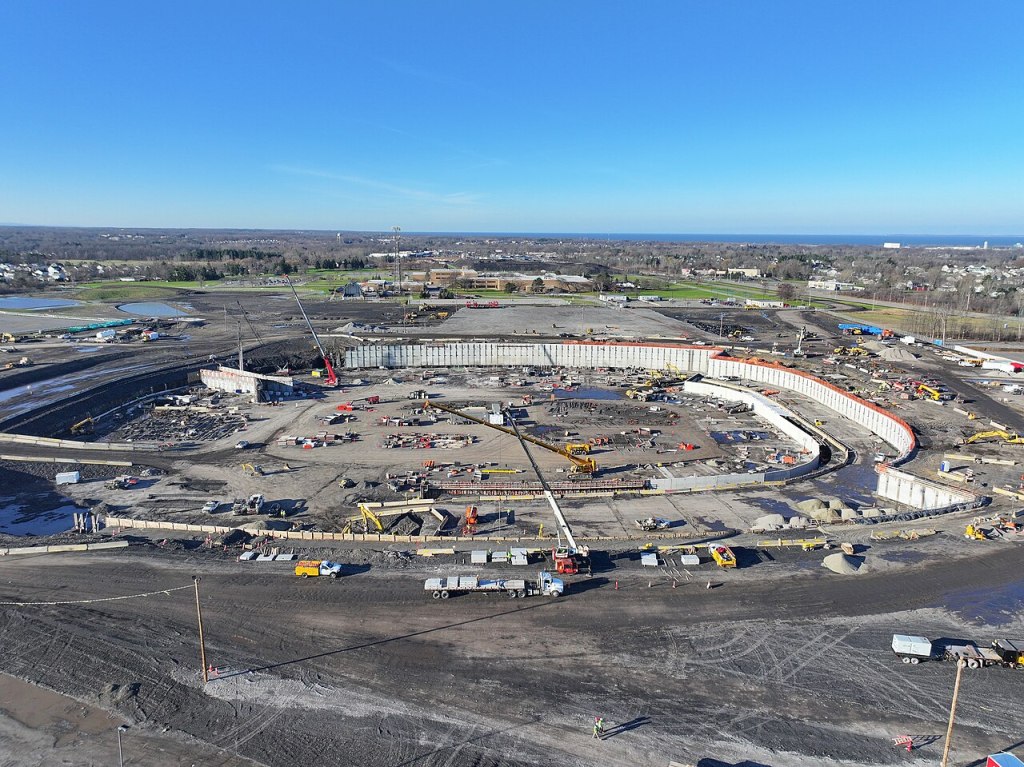
Gov. Kathy Hochul inherited the unpaid judgment. In late March 2022, the state served a restraining order that froze several Seneca bank accounts. Within days, the Nation’s council authorized the transfer of $564,842,625.20, covering 2017 through 2021. The Nation’s president, Matthew Pagels, accused the state of “holding the Seneca people and thousands of Western New Yorkers hostage” and called the payment the governor’s “Seneca ransom money.” Hochul said, “The courts have consistently ruled in the State’s favor, yet no payments were made. Upon taking office, I sought to negotiate in good faith.” The state was, in law, enforcing a confirmed judgment.
Then it spent the money. “These funds were generated in Western New York, and I am directing the State’s share, which is more than $418 million, to the new Buffalo Bills stadium,” the governor’s March 29, 2022 statement said. The team is owned by Terry and Kim Pegula.
The Senecas also knew who ran the competing machines. William J. Hochul Jr., the governor’s husband, was U.S. Attorney for the Western District of New York from 2010 to October 2016, then became Delaware North’s general counsel. He was paid $650,375 there in 2022, Politico reported from the couple’s tax returns, and $1.47 million in 2023, the year he left, which the administration attributed to bonuses and separation pay, the Times Union reported.
As governor, Hochul signed recusals from Delaware North matters in August and October 2021 and left the Seneca talks to senior staff. In March 2022, Pagels noted that the first gentleman’s company “operates Video Lottery Terminals within the Seneca Nation’s supposed gaming exclusivity zone with the State’s blessing.” William Hochul left Delaware North on Aug. 15, 2023, and that day the governor’s counsel rescinded the recusals, citing “the complete termination of any financial ties”; her office said she was “no longer recused from negotiations with the Seneca Nation,” Spectrum News reported. Nothing in the record shows that either Hochul acted improperly, and the recusals followed the rules as written. But from the Nation’s side, the household of the official collecting its money earned more than $2 million in two years from the company operating machines inside the zone it had paid to protect.
What the Nation wants now
Today the Nation’s president, J.C. Seneca, says a framework for a new compact contains no revenue sharing with the state; the governor’s office says there is “currently no agreement.” Through the lens of federal law, that is not a windfall. It is IGRA’s default: no tax, no fee, no assessment, unless the state gives something real in return.
The Senecas paid for a promise, watched the state let competitors into the zone they had bought, and were made to keep paying after the compact’s schedule ran out, with their accounts frozen until they did. The arbitrators and the courts held that the law allowed it. Federal Indian law, read as the Supreme Court says it must be read, in the tribe’s favor, says the Senecas did not get what they paid for.




Leave a Reply