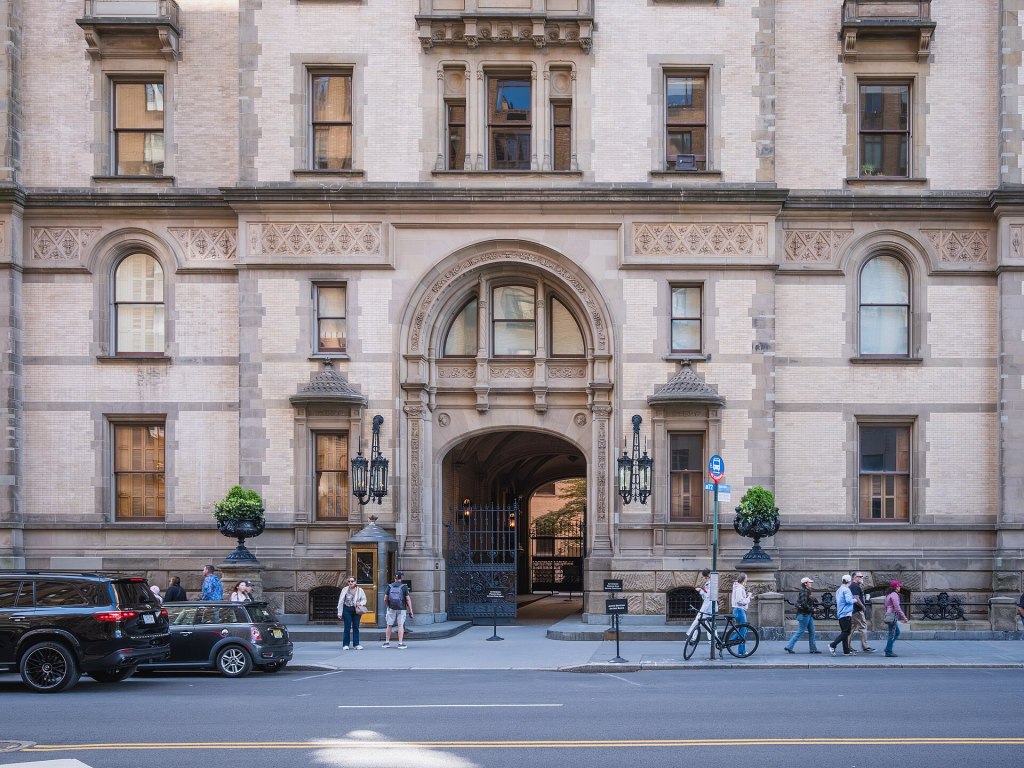
There are buildings in Manhattan where a politician goes to raise money, and buildings where a politician goes to make a point. With two weeks left in the race for governor, the Dakota appears to be doing both jobs at once.
According to Page Six, an invitation went out this week for a New York fundraiser for Gov. Kathy Hochul at the Dakota, Henry Janeway Hardenbergh’s 1884 fortress at West 72nd Street and Central Park West. The hosts, the paper reports, are Dennis Mehiel, the corrugated-cardboard magnate and Democratic donor, and his wife, Karen, in the $10.8 million apartment they bought in 2022. Page Six says the Dakota’s board had turned the couple down decades earlier. They got in on the second try, after selling a 10,350-square-foot duplex for $23.9 million. In the co-op world, persistence is its own kind of net worth.
The punchline, or the problem, depending on which side of the park you summer on, is the tax. Hochul and Mayor Zohran Mamdani are the political parents of the city’s new surcharge on pricey non-primary residences, the pied-à-terre tax. “Gov Hochul is the architect of [NYC’s] pied-a-terre tax, and she’s having a fundraiser, of all places, at the Dakota. The irony!” an unnamed liberal insider told Page Six. “Only Democrats would have the pied-à-terre tax and then have a fundraiser at a building where everybody has second or third homes.”
That last line is doing a lot of work. Not everybody at the Dakota has a second or third home, and nothing in the reporting suggests the Mehiels’ apartment is anything other than where they live. As theater, though, the setting is hard to beat. John Lennon and Yoko Ono, Leonard Bernstein, Lauren Bacall and Judy Garland all lived in the building, and it is still the city’s shorthand for a certain kind of old, monied, artistic Upper West Side: exactly the people the surcharge was designed to find.
The tax that keeps shrinking
The surcharge applies to second homes above set assessed values: $5 million for one-, two- and three-family houses, and $1 million for condo and co-op units, according to Habitat, summarizing reporting by Crain’s New York Business. The Department of Finance first sent notices to 17,000 owners. By the third extended exemption deadline, Oct. 13, it had received more than 11,000 exemption applications and granted more than 6,800 of them, and another 1,251 owners had been told they were never liable. That frees about 8,950 of the owners first notified. State officials had estimated $500 million a year, based on about 13,000 owners paying. City Hall, Habitat reports, says the mayor is still confident of hitting that number.
The courts have opinions too. Last month a Staten Island judge ruled that Finance must redo the rollout. That order is on hold while a higher court considers the city’s appeal, with a decision expected by Nov. 10, a week after Election Day. Two other suits challenge whether the surcharge is constitutional at all. And the office of Comptroller Mark Levine, which found that $500 million could be reached with about 11,200 payers, also warned that revenue could fall sharply as exemptions pile up. As we noted last week, Park Avenue signed contracts anyway.
Asked by The City Politic for a current revenue estimate, the Comptroller’s office pointed to the information it had provided to The City Reporter on the subject and said there were “no updates on our end.”
The ghost of 2002
This is where the evening picks up a historical footnote. Mehiel is not just a donor with a view of the park. In 2002 he was the Democratic nominee for lieutenant governor, running with State Comptroller H. Carl McCall, when he was chairman and chief executive of Box USA, according to the record of that race. They lost badly to George Pataki, who won a third term with 49.4 percent of the vote to McCall’s 33.5. Twenty-four years later, that is still the last time a Republican won any statewide election in New York.
And who was Bruce Blakeman, the Nassau County executive and Republican nominee, campaigning with on Tuesday? George Pataki. The two toured Washington Heights, ABC7 reported, with Blakeman blaming Hochul for utility bills. “People are telling me wherever I go how expensive their utility bills are,” he said. He has promised to cut those bills in half by rolling back clean-energy surcharges, ending restrictions on natural gas production and lifting Hochul’s moratorium on data centers. Hochul was unimpressed. “I don’t pretend to say energy costs are going to be slashed in half on Day One,” she said, before painting a picture of “smokestacks billowing” and “fracking rigs everywhere.”
So, in the home stretch, the governor raises money in the living room of the man Pataki beat, while her opponent works the uptown sidewalks with Pataki himself. Albany doesn’t write new material. It reruns the old episodes in better apartments.
Money is not the problem
Whatever the optics, Hochul does not need the Dakota for the cash. In late September she announced raising $8.5 million over the summer between her campaign and the state Democratic Party, for $33 million in combined cash on hand. Her campaign called that a record for this point in a governor’s race, the Post reported, and said she had 17,800 individual donors. Page Six lists Jed Walentas, Douglas Durst, members of the LeFrak Organization and Larry Silverstein among her deep-pocketed real estate backers. On the other side, Blakeman’s fundraising has drawn questions: New York Focus reported that he sought public matching funds for thousands of ineligible donations.
The polls say the same thing as the bank balances, with an asterisk. A Siena poll of likely voters in September had Hochul ahead 50 percent to 41. An Emerson College/PIX11 survey taken Oct. 3 to 5 had her up 52 to 40. The same poll had independents breaking for Blakeman 55 to 34 and put the governor’s job approval at 40 percent, with 46 percent disapproving. Mamdani, for the record, came in at 47 percent approval and 41 percent disapproval statewide. Election Day is Nov. 3.
Why the Dakota, then?
Because a fundraiser is never only about the money. It is about who stands next to whom. A governor who campaigns on affordability and championed the pied-à-terre tax is reminding the Central Park West donor class that she is still their governor. The donor class, in turn, is reminding her that it is still here, in the building, with the good light over the park and the long memory. Neither side is wrong. That is the arrangement New York politics has run on since before Hardenbergh drew his gables.
The pied-à-terre tax may survive its lawsuits, or it may shrink into a rounding error that City Hall still calls a success. Blakeman may narrow the gap in the final days, the way Lee Zeldin did in 2022, or he may not. Either way, for one evening the governor will be at the Dakota, a building that has always known the difference between the people who live there and the people who drop by to ask for something.
Gov. Kathy Hochul’s campaign, Bruce Blakeman’s campaign, the New York City Department of Finance and the Mayor’s press office did not respond to requests for comment by publication time.
Photo: The Dakota’s carriage entrance on West 72nd Street, by Christian David via Wikimedia Commons, CC BY-SA 4.0.


Leave a Reply