Florence has always had the better publicist. For five centuries the Renaissance has been told as a Medici production, with Siena cast as the charming provincial cousin forty miles down the road — gold-ground Madonnas, a horse race, a nice lunch. The Frick Collection would like a word. “Siena: The Art of Bronze, 1450–1500,” which opened Oct. 15 in the museum’s new Ronald S. Lauder Exhibition Galleries and runs through Jan. 18, 2027, is billed as the first exhibition ever devoted to Siena as a center of Renaissance bronze. It is not a blockbuster. It is something rarer on the Upper East Side this season: an argument.
The case is made by nearly forty objects — statues, reliefs, candelabra, medals, a church bell — by Donatello, Vecchietta, Francesco di Giorgio and their circle, many of which, the museum says, have never been shown outside Tuscany, let alone in the United States. The organizer is Giulio Dalvit, the Frick’s associate curator, who wrote the catalogue with an international team. “Between 1450 and 1500, almost nowhere in Italy did local artistic traditions rely so heavily on a single medium as Siena’s did on bronze,” Dalvit said in the museum’s announcement. “Yet, the Tuscan city has been celebrated chiefly for its paintings.”
That last line is a polite nod across Central Park. In 2024 the Metropolitan Museum of Art and London’s National Gallery staged “Siena: The Rise of Painting, 1300–1350,” the show that reminded New York how much it loves Duccio. The Frick’s answer arrives a century and a half later and in a different metal, which is the sort of one-upmanship the city’s museums practice with exquisite manners.
A Donatello people walked on
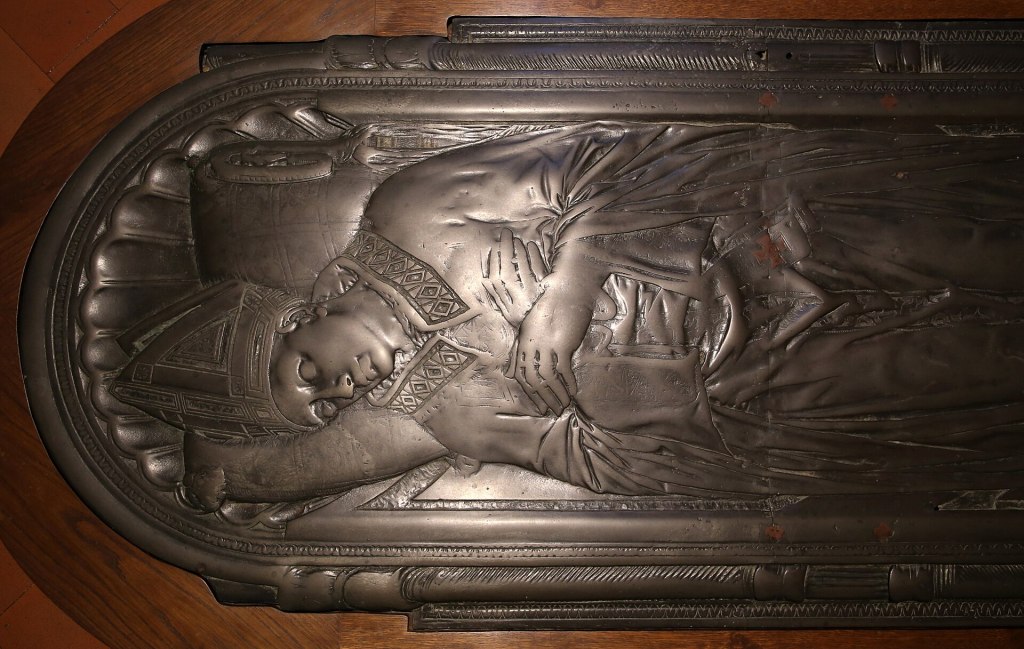
The headline loan, and the reason a certain kind of collector will go twice, sits alone in the small second room: Donatello’s over-life-size bronze tomb slab of Giovanni di Bartolomeo Pecci, Bishop of Grosseto, lent from Siena’s cathedral, which is administered by the Opera della Metropolitana. It is one of only eight signed works by Donatello known to exist, the Frick says, and this is its American debut. It is also, as Galerie noted, a masterpiece that spent centuries set into the cathedral pavement — which is why parts of it are worn smooth. Generations of Sienese walked across a Donatello on their way to Mass. New Yorkers will have to settle for a velvet rope.
The room’s real revelation is historical rather than aesthetic. Donatello spent 1457 to 1461 in Siena, an episode long told as one more case of Florentine genius civilizing the locals. The exhibition argues the reverse: political turmoil and anti-Florentine feeling meant the most celebrated sculptor of the age did not produce a single new work during his Sienese sojourn. The Pecci slab was cast before he arrived and shipped in for installation. (The Opera della Metropolitana, which lent it, did not respond to a request for comment by press time.) Siena, in other words, had its own foundries, its own masters and its own opinions, and it was not especially interested in a visiting celebrity from the rival city. There are co-op boards on Fifth Avenue that would recognize the posture.
Foundry, deathbed, medal
The first gallery treats bronze as what it was in fifteenth-century Siena: an industry as much as an art. A bell cast in 1454 for a church tied to the city’s great hospital complex, Santa Maria della Scala, anchors a room that also holds a flagpole-torchère, a horse ring, a gilded trefoil that may have been a sword pommel, and books of drawings of bronze cannon made for the Orsini family and the Sienese state. Bronze, the curators remind us, was costly, difficult and endlessly recyclable; in wartime, sculpture became artillery. The Frick says it has gathered virtually every Sienese bronze of the period that could safely travel, and the scarcity is part of the drama.
The third and largest room is where the show earns its keep. From Florence’s Bargello comes the unfinished monument to Mariano Sozzini the Elder, a jurist of European reputation and a friend of Pope Pius II, laid out on his bier in the robe and headband of his profession. It is, the museum says, the only bronze effigy of a layman to survive from fifteenth-century Italy, and the hands and feet are so lifelike that they may have been cast from the corpse. Nearby is Vecchietta’s last will and testament, signed not with his name but with a drawing of the Christ he cast for his own funerary chapel — the most elegant estate-planning document in New York this fall, and there is competition.
Eight portrait medals by or attributed to Francesco di Giorgio put rulers, humanists, bankers and soldiers on one side and mythology on the other — the fifteenth-century equivalent of a magazine profile with a flattering pull quote. The portable bronze reliefs, a form that flourished in Siena as nowhere else, are reunited for the first time, several in open-backed cases so visitors can see the rough reverse of the casting. Francesco di Giorgio’s reliefs were once attributed to Leonardo, and his Judgment of Paris, lent by the National Gallery of Art in Washington, explains why. Vecchietta’s Resurrection, the only known signed work by the artist outside Italy, is the Frick’s own — a gift from the dealer Joseph Duveen to Henry Clay Frick, and, the museum says, a major inspiration for the exhibition. Duveen, who made a career of persuading American industrialists that they needed Italy, would be pleased to see the receipt still paying dividends.
Three Hercules and a pair of Davids
The closing set piece is a family reunion of freestanding statues. A Hercules from the Staatliche Museen zu Berlin, newly attributed to Francesco di Giorgio, stands beside a closely related Frick statuette and a monumental Hercules from Dresden, whose subject, date and authorship the exhibition says it clarifies for the first time. A Frick David with the Head of Goliath, attributed to Giovanni di Stefano, is paired with a smaller David attributed to Francesco di Giorgio from the Capodimonte in Naples. Galerie, admiring the contrapposto, observed that Michelangelo neither rediscovered nor monopolized the pose. Siena, it turns out, was flexing first.
The lender list reads like a seating chart for a very serious dinner: the Bargello, the Capodimonte, the Galleria Nazionale dell’Umbria in Perugia, the Museo Diocesano Albani in Urbino, Siena’s Museo Civico, the British Museum, the Victoria and Albert Museum, Berlin and Dresden. Louis Vuitton is principal cultural sponsor — the first show, Galerie reports, in a three-year partnership with the Frick; Heidi Rosenau of the Frick’s communications office told The City Politic that Louis Vuitton’s support covers three major exhibitions, a staff position and the museum’s regular series of free Friday evenings — and the leadership support includes a gift from an anonymous donor in honor of Ian Wardropper, the museum’s former director. The nearly 400-page catalogue, published with Paul Holberton Publishing, includes new photography of nearly all of Siena’s surviving fifteenth-century bronzes and scientific analysis coordinated by the Frick’s associate conservator, Victoria Schussler.
Why it matters on 70th Street
The Frick spent years and a great deal of donor money remaking its Gilded Age mansion, and the question hanging over the reopened house has been what it would do with the new space besides look beautiful. This is a good answer: small enough to see in an hour, scholarly enough to change a footnote, and confident enough to pick a fight with the received history of the Renaissance. Time Out put it more briskly — bronze may be third at the Olympics, but it is No. 1 at the Frick. Tickets run $17 to $30; the museum is open Wednesday through Monday, 10:30 a.m. to 5:30 p.m., and admits children 10 and older. Go on a weekday morning, before the holidays, when the Upper East Side discovers culture all at once. Siena waited five centuries for its close-up; it has earned an audience that is paying attention.
The Frick has offered to arrange a conversation with Giulio Dalvit, and The City Politic hopes to bring readers more from the curator soon.
Photo: Donatello’s bronze tomb slab of Giovanni di Bartolomeo Pecci, Bishop of Grosseto, from Siena Cathedral, photographed at the 2022 Donatello exhibition in Florence, by Francesco Bini via Wikimedia Commons, CC BY-SA 4.0.


Leave a Reply