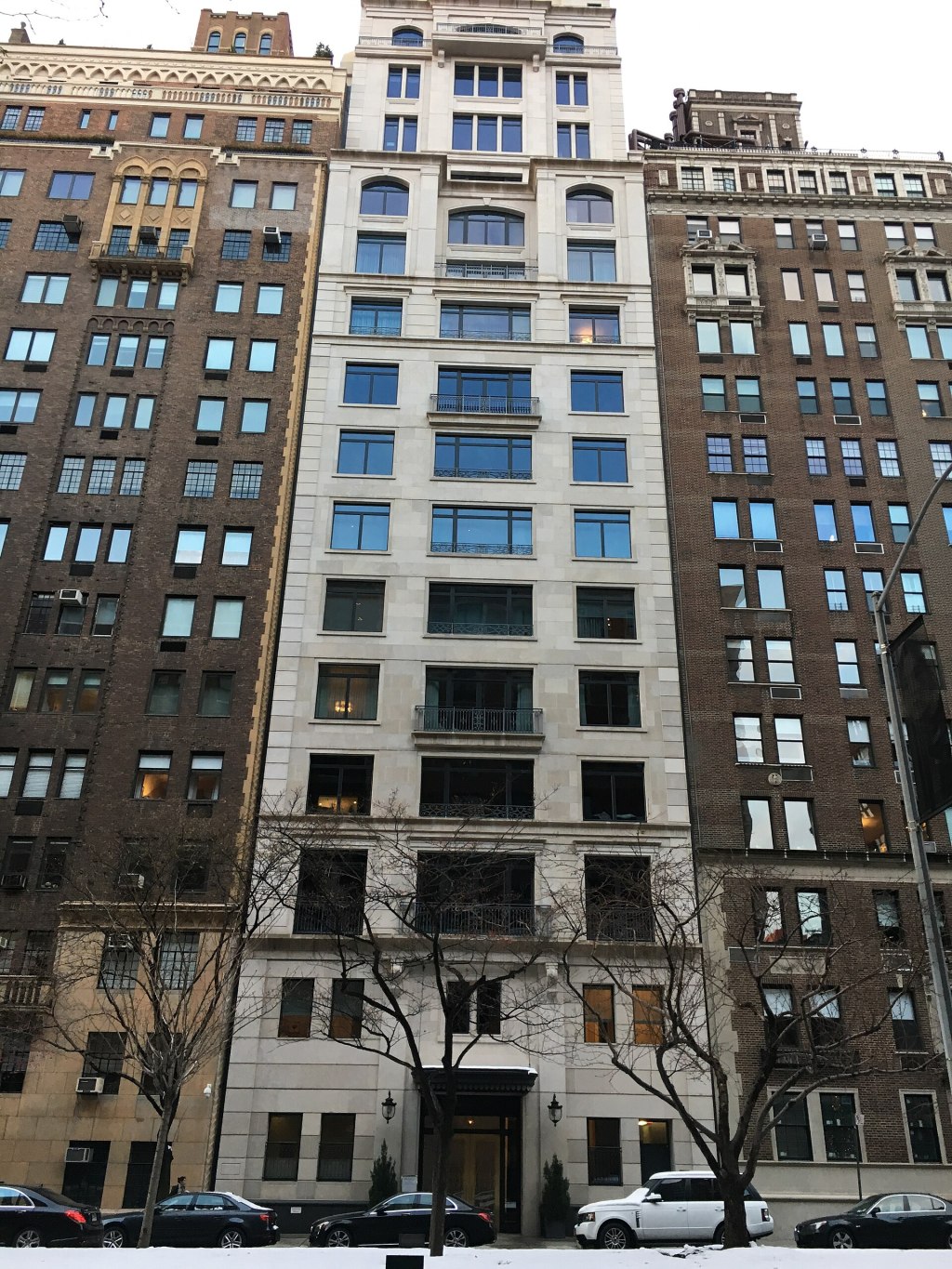
The most expensive home to go into contract in Manhattan last week is a place nobody has ever slept in. It is a 7,000-square-foot, five-bedroom triplex atop 1110 Park Avenue, a nine-unit Carnegie Hill condominium finished in 2015, and it comes, according to Realtor.com, fully furnished down to the Roberto Cavalli and Gianfranco Ferré pieces, the Baccarat and Swarovski chandeliers, and a newly installed “endless” pool on a 1,600-square-foot roof overlooking the Reservoir. Last asking price: $24.95 million, through Sotheby’s International Realty. Monthly charges: $17,407. Occupants, to date: none.
It is hard to imagine a more perfect specimen of what Albany and City Hall spent the spring and summer trying to tax.
A surcharge with a sense of humor
On May 28, a new state law took effect authorizing New York City to levy an annual surcharge on high-value homes that are not their owners’ primary residence. The Department of Finance’s own rate table is a document worth framing: for one-, two- and three-family houses, 0.8 percent of market value starting at $5 million, climbing to 1.3 percent at $25 million; for condominium and co-op units, a startling 4 percent beginning at just $1 million, rising to 6.5 percent of market value for units worth $5 million or more. On a property like the Park Avenue triplex, Realtor.com noted, that top rate would apply if the place were never anyone’s home.
The rollout has been, to put it in the language of the brokerage community, a value-add opportunity. The city mailed roughly 17,000 notices to owners it believed might owe. According to Habitat, summarizing reporting by Crain’s, the department had received upwards of 11,000 exemption applications by the time the third extended deadline passed on Oct. 13, and granted more than 6,800 of them. Another 1,251 owners were told, after the fact, that tax records showed they were never on the hook. That is roughly 8,950 of the original 17,000 freed from the tax for this year, before anyone has filed a valuation appeal with the Tax Commission.
The deadline itself moved three times. The most recent extension, from Oct. 6 to Oct. 13, came, as The City Reporter’s Greg B. Smith reported in a piece republished by Brownstoner, in response to a lawsuit brought by Randy Mastro, the former first deputy mayor under both Eric Adams and Rudy Giuliani, which persuaded a Staten Island judge, Justice Wayne Ozzi, to order a redo of the entire process. The city appealed; an appellate justice, William Ford, declined Mr. Mastro’s request to freeze collection in the meantime. Habitat reports the appeal is expected to be decided by Nov. 10. The first bills are scheduled to go out Nov. 15, due Jan. 1, 2027.
Lurking behind all this, per The City Reporter, are two constitutional challenges, one of them filed by the casino mogul Steve Wynn and the former Commerce Secretary Wilbur Ross, arguing that the surcharge discriminates against out-of-state owners. There is a certain poetry in Mr. Wynn and Mr. Ross being the ones to stand up for the little guy with the $5 million weekend apartment.
The money question
The administration of Mayor Zohran Mamdani has repeatedly said the surcharge will raise $500 million toward a projected $5 billion budget gap. Governor Kathy Hochul’s original estimate assumed 13,000 houses and, as The City Reporter pointed out, did not factor in co-ops and condos at all. City Comptroller Mark Levine later figured $500 million could come from about 11,200 properties, then acknowledged that exemptions could pull the number down to between $340 million and $380 million. A Levine spokesperson told The City Reporter this month that the office has no new estimate. City Hall, per Habitat, remains confident in the $500 million figure; it has not released an updated list of taxable properties or their values.
A finance department spokesperson, Jae Ko, told The City Reporter that the litigation had “created a lot of unnecessary confusion,” and that the department would “continue administering the surcharge fairly, efficiently, and in full compliance with the law, as we have done from day one.”
Meanwhile, at the closing table
Here is the part that should interest everyone at the Racquet Club bar. The market does not appear to have read the memo.
According to the weekly report from Olshan Realty, the closely watched tally of Manhattan contracts at $4 million and up, buyers signed 30 such deals in the week of Sept. 28 to Oct. 4, up from 17 the week before and the first time the count had reached 30 since the beginning of June, The Real Deal reported. The priciest was a resale condo at Related Companies’ 70 Vestry Street in Tribeca, asking $34 million; TRD noted the apartment last traded for $21.4 million in 2018. Another 25 contracts followed the next week. That brought the first two weeks of October to 55 luxury contracts, Realtor.com reported, against a ten-year average of 47 for the same stretch.
The details are instructive. The typical home in that first October week, per TRD, had spent more than a year and a half on the market and was discounted 5 percent. The 1110 Park penthouse sold as a sponsor unit in 2019 for $17.25 million and has been on and off the market since, at one point asking $29 million, according to Realtor.com. Michael Passor, a Douglas Elliman agent who toured it in late 2024, told the site that “the market is currently seeing a real lack of supply for high-end product, but doesn’t necessarily mean buyers will overpay.” Michael Reisor, a Compass-affiliated broker, told Realtor.com that buyers never moving into such places “is not super uncommon,” and that “they’re just buying real estate and holding it.”
Which is, of course, precisely the behavior the surcharge was designed to price. Whether a 6.5 percent annual levy changes the calculus for someone who buys a furnished triplex as a kind of very tall savings account is the question the Department of Finance’s revenue projections will eventually answer. For now, the people buying in this bracket seem to be treating the tax the way they treat the monthly charges: as weather.
Who is still buying
Some of the month’s closed deals offer their own small morality plays. On Oct. 1, according to The Real Deal’s daily tally, a company tied to American Eagle Outfitters chief executive Jay Schottenstein sold a full-floor, 4,500-square-foot condo at the Giorgio Armani Residences at 760 Madison Avenue for $23 million, about $5,100 a foot. He had paid $21.6 million in late 2024. The buyer was an entity called Madison Avenue Enterprises LLC; the Modlin Group and Douglas Elliman’s Sarway Team had the listing. On Oct. 9, per TRD, a 20-foot-wide townhouse at 111 East 81st Street, complete with a 1,000-bottle wine cellar, sold to a trust for $13 million, a shade under the $13.3 million it fetched in 2022.
And downtown, the week’s second-priciest contract was the 1867 townhouse at 67 Charles Street in the West Village, last asking $22.5 million after a $2.5 million trim. “It’s a highly desirable location,” the listing agent, Compass’s Jim St. Andre, told Realtor.com. Houses, it should be said, are taxed at a gentler rate than apartments under the new regime, which may be the most Manhattan sentence of the year.
The view from here
Two ledgers, then. On one, a city government that promised half a billion dollars from second homes and is now watching more than half its notified owners prove they live where they say they live. On the other, a top-of-market that just posted a better first half of October than its ten-year average, led by an apartment that exists, as far as anyone can tell, to be owned.
The courts will have their say by Nov. 10. The bills arrive Nov. 15. The endless pool, presumably, keeps running.
The City Politic has reached out to the New York City Department of Finance, the Mayor’s press office, Comptroller Mark Levine’s office, Olshan Realty, Sotheby’s International Realty, Related Companies, and Randy Mastro for comment, and will update this story with any response.
Photo: 1110 Park Avenue, Carnegie Hill, by Deansfa via Wikimedia Commons, CC BY-SA 4.0.


Leave a Reply