Late this afternoon, a few hours after most of the Upper West Side had finished debating brunch, a man was hoisted onto a 30-foot stake and set on fire on the stage of the Metropolitan Opera, and the image was beamed, in high definition, to nearly 650 movie theaters across the country. That is how Louisa Proske’s new production of Verdi’s Macbeth ends. Verdi, it should be said, called for a hymn of victory. Ms. Proske called for kindling.
Today’s Live in HD transmission, distributed by Fathom Entertainment, with encores in cinemas Wednesday, Oct. 21, is the production’s grand public moment, and it arrives at the tail end of the house run, which closes Tuesday, Oct. 20. The show opened the Met’s 2026-27 season on Sept. 22, and it is the company’s first new Macbeth in nearly 20 years. For a house that likes its season openers grand and its arguments genteel, it has managed to be both less and more than advertised.
The cast, and the hype
The Met sold this one on a soprano. Its own cinema page bills Lise Davidsen as “the world’s reigning dramatic soprano,” cast as the power-mad Lady Macbeth, opposite the Hawaiian baritone Quinn Kelsey in the title role. The tenor Freddie De Tommaso sings Macduff; the bass-baritone Ryan Speedo Green is Banquo. Yannick Nézet-Séguin, the Met’s music director, conducts. The production is a gift of the Joseph and Robert Cornell Memorial Foundation and Gwendolyn and Austin Fragomen, with support from Rolex, which at this point seems to underwrite a good share of cultured Manhattan.
The critics, in aggregate, have bought the tenor of the evening but not necessarily the soprano. The Wall Street Journal headlined its review “A Ferocious Start to the Met Opera’s Season.” Andrew Moravcsik, writing in Opera Today after the Oct. 5 performance, was cooler: “a smooth professional effort, though uneven casting and overexuberant staging dull its impact.”
Mr. Moravcsik’s case against Ms. Davidsen is technical and, for an opera crowd, irresistible. Verdi famously wanted his Lady Macbeth to sound “harsh, stifled, and hollow,” and wrote the part low, which is why its great exponents, he notes, have been mezzos like Shirley Verrett or sopranos with formidable chest voices like Maria Callas. Ms. Davidsen’s glories are elsewhere, in a “lovely upper middle register” and “penetrating high Bs and Cs.” She “sings cleanly throughout, sometimes astonishingly so,” he writes, “yet ultimately fails to inhabit the character.” Her sleepwalking scene, in his view, has “technical precision” but lacks “a spooky aura of midnight madness.” It is the kind of review a great singer gets precisely because she is a great singer, and it will be argued over at Café Fiorello for weeks.
Kelsey’s night
The consensus winner is Mr. Kelsey. Mr. Moravcsik, who is not a soft touch, writes that he had “never heard Kelsey sing with as much conviction, coherence and sheer power as in this run,” and calls him one of the few American baritones “who produces a sound of genuinely Verdian weight.” The tell came at the end: Macbeth’s final monologue, the moment the tyrant admits all is lost, which on the night he attended drew “the evening’s largest ovation” from an audience that had been, in his word, “tepid” until then.
There is a New York story in that. Mr. Kelsey has sung the big Verdi baritone roles at the Met for years without quite becoming a household name; this production, and this afternoon’s cinema audience, may be the thing that changes that. If you are going to see one performance in a movie theater this fall in the company of strangers eating popcorn, a baritone’s coming-of-age is not a bad choice.
The staging question
Then there is the production itself. Ms. Proske, making her company debut, comes to the Met from Heartbeat Opera, the scrappy downtown troupe she co-founded and which has built a following on radical, small-scale reimaginings. Her creative team, per Playbill, includes the set designer Jon Bausor, costume designer Montana Levi Blanco, lighting designer Adam Silverman, choreographer Jorrell Lawyer-Jefferson and action director Ran Arthur Braun. The set rides a turntable; the curved walls, Mr. Moravcsik grants, move things briskly and bounce the voices out nicely.
His verdict on the aesthetic is a sentence for the ages: “a modern Met mashup: characters in posh period costumes (for high-definition TV) scrambling over piles of post-apocalyptic rubble (for those who value vague edginess) while with random antics going on around them (for first-time operagoers).” He reports that “Cossack-style dancers leaping froggishly on the banquet tables” drew laughter around him, and that the stake, at the end, struck him as “more suited to a B-grade movie than Verdi’s sober hymn of victory.” Of the pit, he writes that Mr. Nézet-Séguin conducts “with exuberance but in a more symphonic than operatic style,” and that no one would guess from the sound that so much of Verdi’s score is marked piano, pianissimo, even ppp. He closes the comparison by recalling Teatro Nuovo‘s period-instrument account of the 1847 version, which, he notes, many New Yorkers heard last year.
It is worth saying plainly that this is precisely the argument the Met under Peter Gelb has been courting for years: the downtown director, the uptown house, the cinema audience that may never set foot at Lincoln Center. The burning stake is a choice made with a camera in mind. Whether it is a good choice is the sort of question that once filled the letters page of this city’s newspapers and now fills group chats. Either way, people are talking about Verdi in October, which is more than most season openers manage.
What comes next
The rest of the season, as Playbill lays it out, leans further into the new: the world premiere of Missy Mazzoli and Royce Vavrek’s Lincoln in the Bardo, the Met premiere of Kevin Puts and Mark Campbell’s Silent Night, and new productions of Janáček’s Jenůfa and Puccini’s La Fanciulla del West. And on Oct. 27, Mr. Gelb sits down with Wynton Marsalis at the New York Public Library for the Performing Arts to talk about jazz’s influence across genres, a conversation between two men who have spent decades building the most important cultural institutions on a single Upper West Side campus and who are, between them, very good at getting people to argue.
For those who missed this afternoon, Wednesday’s cinema encores are at 1 p.m. and 6:30 p.m. local time. Bring a coat. It gets warm at the end.
The City Politic has reached out to the Metropolitan Opera, Louisa Proske via Heartbeat Opera, and representatives for Lise Davidsen and Quinn Kelsey for comment, and will update this story with any response.
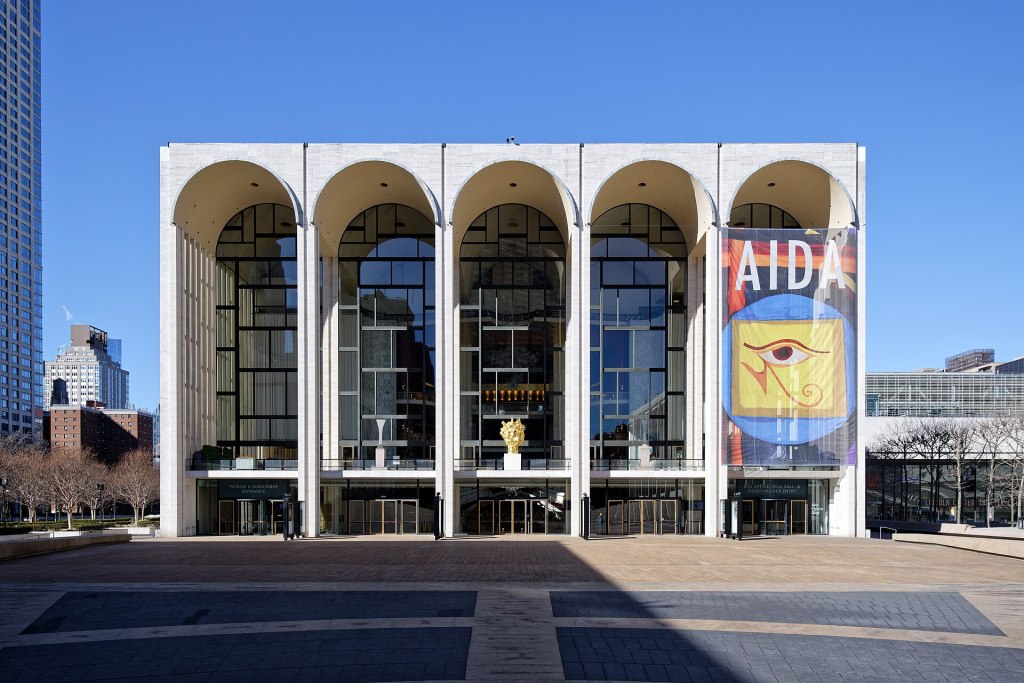
Photo: The Metropolitan Opera House at Lincoln Center, by D. Benjamin Miller via Wikimedia Commons, CC0.


Leave a Reply