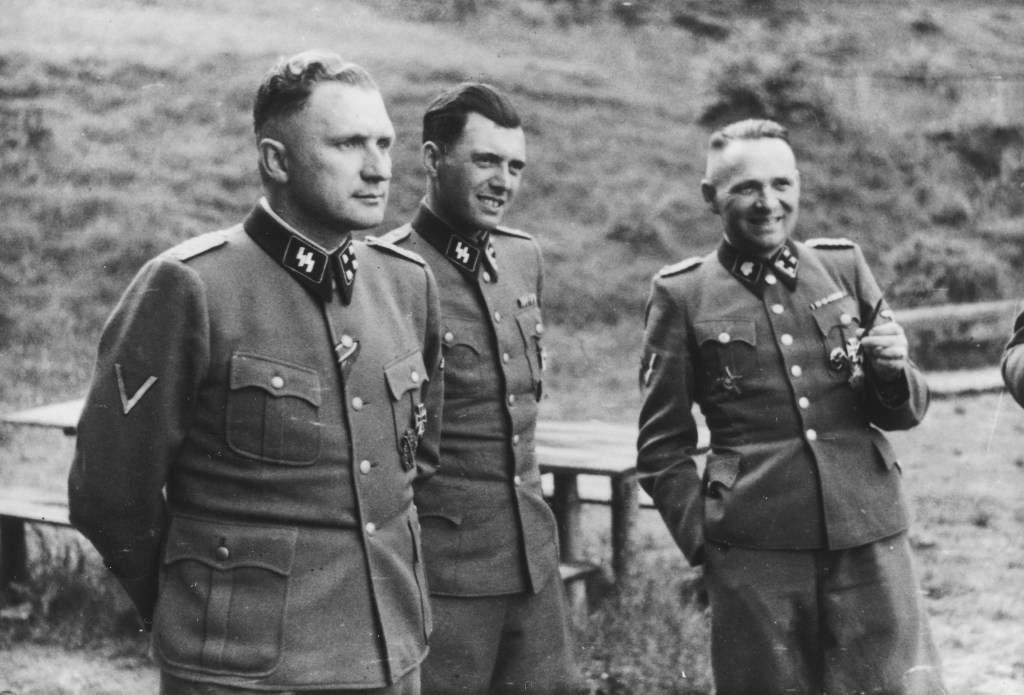
The most unsettling images on Broadway this season are not special effects. They are snapshots: young men in uniform laughing on a deck, an accordionist leading a sing-along, a row of young women perched on a railing with bowls of berries. The caption on one of them, in German, gives the play its title. The pictures were taken in 1944 at Solahütte, an SS retreat a few miles from Auschwitz.
Here There Are Blueberries, the docudrama by Moisés Kaufman and Amanda Gronich, opened on Monday night, Nov. 9, at the Ethel Barrymore Theatre for a strictly limited 10-week run, two years after it was received with what Deadline calls “great admiration” Off Broadway and became a Pulitzer finalist. Kaufman, who founded the Tectonic Theater Project, the company behind “The Laramie Project,” directs.
The album
The story is true in its outline. In 2007, an archivist at the United States Holocaust Memorial Museum in Washington, Rebecca Erbelding, received a letter from a retired Army lieutenant colonel offering an album of photographs he had found in an abandoned Frankfurt apartment at the end of the war. The album had belonged to Karl Höcker, adjutant to the Auschwitz commandant Richard Baer in 1944. It contains 116 photographs, by TheWrap’s count, and not one of them shows a prisoner. It does show Baer, Rudolf Höss and Josef Mengele relaxing between shifts.
The play is a detective story about identifying the people in those pictures, and then about what happens when the museum finds their descendants. Some refuse to talk. Some deny. One, the grandson of Höss, describes a fear that the violence is hereditary.
The critics
The first-night reviews agree on the photographs and divide on nearly everything else.
Adam Feldman of Time Out New York gave it four stars, “firmly recommended,” and called it “an elegant arrangement of strange fruit” and “a celebration of principled historiography.” He praised the ensemble of eight, who play many roles “with simplicity and restraint, without foreign accents,” and ended on the play’s sharpest point: “A picture can tell a thousand words and leave six million unspoken.”
Greg Evans of Deadline called the play “vital and more often than not riveting,” while conceding that the album’s emotional heft “dominates Blueberries to an extent that the play itself can seem rather thin at times.” He found the play’s central suspense, whether the museum will accept a perpetrator’s album, “a stick man argument,” and suggested the script sometimes presumes “that no one in the audience has ever heard of Hannah Arendt.” He singled out Brandon Flynn as the Höss grandson, calling his performance “a stand-out.”
Robert Hofler of TheWrap was the toughest. His headline says no actor can upstage these photographs, and he means it as a criticism of the actors. He called David Bengali’s projection design “nothing short of brilliant,” wrote that the play “actually works better on Broadway in a larger theater than it did Off Broadway,” and suggested it “may be the first opera of photographs.” But he found the museum debate “completely bogus,” the dialogue “delivered with great drama,” and the interviews with descendants canned in the manner of Laramie. Only Kathleen Chalfant, he wrote, “manages to bring a modicum of understatement to the production.” He also argued that the play’s mystery is a little contrived, since Höcker had been tried and imprisoned twice after the war.
The case for going
A reader trying to decide can take two things from this. First, nobody disputes the material. The photographs are, in Hofler’s word, unforgettable, and the production around them, from Derek McLane’s stark set of archivists’ standing desks to David Lander’s lighting and Bobby McElver’s sound, is designed to make an audience look at them for 90 minutes without intermission. Second, the argument is about dramaturgy, not about worth. Even the play’s skeptics treat it as serious work on a serious subject.

There is also a casting argument for going. Chalfant, the Angels in America veteran whom every review singles out, plays one of the museum’s senior figures. Conrad Ricamora plays the German descendant who recognizes his grandfather in the album. Michael Cerveris, Montego Glover, Delia Cunningham as Erbelding, Scott Barrow and Michelle Beck round out a company of eight in which most actors play several roles.
Broadway’s November
The opening caps a crowded stretch. “Wanted” opened the same night at the James Earl Jones, and Rosamund Pike was set to begin previews of “Inter Alia” at the Music Box on Tuesday, Nov. 10, according to BroadwayWorld and Broadway News. The season’s holiday titles are lining up behind them. Against that, a 90-minute play about a Nazi photo album is the definition of counterprogramming.
It is also, in a season of revivals and brand extensions, one of the few shows on Broadway that asks its audience to do something other than enjoy itself. The play’s last turn, which the critics have tactfully declined to spoil, introduces a second album from the same place and time. Feldman describes it only as a contrast, and so will we. Go, and look at both.
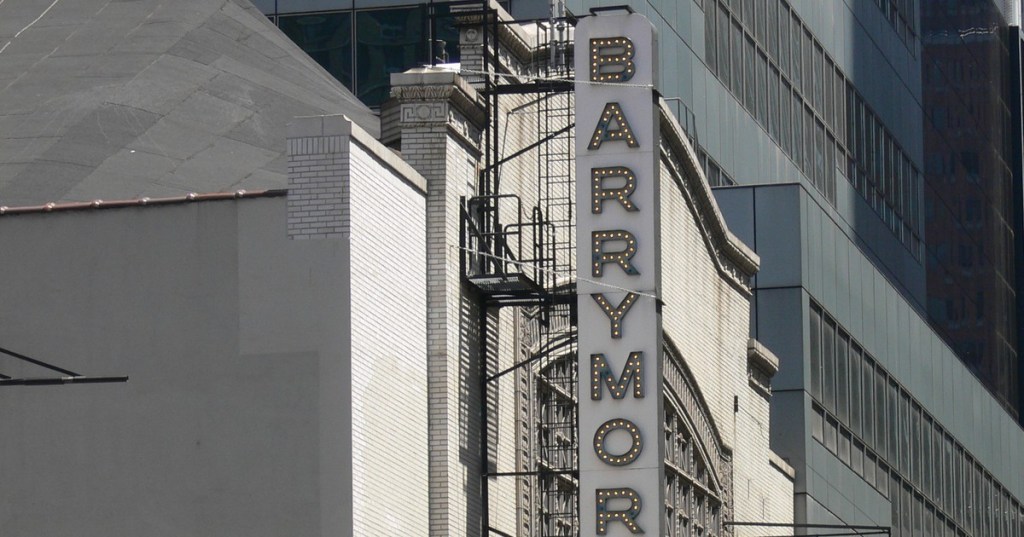
“Here There Are Blueberries” plays the Ethel Barrymore Theatre, 243 West 47th Street, for a limited engagement.
Featured image: The Ethel Barrymore Theatre on West 47th Street, where “Here There Are Blueberries” opened on Nov. 9 (photo shows an earlier production; cropped). Photo by Andreas Praefcke via Wikimedia Commons, CC BY 3.0.




Leave a Reply