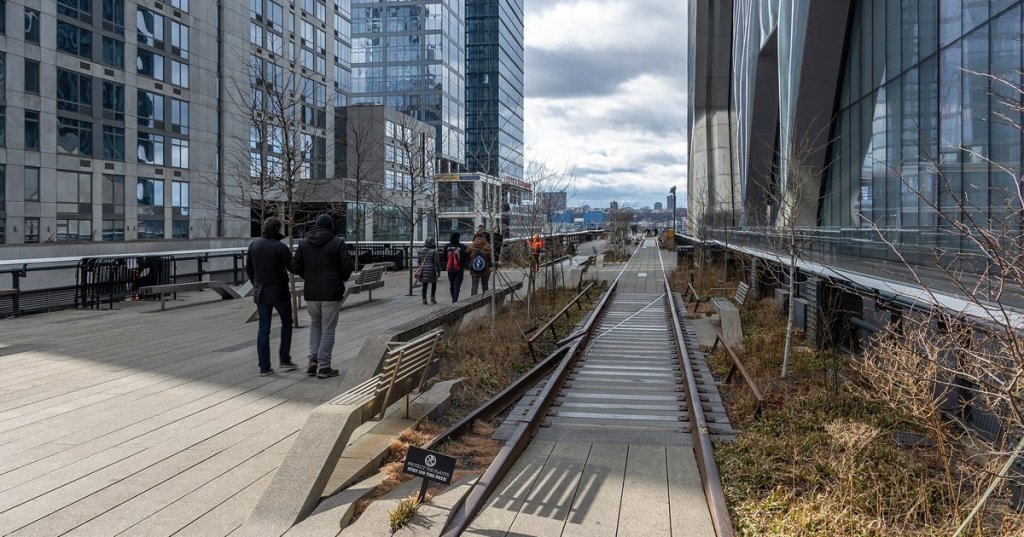
There is a particular kind of Manhattanite who will tell you, unprompted, that the High Line was better before it was a park—back when it was a rusting freight trestle colonized by sumac and wild grasses, glimpsed only by trespassers and Joel Sternfeld’s camera. That person has always had a refuge of sorts at the far northern end, where the elevated rail bends around the West Side Yard and the landscaping was left deliberately feral. This November, after a long and rather thorough restoration, that refuge returns under a new name: the Rail Yard Preserve.
The announcement, posted by Friends of the High Line on the park’s blog on Oct. 23, is framed as a reopening rather than a reinvention, and the distinction matters to the people who run the place. “What makes the Rail Yard Preserve so special is that it retains the character of the High Line before it was transformed into a public park,” said Patrick Hazari, the conservancy’s senior director of planning, design and construction. “The self-seeded landscape, exposed rail tracks, and industrial infrastructure tell an important part of the site’s history.”
Twelve Years of Feet
The stretch first opened in 2014 as the High Line at the Rail Yards, the third and final section of the park, and it was greeted with a procession of more than 500 neighbors, volunteers and officials who marched the length of the structure to a picnic on West 34th Street. Twelve years of heavy foot traffic and Hudson River weather have since done what twelve years tend to do.
The fix is less romantic than the landscape but considerably more consequential. The original walkway has been torn out and replaced with cast-in-place exposed aggregate concrete, built to take year-round abuse. Crucially, according to the conservancy, the new surface can bear the same snow-removal equipment used elsewhere on the park. The old path could not, which is why the northern section has historically gone dark in winter. Under the new arrangement, it is meant to remain open through the cold months—a small administrative fact that, for West Siders, amounts to an extra season of park.
The art deco railings, among the structure’s handsomest original details, have been re-encapsulated, and the seating replaced with new materials. And in a gesture toward continuity that the High Line’s admirers will appreciate, the original design team was brought back for the job: James Corner’s Field Operations as design lead, Buro Happold on engineering, and the Dutch garden designer Piet Oudolf.
A Garden at the Front Door
Mr. Oudolf’s contribution is a new 34th Street Garden at the entrance, designed as a dense thicket of native and ornamental trees and shrubs—Eastern redbud, Appalachian Spring dogwood, winged sumac and varieties of viburnum, with a few species making their High Line debut. The conservancy is candid that the thicket has a practical purpose: it is meant to screen out the bus stop and the parking lot next door. Richard Hayden, the park’s senior director of horticulture, predicted it would become “a very beautiful bird garden,” with migrating birds stopping in the fall for winterberry, viburnum and sumac.
The entrance itself is the more significant civic improvement. As Mr. Hazari noted, 34th Street is “the only place where visitors can enter the High Line directly from street level, without navigating stairs or an elevator.” For a park reached almost everywhere else by staircase or elevator, reopening its one step-free front door is not a trivial thing.
From there, the preserve curves southwest around the Hudson Yards campus toward the 30th Street section, the Pershing Square Beams and the Coach Passage. To the west lies what the conservancy describes as the only stretch of the High Line with completely unobstructed views of the river; to the east, the commuter trains sit in their yard below, and the glass towers of Hudson Yards loom with all the subtlety they are known for.
Who Paid
The 34th Street garden was underwritten principally by the Farvue Foundation and the Rose Family Foundation, with project support from Con Edison and CBRE and additional support from Paul Barringer. The conservancy also credits the Mayor’s Office, the City Council and the Manhattan Borough President, along with donors to its High Line Essential Bridge Fund. That mix—private philanthropy, corporate neighbors and a dollop of public capital—is by now the standard recipe for a Manhattan park of a certain profile, and the High Line, more than any other project, wrote it.
“Most of us can only imagine what it must have been like to come up onto this abandoned rail track 30 years ago and behold these views,” said Alan van Capelle, the executive director of Friends of the High Line. “The Rail Yard Preserve allows our visitors to experience that same wonder, awe, and magic.”
The Neighborhood Around It
The reopening lands during a busy autumn for Manhattan’s open spaces. In Yorkville, the long-delayed $13.4 million reconstruction of Ruppert Park broke ground, Hoodline reported on Oct. 28, with a first phase due back in 2027 and restroom work running into 2029. Downtown, Community Board 3 halted its vote on a roughly $10 million recreation overhaul of Tompkins Square Park after a heated meeting, Gothamist reported—a reminder that in Manhattan, even a pull-up bar can be a negotiation.
The High Line, for its part, long ago stopped being a neighborhood amenity and became an instrument of real-estate value, a tourist itinerary item and a model exported to cities that had never seen a freight trestle. It is a measure of the place’s maturity that its most anticipated project this year is not a new extension or a splashy installation but a more durable sidewalk, a better entrance and a garden meant to hide a parking lot. Visitors will find the Rail Yard Preserve at 34th Street, between 11th and 12th Avenues, when it reopens in November.
Featured image: The High Line’s Section 3 at the Rail Yards. Photo by Mike Peel (www.mikepeel.net) via Wikimedia Commons, CC BY-SA 4.0.



Leave a Reply