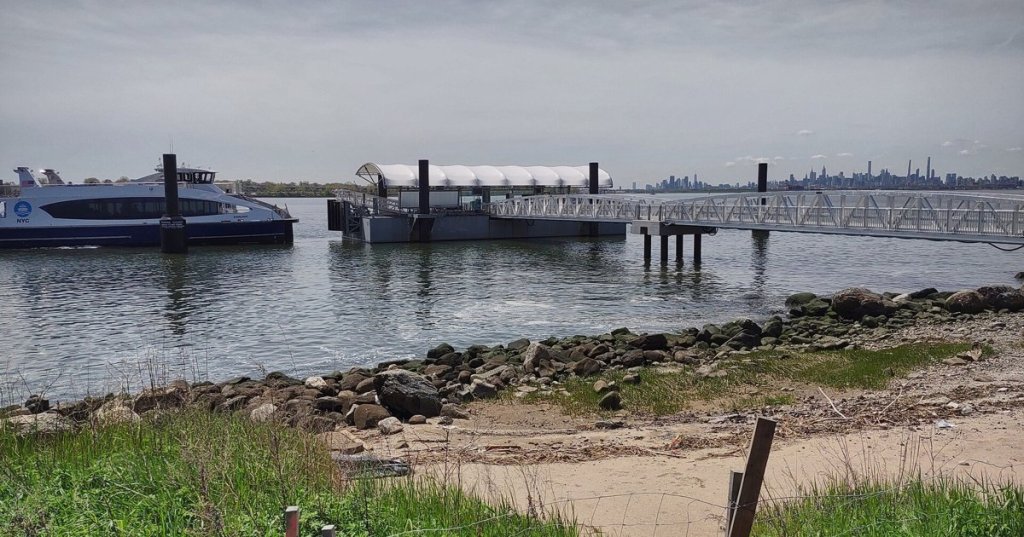
For most of its history Ferry Point Park has been the Bronx’s best-kept secret, or its most neglected asset, depending on whom you ask: a sprawl of waterfront land at the foot of the Whitestone Bridge, better known to motorists glimpsing it from the span than to the families who live a mile away. That is about to change, and the reason it is changing is the most interesting thing about it.
On Oct. 15, Community Board 10 reviewed a $160 million redesign of the park’s public spaces, according to How2NewYork, which reported on the presentation. The plan, by the landscape architecture firm Hargreaves Jones, spreads across five sites, two of them near Throgs Neck, and reads like a wish list compiled by every constituency in the borough at once.
The Wish List
There is a 20-foot slide and a splash pad for children. There are tennis and pickleball courts, a baseball field, basketball courts and three soccer fields. There is a lookout over the water and a network of paths along the East River. Some of the ground would be raised by as much as ten feet, and an existing detention basin would shrink to roughly a fifth of its current size, freeing land for recreation. The NYC Ferry landing, which has given the area a rare transit link to Manhattan, would stay.
“This park belongs to the community and residents helped shape the vision for its redesign from day one,” said Jessenia Aponte, as quoted by How2NewYork.
Board members, for their part, did what community boards do: they asked for more. One representative pressed for a second baseball field to serve Lehman High School. Others raised the perennial Throgs Neck complaint, which is that there is no subway anywhere nearby, and that a park this ambitious will draw visitors who have few ways to get there other than by car.
The Casino in the Room
All of which would be ordinary parks news, except for the neighbor. The redesign is tied to the Bally’s casino resort planned for the adjacent site, after New York State awarded the company one of the downstate gaming licenses last December. How2NewYork describes the casino plan as a $4 billion resort with more than three million square feet, a 500-room hotel, a 2,000-person event center, 250 table games and 3,500 gaming machines.
However the accounting is ultimately described, the park plan and the casino now travel together. In New York, large private projects tend to arrive with public commitments attached, and a $160 million park makeover is a considerable one. It gives the Bronx something it rarely receives: a major public amenity arriving alongside a private development.
Whether that is a good trade is a question the Throgs Neck and Schuylerville neighborhoods have been arguing about since the casino was first proposed. The skeptics’ case is about traffic, character and the social costs of gambling. The supporters’ case is about jobs, tax revenue and, now, ball fields. The park design does not resolve that argument, but it does make the supporters’ side of it considerably more concrete—quite literally, in the case of the raised lawns.
What Comes Next
The plan now goes before the city’s Public Design Commission, the body that reviews the appearance of projects on city property. According to How2NewYork, no construction is expected before 2028, which leaves ample time for the board’s requests—a second baseball field, better transit—to be negotiated, granted or quietly forgotten.
The transit question is the one to watch. A destination park with a casino resort next door will generate trips, and a neighborhood without a subway station is not obviously equipped to absorb them. Hargreaves Jones can design a twenty-foot slide; it cannot design a subway line.
The Larger Pattern
Ferry Point is part of a broader pattern in the way New York now builds its public realm. Box Street Park in Greenpoint was rescued by a rezoning deal. The Navy Street towers in Brooklyn promise a school in exchange for height. In the Bronx, soccer fields are arriving alongside a casino license. The city has learned to treat private development as a parks budget, and the communities on the receiving end have learned to bargain accordingly.
The test, as always, will be in the follow-through. Renderings are cheap and community-board presentations are cheaper still; the Bronx has seen many of both. If the slides and soccer fields materialize on schedule, Ferry Point could become what it has always had the bones to be: one of the great waterfront parks of the outer boroughs. If not, Throgs Neck will have gotten a casino and a promise, a combination the borough has some experience with.
Featured image: Ferry Point Park, the Bronx. Photo by Jim Henderson via Wikimedia Commons, CC BY-SA 4.0.



Leave a Reply