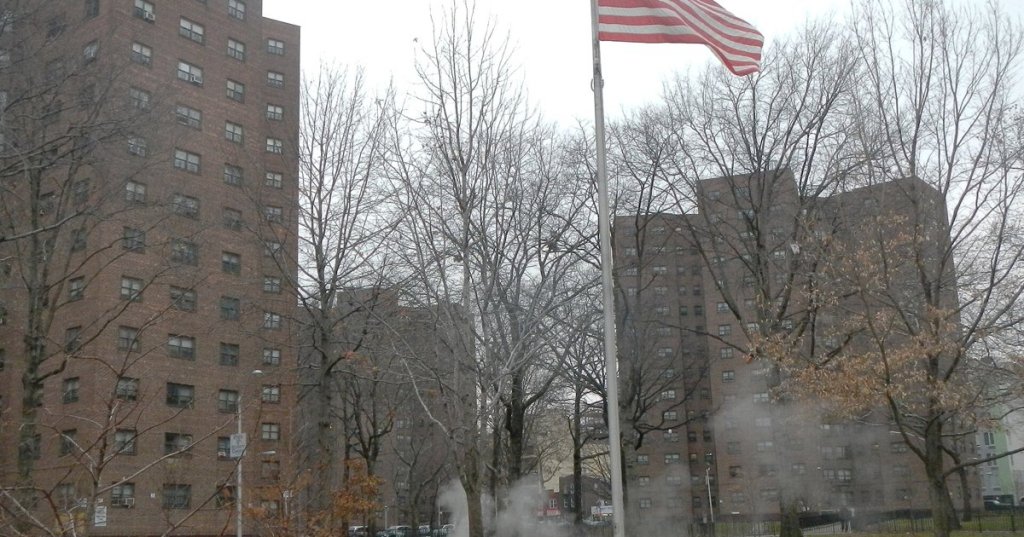
Downtown Brooklyn has spent the better part of two decades growing upward at a pace that would have startled the borough’s old brownstone gentry, and most of the time the neighbors on the receiving end have had little say in it. The fight over Navy Street is different, if only because it is happening in public, under the formal machinery of the city’s land-use review, and because the people across the street have decided to show up.
At issue is a proposal by Alloy Development to build two residential buildings of 73 and 63 stories—1.4 million square feet in all, holding 1,502 apartments—on a pair of sites facing the Farragut Houses. One is the former Boys & Girls Navy Yard Clubhouse at 240 Nassau Street, which Alloy bought for $15 million, according to the Amsterdam News. The other is the building at 46 Navy Street that houses P.S. 287, which would be demolished and rebuilt as part of the project in partnership with the New York City Educational Construction Fund.
The Offer
The project requires a special rezoning permit, and its formal public hearing took place at Brooklyn Borough Hall on Oct. 14. Alloy’s representatives told the hearing that three years of community outreach had shaped the plan, the Amsterdam News reported, and laid out what the neighborhood would get in return: 300 permanently affordable apartments, including 95 reserved for seniors from nearby NYCHA developments; a 120,000-square-foot pre-K-through-8 school to replace P.S. 287; a new community center; a 15,000-square-foot African art museum; retail; and publicly accessible open space. The firm said affordable units would match market-rate ones in size, finishes and appliances.
Alloy values the package at $470 million in public benefits, and was candid that the arithmetic depends on the rest of the building. Its representatives said they could pay for those benefits only if the market-rate portion went forward, and argued that raising the share of affordable units would undercut the project’s financing. Of the 45 recommendations made by Community Board 2, the firm said, some would require cooperation from city agencies and several were not realistic.
The Room
The application has drawn coverage beyond the neighborhood—the Kings County Herald laid out Alloy’s rezoning request on Oct. 27—but the testimony itself was a local affair. Residents of the Farragut, Ingersoll and Whitman Houses filled the hearing alongside union members, contractors and nonprofit leaders.
Among the project’s supporters was LaShawn Doyle, who attended and later worked at the old clubhouse and now runs the basketball organization Bucketfam, which uses the building free of charge under Alloy’s ownership. “This is not just a project,” he testified. “This is home for me because I am from the Fort Greene-Farragut area and for the last 30 years, we’ve watched developments go up around us, and we have no say-so.”
Justice Favor of the Mason Tenders District Council, who said he grew up in public housing, spoke for the jobs. “What changed my life and transformed my life and [is] transforming the lives of my members is having that good union career,” he said. “I’m proud to say that I stand in support of this project.”
Opponents, by the Amsterdam News’s account, were not arguing against construction as such but for less height, more affordability and enforceable protections. Sam Blackwell said the project “should be half the proposed size and twice the amount of affordable housing,” adding: “You bought a building. You didn’t buy our history; you didn’t buy the right to control our future.”
David Banks, a longtime Farragut resident, made the most lawyerly case. “I recognize the value of a new school, affordable senior housing, and community facilities,” he said, “but the question before us is whether these proposed benefits are supported by enforceable commitments and adequate protections for the existing residents.” Latrell Masso, the founder of Farragut Stakeholders, asked whether the towers would widen the gap between private development and the NYCHA campus across the street. “Think about the whole community,” she said.
Deacon Jeffrey Flowers, speaking on behalf of the Rev. Mark V.C. Taylor of the Church of the Open Door, urged the developer to return to the drawing board, citing the affordability ratio, the demolition of P.S. 287 and the absence of a clear plan for dust, noise, traffic and parking.
The Math of the Thing
Strip away the testimony and the Navy Street debate reduces to a familiar New York equation. The public goods—the school, the senior apartments, the community center the neighborhood plainly wants—are financed by the luxury units the neighborhood plainly fears. The developer says the ratio cannot move without the whole structure collapsing; the opponents say that is precisely what developers always say. Both may be right.
What is new is the scale. Seventy-three stories would make the taller building one of the more conspicuous objects in a skyline already crowded with them, and it would rise directly across from a low-slung public housing complex whose residents, as several of them told the hearing, have watched the neighborhood transform around them for a generation.
The application now moves through the rest of the Uniform Land Use Review Procedure, which ends, as these things do, with the City Council—and, by long custom, with the preference of the local Council member. Whatever the outcome, Navy Street has already produced something the Downtown Brooklyn boom rarely did: a public accounting, on the record, of what a neighborhood is being asked to trade.
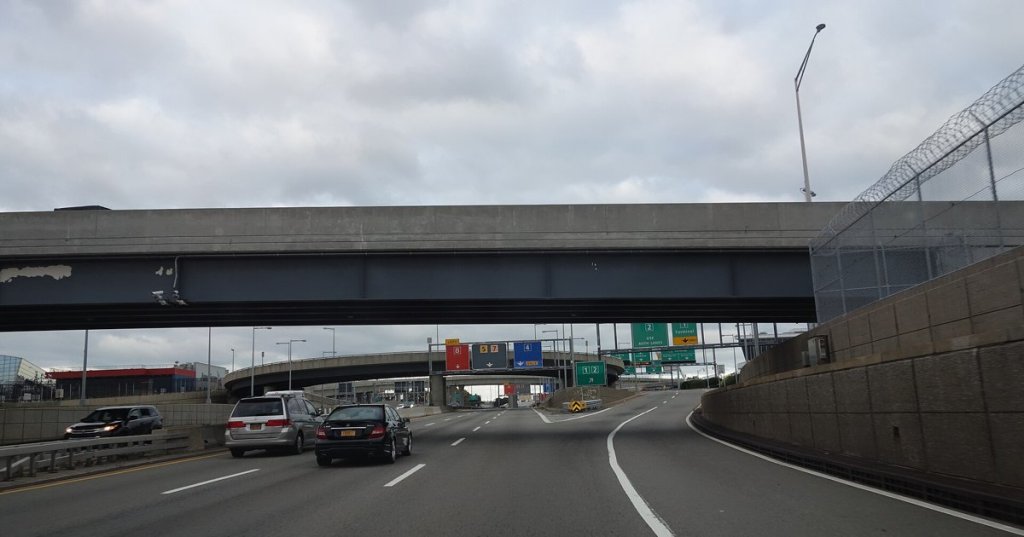
Featured image: The Farragut Houses, near Navy Street. Photo by Jim Henderson via Wikimedia Commons, CC0.



Leave a Reply