It is the sort of question that gets asked over a second martini on the Upper East Side, usually by someone who hasn’t been to Jamaica, Queens, since the Bloomberg administration: why don’t Black voters jibe with Kathy Hochul? The governor has never been accused of setting a room on fire. She has spent much of this year being told she is unloved, and statewide she has the favorability numbers to back that up.
The trouble with the question is that the numbers don’t support it, at least not in the form it’s usually asked. What the polling shows is subtler, and with a week left in her race against Nassau County Executive Bruce Blakeman, arguably more worrying for her campaign.
What the numbers say
The most recent Siena Research Institute poll with a racial breakdown surveyed 1,144 likely voters from Sept. 11 to 17. It has Hochul ahead of Blakeman 50 to 41 statewide. Among Black voters, according to the poll’s crosstabs, she leads 81 to 8. Eighty-six percent of Black likely voters view her favorably, and 80 percent say she is in touch with average New Yorkers. That is not a constituency in revolt.
An Emerson College/PIX11 survey of 900 likely voters, taken Oct. 3 to 5, has the same basic shape. Hochul leads 52 to 40 overall and about 72 to 14 among Black voters, with roughly 13 percent undecided. Concord Public Opinion Partners, polling in late August, had her at 65 percent among Black voters. The Black subsamples in statewide polls are small, so any single figure carries a wide margin of error. The direction, though, is consistent.
The newest statewide poll, from Quinnipiac University, surveyed 1,167 likely voters from Oct. 15 to 19. It has Hochul up 55 to 41 and carrying New York City 70 to 24. Its published release doesn’t break results out by race, but a crosstab Quinnipiac provided to The City Politic shows her leading Blakeman 82 to 9 among Black likely voters, with 5 percent undecided, almost exactly Siena’s September result and, like the others, drawn from a small subsample. “As Republican Bruce Blakeman becomes better known, he’s improved his image among independents,” said Quinnipiac’s Mary Snow in the poll’s release. “But with less than two weeks to go until the final votes are cast, he faces an uphill battle as Hochul maintains a double-digit lead.”
So where’s the problem?
The problem is in the intensity. In Siena’s August poll, 40 percent of Black likely voters strongly approved of the job Hochul was doing. By September that share had fallen to 29 percent, even though overall approval among Black voters rose from 72 percent to 83. More people approve of her, but fewer of them feel strongly about it. In August, 19 percent of Black voters were still undecided between Hochul and Blakeman.
Emerson comes at the same gap from another direction. In its poll, 57 percent of Black voters approved of Hochul’s job performance, 27 percent disapproved and 16 percent were neutral. In the same survey, about 73 percent of Black voters approved of Mayor Zohran Mamdani. Siena found Mamdani’s favorability among Black voters at 85 to 9, and 83 percent of them called his endorsement of the governor a positive. With this electorate, Hochul’s warmest asset may be the mayor. That helps explain why Mamdani is scheduled to campaign with her in the race’s final stretch.
Then there’s the baseline. In October 2022, Siena had Hochul beating Lee Zeldin 92 to 2 among Black voters. On Election Day, AP VoteCast data cited in City & State gave Zeldin about 17 percent of the Black vote, and Black voters made up about 11 percent of the electorate. Hochul won that race by roughly six points. Siena’s Steven Greenberg has noted that at this point in 2022 she led Zeldin 54 to 37. This September, Siena had her up nine, and her margin among Black voters was 73 points, against 90 four years ago.
Turnout, not defection
For Democrats, the realistic fear isn’t that Black New Yorkers will switch to Blakeman. It’s that some of them will stay home. At the late-August opening of a campaign field office in Flatbush, Hochul’s running mate, former City Council Speaker Adrienne Adams, said so plainly, according to the Amsterdam News: “I know unfortunately our track record as voters has become abysmal in New York, so when I say, and I plead to you this evening, please, please do everything you can do get out the vote.” Rep. Yvette Clarke, speaking at the same event, called the closing stretch “democracy building.”
The enthusiasm data is mixed. Emerson found 70 percent of Black voters “very excited” to vote, compared with 57 percent of white voters. Quinnipiac, measuring all of the governor’s supporters, found only 33 percent of them very enthusiastic about her, against 65 percent of Blakeman’s backers who felt that way about him. Snow, the poll’s assistant director, confirmed those figures to The City Politic and described the trade-off each campaign is living with: “While Bruce Blakeman is trailing Kathy Hochul in the overall race, he has a clear advantage when it comes to having the most enthusiastic supporters. On the flip side of that, Hochul’s supporters may not be as excited about her, but a vast majority of the likely voters who are backing her say their minds are made up.” The issues Black voters rank highest aren’t a mystery either. In Emerson’s poll, housing affordability (25 percent) and the economy (24 percent) led the list, ahead of healthcare (16 percent).
The Adams bet and the ‘computer’ line
Hochul made her own wager on this electorate in February, when she named Adams as her running mate. Adams is the first Black woman to lead the City Council and a longtime figure in Southeast Queens politics. Basil Smikle, a Columbia professor and former executive director of the state Democratic Party, told Gothamist: “What any governor would want is someone who really could be out there and shore up her base – and expand her base – while she’s actually doing the job of being governor.”
Not everyone was pleased. Brooklyn Democratic chair Rodneyse Bichotte Hermelyn first called the pick a miscalculation and briefly withdrew her endorsement before reversing herself, NY1 reported. She said there had been “hopes that the running mate would be a Latino, a Latino male in particular.” That is a reminder that the coalition Hochul is courting in the city isn’t one bloc but several. Within the Black vote alone there are Caribbean Brooklyn, Southeast Queens homeowners, the Bronx, and voters in Buffalo, Rochester and Long Island, each with its own priorities.
Blakeman, for his part, has tried to turn one of the governor’s own lines against her. He has revived Hochul’s May 2024 remark at the Milken conference about “young Black kids growing up in the Bronx who don’t even know what the word computer is,” and at the Oct. 13 NY1 debate he called it “reprehensible,” the New York Post reported. At the time, Hochul said she “misspoke” and regretted it. Reaction among Black and Latino Democrats then was divided: Assemblywoman Amanda Septimo called the remark “harmful, deeply misinformed and genuinely appalling,” while Senate Majority Leader Andrea Stewart-Cousins said, “She said she misspoke. She said it was inartful.”
Hochul’s campaign has answered with the record and a counterattack. Spokesperson Sarafina Chitika told LI Life & Politics that the governor “immediately apologized.” She pointed to universal free school meals, the bell-to-bell school phone ban and a path to universal childcare, and said Blakeman “has been unapologetic about each and every one of his attacks on Black New Yorkers.”
Hochul’s campaign, the governor’s press office, Assemblywoman Rodneyse Bichotte Hermelyn and Emerson College Polling did not respond to requests for comment.
The answer
So, do Black voters jibe with Kathy Hochul? By the numbers, yes, by margins any politician would envy. But polling measures preference, not passion, and the softening in strong approval, the persistent undecideds and the gap between her ratings and the mayor’s all point to the same thing. Black New Yorkers aren’t rejecting the governor. Many just aren’t excited about her. Whether that matters on Nov. 3 depends less on what they think of Hochul than on whether they turn out.
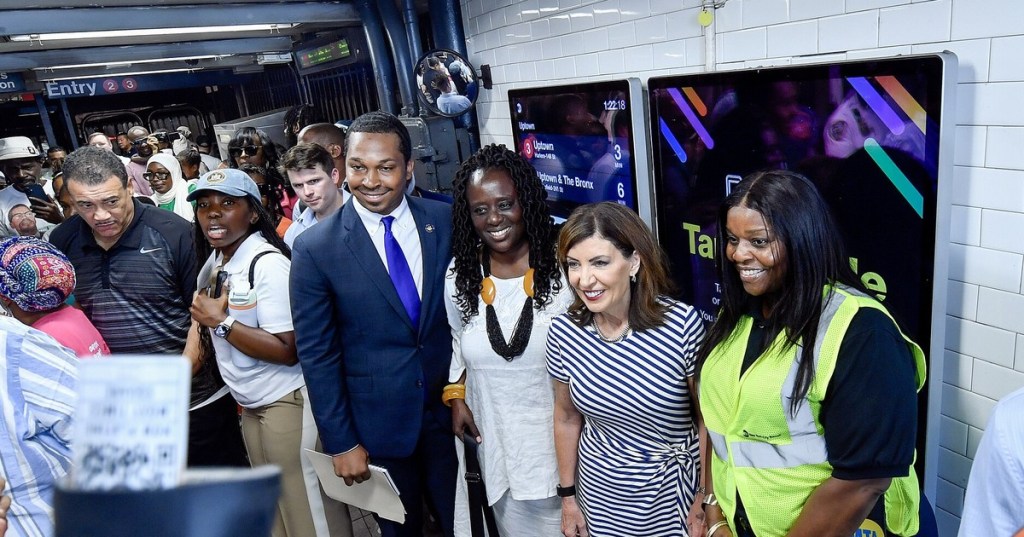
Featured image: Gov. Kathy Hochul with Assembly Member Jordan J.G. Wright, State Senator Cordell Cleare and NYC Transit President Demetrius Crichlow at the renaming of the 110 St-Malcolm X Plaza subway station in Harlem, Aug. 10, 2025. Photo by Marc A. Hermann/MTA via Wikimedia Commons, CC BY 4.0.


Leave a Reply