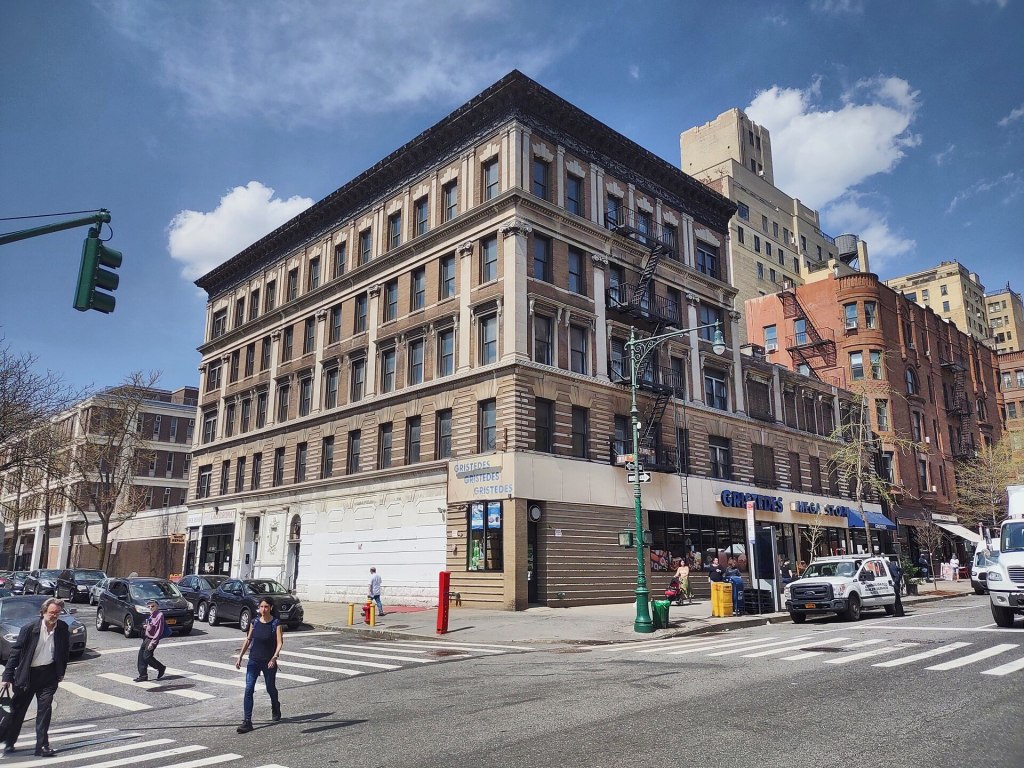
For roughly 30 years, the apartments above the Gristedes on Columbus Avenue sat empty. Not under renovation, not in litigation, just empty, a dozen units in the middle of one of the most expensive residential neighborhoods on earth, with Life magazines from the 1960s still lying around in some of them when the architects first toured the place about a decade ago. Nobody petitioned. Nobody testified. The light and air were in perfect condition. There was simply nobody inside to enjoy them.
Now someone wants to put people there, and the Upper West Side has discovered a crisis.
The someone is Terra Developers, a Brooklyn firm that bought 500 Columbus Avenue, the two-building corner at West 84th Street, for $28 million this summer, as West Side Rag reported in August, following Crain’s. City records reviewed by The American Developer show the buyer, 500 Columbus SP LLC, financed it with $25 million in mortgages. On Oct. 8, its architects, DXA Studio, showed Community Board 7‘s preservation committee what the money is for.
What is actually proposed
It is worth describing carefully, because the argument has already outrun the drawings. According to detailed accounts from I Love the Upper West Side and West Side Rag, the site is two buildings, both completed in 1895. The corner building is still five stories. Its neighbor to the north was chopped down to three stories in 1936 and converted into a movie theater, which is why the Gristedes frontage has that oddly decapitated look, a cornice line that drops off a cliff halfway up the block.
The plan restores both. The corner building would be restored and get one more floor, set back so it is barely visible from the street. The northern building would get its two missing floors back. Above that northern half, a new tower would step back as it rises, its top three floors set 30 feet from Columbus Avenue, reaching 145 feet, or 161 with the elevator, stairs and mechanical equipment. The bricked-up windows on 84th Street would be reopened, and the storefronts brought back toward what old photographs show. Jordan Rogove of DXA told the committee the team even fed historic black-and-white photographs to AI to work out the original paint colors, which is either the future of preservation or the most Brooklyn sentence ever spoken at a community board.
The result: 19 condominiums, most of them three-bedrooms and two of them with five. Gristedes, if negotiations go well, would decamp temporarily and come back.
The case against, taken seriously
The opposition comes mostly from 102 West 85th Street, the 12-story co-op directly behind the site, whose south wall would sit 20 feet from the tower’s north wall. A resident who bought her first-floor studio 27 years ago for its light said it will become “a dark apartment 24/7.” Elizabeth Harris, 78, told the committee that the hour of sun her south window gets each day makes a real difference in her life. That is not nothing, and nobody should sneer at it.
A Change.org petition started on Oct. 16 by Serena Robbins asks Council Member Gale Brewer and the Landmarks Preservation Commission to reject the proposal as out of scale and a damaging precedent; it had 127 signatures as of Oct. 19. “This is going to start a very dangerous precedent for the Upper West Side Historic District,” one neighbor told the committee, according to West Side Rag. “If we allow this sort of creep to happen on the avenues that are established. This may open some floodgates.”
Here is the problem. The Landmarks Preservation Commission is not the Department of Sunlight, and the commission itself says it does not regulate light and air. It exists to protect the architectural character of designated places, and the most damaged piece of architectural character on this block is the building that lost its top two floors to a movie theater during the Roosevelt administration. A plan that puts those floors back, restores two 131-year-old facades, reopens their windows and parks the new bulk well behind the street wall is about as close to a textbook landmarks application as Manhattan produces. One committee member who voted yes said as much: “We are only here to consider the appropriateness of the design of the project and how it relates to the Historic District.” Another noted, correctly, that neighbors have no legal entitlement to the light and air they currently enjoy; that is governed by zoning.
The preservation consultant on the job, Cas Stachelberg of Higgins Quasebarth & Partners, made the precedent argument in reverse: this is the only place in the district where a building was cut down and lost that much of its original architecture, so it cannot be a model for anywhere else. He is a hired advocate, and his clients would say that. He is also, as far as anyone has shown, right.
The case against that nobody is making
And yet I would not wave this through with a bow on it. The trouble with 500 Columbus is not that it is too tall. It is that it is too empty.
Nineteen apartments in a 13-story building works out to fewer than two a floor: big family condominiums for families who can pay New York new-construction prices. There is nothing wrong with that; the rich have to live somewhere, and every one of them who moves into a five-bedroom on Columbus is not outbidding someone for a classic six on West End. But Rogove also told the committee that the developer is leaving several thousand square feet of buildable space on the table. In a city that adopted the City of Yes for Housing Opportunity in 2024 precisely to squeeze more homes out of more lots, a developer volunteering to build less is being treated as a courtesy. It is a missed opportunity.
The neighbors want the building shorter. The better demand is that it be fuller: more, smaller apartments in the same envelope, a few of them priced for the teachers at the nearby school the petition invokes. The commission cannot require that; its jurisdiction is facades and massing, not unit counts. But Community Board 7 can say it, Brewer can say it, and the people who have suddenly found their voices on the subject of Columbus Avenue could say it too, instead of asking for the one outcome guaranteed to produce nothing at all.
The vote ahead
As for the architecture, the tower as described to the committee is a study in deference, stepping back from the avenue as it rises and letting the 1895 base do the talking, which is exactly what the commission rewards and exactly why New York’s new buildings in historic districts so often look like they are apologizing for being there. The committee’s own resolution asked for better windows on the rebuilt floors, more detail on the new cornices and more consistent storefronts, and at least one member said he could not get behind the tower’s size. Those are the right arguments to be having. DXA has at least promised not to leave a blank wall facing 102 West 85th; Rogove said that side would be clad like the rest and that the team is open to discussing windows there. Add the windows. Neighbors who must look at a wall should at least be looking at a façade.
The committee voted 4-1, with no abstentions, to recommend approval of the restoration, the facade changes and the additions as appropriate to the buildings and the historic district, according to its adopted resolution; among non-committee board members, the vote was 1-0. The board has received eight letters or emails on the project so far, “with both supporters and detractors,” the committee said. Community Board 7 said that, as is its practice, it would not comment further until after the full board votes.
The full board of Community Board 7 votes on Nov. 4, at a meeting the public can attend on Zoom or in person at the New York Society for Ethical Culture, 2 W. 64th St. The Landmarks Preservation Commission has not yet scheduled its public hearing on the application, according to the commission, which posts hearing dates and materials on its website in advance. When it does hear the case, the commission should approve it. The neighbors will lose some light, and that is a real loss. But the alternative on offer is another 30 years of the arrangement everyone apparently found acceptable until this month: a decapitated building, a dozen dark apartments, and nobody home.
Terra Developers could not be reached for comment; an email to the address listed on its website was returned as undeliverable. DXA Studio, Higgins Quasebarth & Partners and the office of Council Member Gale Brewer did not respond to requests for comment.
Featured image: 500 Columbus Avenue at West 84th Street, the Gristedes building and former movie theater, in 2022, by Jim.henderson, CC BY-SA 4.0, via Wikimedia Commons.


Leave a Reply