The overture is played on kazoos. Sixty-five members of the Metropolitan Opera chorus, ghosts all, rising from their graves and buzzing, while the chandeliers, instead of making their stately ascent, flicker like a séance gone wrong. Whatever else you say about Missy Mazzoli’s “Lincoln in the Bardo,” which had its world premiere at the Met on Oct. 19, nobody can accuse it of a timid first minute.
The premiere was billed as history, and it was, with footnotes. The Met’s own announcement declared that Mazzoli “becomes the first woman to have a world premiere at the Metropolitan Opera,” joining “a distinguished group of female composers whose works have had Met premieres in recent seasons,” among them Gabriela Lena Frank, Jeanine Tesori and Kaija Saariaho. The distinction is the word “world”: those earlier operas had been heard elsewhere first, and Vogue, scrupulous about such things, noted that Tesori’s “Grounded,” which opened last season at the Met, debuted at the Kennedy Center. TheaterMania called Mazzoli “one of the first two women to be commissioned by the Met to compose an original opera, a major initiative by general manager Peter Gelb.” Progress at the Met moves at the speed of a Wagner act. It does move.
The source, and the stakes
The opera is adapted from George Saunders‘s 2017 novel, the Booker winner about the night in 1862 when, as rumor had it, Abraham Lincoln returned to a Georgetown crypt to hold the body of his 11-year-old son, Willie, dead of typhoid. The novel unfolds in the bardo, the Buddhist in-between, crowded with the dead who will not admit they are dead and who call their coffins “sick-boxes.” Saunders’s book has 166 voices. The libretto, by Mazzoli’s longtime collaborator Royce Vavrek, keeps a dozen or so.
Mazzoli told Nylon that when the pair first wrote to Saunders out of the blue for permission, he replied: “I’m so glad you wrote me, because when I wrote this novel, I imagined it as an opera.” The Times put it nearly the same way, calling the novel “a book in search of an opera adaptation.”
The cast is an embarrassment of riches. Peter Mattei, the Swedish baritone who could make a grocery list sound like Schubert, sings Lincoln; the treble Everett Sobers, in his Met debut, sings Willie (Michael Hurst shares the role). Christine Goerke, a soprano, plays the Reverend Everly Thomas; Stephanie Blythe and Craig Colclough are the bickering Barons; Anthony Roth Costanzo is the shape-shifting Miss Elise Traynor; Ryan McKinny and Jonah Hoskins are the ghostly duo Vollman and Bevins; Janai Brugger and Joshua Blue complete the principals. Lileana Blain-Cruz, Tony-nominated for “The Skin of Our Teeth,” directs, in her second Met production. Yannick Nézet-Séguin conducts.
The verdicts
The reviews, rounded up by Playbill, are a genuine split, which is more interesting than a rave.
The enthusiasts were loud. BroadwayWorld’s Richard Sasanow wrote that it “held the audience in its thrall from the opening notes of the overture,” and called Blain-Cruz’s staging “a place of wonder.” The headline on The Times of London’s review promised “chills and laughs in the Met’s bold new opera.”
The skeptics were sharper. TheaterMania’s Zachary Stewart called the flickering-chandelier opening “a thrilling overture to a mostly disappointing night,” found the songs “aural apparitions, flying in one ear and out the other,” and described Vavrek’s lyrics as ranging “from banal to turgid.” He also thought the countertenor Costanzo “totally misused.” OperaWire’s David Salazar admired the libretto’s architecture but not its language, arguing that for Lincoln, “a man known for his eloquence and refinement, to lack any of that, is a misfire.”
In the middle sits George Grella of New York Classical Review, who heard “magic on the stage” and “prosaic moments as well,” located the problems in a libretto that “swings drastically between an elegant partnership with the music and writing that makes better dialogue than song,” and found the evening’s emotional summit in Lincoln’s Act II aria, “Dear Little Chap,” built to land on the words “Willie is dead.” On that point there is something like consensus. Grella praised Mattei’s “wrenching feeling of sorrow”; even Stewart allowed that Mattei “perseveres,” conveying both a father’s grief and the guilt of a president sending thousands of other fathers’ sons to die.
The fault line, then, runs straight through the text. Everyone loved the look (Adam Rigg’s misty gothic forest, James Ortiz’s creature suits and puppets, Montana Levi Blanco’s distressed period costumes, and, per the Met, pyrotechnics and a live horse) and almost everyone admired Mattei. What divides the critics is whether Vavrek’s plain-spoken libretto is a feature, faithful to Saunders’s deliberately flat, overlapping voices, or a missed chance to give the most eloquent American president words worth singing.
The room
Then there was the audience, which on opening night was not the Met’s usual subscription crowd. Dua Lipa, in black-sequined Ferragamo, arrived with her husband, the actor Callum Turner, and sat beside Saunders at the pre-performance gala dinner on the Grand Tier, per Nylon. This was not mere celebrity tourism: Lipa chose the novel for her Service95 book club in 2024, and Service95 is producing a behind-the-scenes mini-documentary on the adaptation. “Last night, Lincoln In The Bardo at The Met Opera,” she posted on X the next day, to an audience that, at last count, had liked it nearly 10,000 times, which is to say several Met Opera Houses’ worth of potential first-timers.
Vogue’s party report filled in the rest: Amy Poehler, Maggie Gyllenhaal, Bowen Yang and Matt Rogers (Yang, currently in “Oh, Mary!,” is playing a rather different Lincoln story eight times a week), Gina Gershon, Laurie Anderson, Dev Hynes and Cécile McLorin Salvant. At intermission, guests were served desserts drawn from the novel’s world, including Mary Todd’s white almond cake and apple pie. The cast-and-company after-party, Vogue reported, “ran much, much later than anyone expected.”
Why it matters
The Met has spent a decade making the case that new opera can fill its 3,800 seats, and a decade being told, with some justice, that it plays it safe. “Lincoln in the Bardo” is not safe. It has a man with a comically swollen prosthetic, a chorus of kazoos and a dead child at its center. It also arrived with exactly what the house needs: a famous book, a pop star with a reading list, and a fight among the critics. Operas that everyone politely admires tend to vanish. Operas that people argue about at dinner tend to get revived.
Mazzoli, asked by Nylon what should be adapted next, suggested “Catfish,” “Real Housewives” and the Elizabeth Holmes saga, all of which, she said, “feel like contemporary versions of Verdi or Puccini opera plots.” Mr. Gelb, take note. The kazoos are already paid for.
“Lincoln in the Bardo” runs at the Metropolitan Opera through Nov. 14, with Yannick Nézet-Séguin conducting except on Oct. 31 and Nov. 14, when Steven Osgood takes the podium. The Met says the Nov. 11 performance will be broadcast live on the SiriusXM app. Details at metopera.org.
The Metropolitan Opera’s press office and Service95 did not respond to requests for comment.
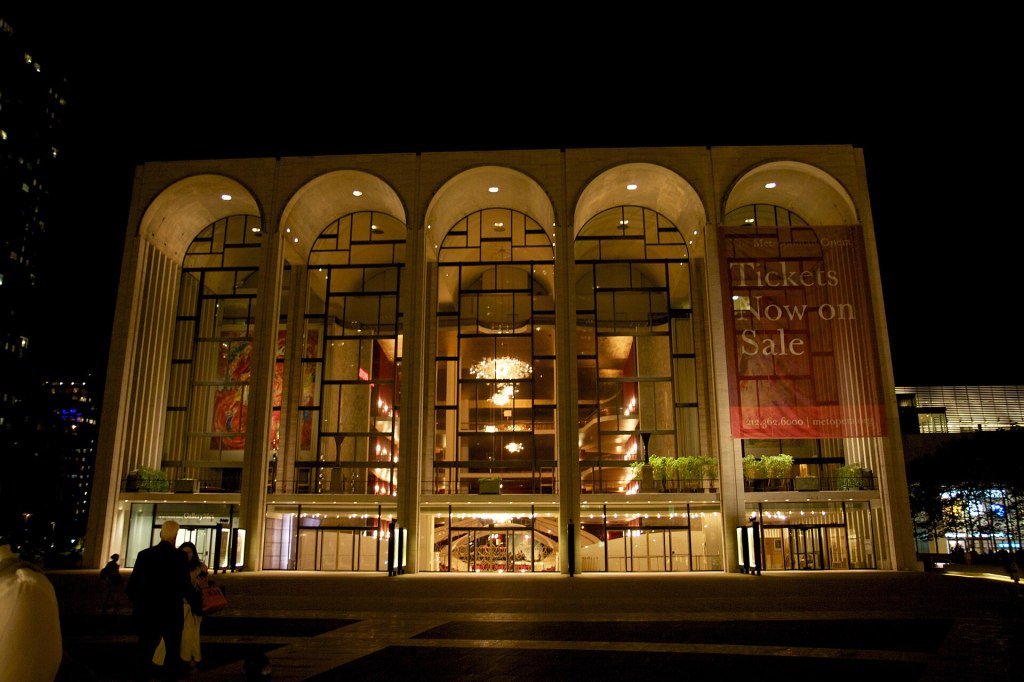
Featured image: The Metropolitan Opera House at Lincoln Center, photograph by Lydia Liu, CC BY 2.0, via Wikimedia Commons.


Leave a Reply