There is a song in the new musical at the Public Theater called “Rag Ty Yw Tre,” and Howard Miller of Talkin’ Broadway has helpfully told his readers that its meaning is theirs to decipher. It is Cornish. The show is set in a Cornish fishing village, its cast of 15 plays fiddles, whistles and accordions while singing in coached West Country vowels, and its hero is a man born at the end of his life who spends the next two hours and 45 minutes getting younger. If that sounds like a lot of folk for one evening, the critics who filed after the Oct. 21 opening would like a word. If it sounds like a Broadway hit in waiting, so would the people paying for it.
The Curious Case of Benjamin Button, adapted from the 1922 F. Scott Fitzgerald story, opened at the Public’s Newman Theater on Oct. 21 after previews that began Oct. 8. It arrives with the Englishman’s favorite credential: the 2025 Olivier Award for best new musical. It started small, at London’s Southwark Playhouse in 2019, came back larger and moved to the Ambassadors Theatre in the West End in 2024, according to Playbill. The Public has already extended the run twice, now through Dec. 6.
A Cornish reel, and another, and another
The writing team is Jethro Compton, who wrote the book and lyrics, directs, and designed the wood-and-fishnet set, and Darren Clark, who wrote the music and shares the lyrics. Chi-San Howard choreographs. Fitzgerald’s Baltimore has become a harbor town, and his satire has become something closer to a sea shanty with a lump in its throat.
The reviews, gathered by BroadwayWorld, divide neatly along a single fault line: whether one Celtic reel can carry a man across a century. Helen Shaw of The New York Times said no, and said it memorably. The two-hour-and-45-minute show, she wrote, “hits one musical idea — a folksy Celtic reel — and then never veers,” and she then demonstrated the effect: “Man is born as an old guy? Folksy Celtic reel. Man enters World War II? Folksy Celtic reel.”
Sara Holdren of Vulture found real “moments of beauty and delight,” among them a hovering buoy that lights up to become the moon, but advised that the evening is best taken by those with “a strong stomach for schmaltz,” and wished its creators had learned their own lesson: “that more is sometimes the enemy of enough.” Jonathan Mandell of New York Theater and Miller both noted that the carefully coached Cornish accents can defeat the American ear. Miller also flagged the show’s fondness for reminding everyone that time and tide wait for no man. “We know,” he wrote. “We know.”
Then there is the other camp, which is larger. Charles Isherwood of The Wall Street Journal called it “jaunty and moving.” Johnny Oleksinski of the New York Post charted the evening’s own reverse aging: “From annoying to beautiful.” Frank Scheck of New York Stage Review called it “a charmer of a musical that possesses distinct Come from Away vibes,” and Hayley Levitt of TheaterMania singled out “When E’re She Looked at Me” as a jig that “could be a staple at any Dublin pub.” BroadwayWorld’s running average sat at 79.2 percent the morning after opening, which in Broadway terms is the grade of a show that will be fine.
The man getting younger
Almost everyone agrees on Andrew Durand, the Tony nominee from Dead Outlaw and Shucked, who plays Benjamin. Levitt praised an “understated and vulnerable performance” in which the de-aging is achieved through “delicate shifts of voice and posture.” Thom Geier, writing at Culture Sauce, called Durand and Kelsee Kimmel, as the barmaid Elowen Keene, “such an infectiously appealing onstage couple that it’s hard not to root for whatever version of a happy ending they can muster.” Kimmel comes to the Public from playing Jersey in Hell’s Kitchen on Broadway, according to the company’s program notes.
It is a peculiar acting problem: a love story in which one partner ages normally and the other is walking the wrong way down the escalator. Fitzgerald played it as a joke about convention. Compton and Clark play it for tears, and judging by the reviews, the tears are earned at least some of the time.
Lafayette Street, Broadway’s newest out-of-town
The more interesting story is not on the stage but in the program’s fine print. Geier pointed out what the rest of the theater press has been murmuring since summer: “a Broadway berth seems inevitable (especially since Broadway theater owner ATG is a producer of the trial run at the Public Theater).”
That would be ATG Entertainment, the multinational theater landlord and producer. In August, Philip Boroff of Broadway Journal reported, citing investment documents, that ATG was raising $15 million to bring Benjamin Button to Broadway in the spring, after its stand at the Public, with producers Gavin Kalin and GBA also involved. The same week, Boroff noted, Ari Emanuel’s live-events company Mari said it had signed a deal to buy ATG, which has been majority owned since 2013 by the private equity firm Providence Equity Partners, for a reported $6 billion. No Broadway theater or date has been announced.
So the institution Joseph Papp built as one of the country’s first nonprofit theaters, and which describes itself as “theater of, by & for all people,” is this fall doing what Boston and New Haven used to do for the commercial producers of the 1950s: giving a show somewhere to open, get reviewed, and get fixed before the real money arrives. Nobody should clutch pearls. The Public has always been Broadway’s most productive feeder, from Hair to A Chorus Line to Hamilton, which the theater still lists, with some justified smugness, in its boilerplate. Under artistic director Oskar Eustis and executive director Patrick Willingham, the arrangement keeps the lights on at Astor Place and sends something back downtown when a transfer works.
But there is a difference between a show the Public developed and a show the Public is hosting for people who already own Broadway theaters. A finished Olivier winner, recast but with its original London creative team reassembled, is not exactly an artistic risk. It is a $149 ticket, $119 for Public supporters and partners, with a $45 day-of lottery called the Curious Queue for the rest of us, and a very expensive focus group.
What the tide brings in
None of which makes the evening worse. By most accounts, it is a warm, handsome, overlong piece of craftsmanship, with Zoe Spurr’s lighting turning the stage into seawater and Anna Kelsey’s costumes doing quiet work as Benjamin sheds decades. The fiddles are real, the actors play them, and there is something lovely about watching a cast make its own weather.
The question for the spring is whether a musical that critics keep comparing to Come From Away and Once can find the same audience at Broadway prices, in a season in which Boroff expects the number of new Broadway musicals to rebound after last year’s lull. The Times may have found it monotonous. But Broadway has never been allergic to a tune you can hum on the way out, and this one, by every account, is very hummable.
Whether anyone on the way out will be able to translate “Rag Ty Yw Tre” is another matter. Time, as the show will tell you, and tell you again, waits for no man.
The Public Theater did not respond to a request for comment. An email to ATG Entertainment’s listed press address was returned as undeliverable.
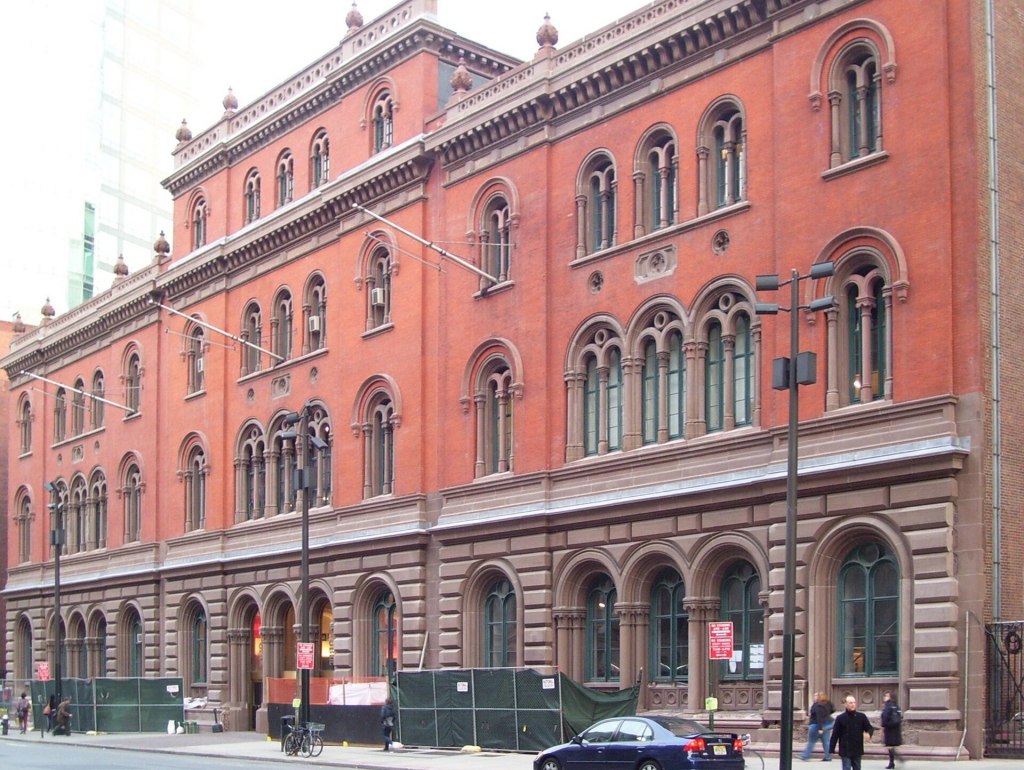
Featured image: The Public Theater in the former Astor Library building on Lafayette Street, by Beyond My Ken, CC BY-SA 4.0, via Wikimedia Commons.


Leave a Reply