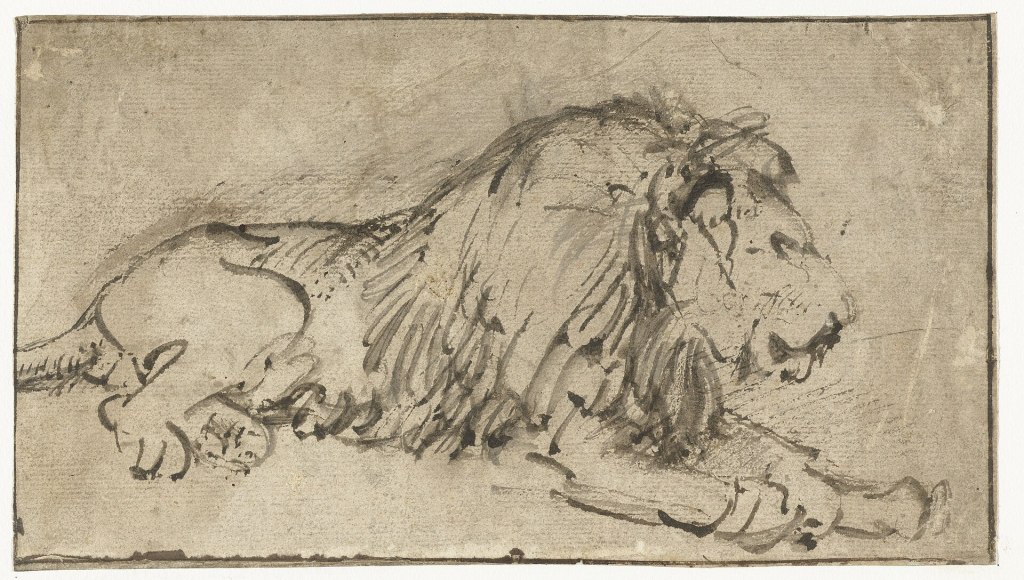
The lion in question is asleep. Rembrandt drew it around 1660 in reed pen and brown ink, smudging the mane with a wet finger or brush, on a sheet of light-brown paper barely five inches by eight. It does not roar. It does not pose. It lies there, heavy and magnificent, and lets you look. Since Friday, Oct. 23, it has been lying in the Morgan Library & Museum on Madison Avenue, on loan from the Rijksmuseum, as the calling card for a small exhibition with a large argument.
The show is “Rembrandt’s Lions: Art and Exile in the Dutch Republic,” on view Oct. 23 through Jan. 31, 2027, in the Morgan Stanley West Gallery. The title, as the museum is careful to say, is only partly about big cats. Its real subject is the people who made Rembrandt’s Amsterdam: migrants, exiles and refugees, in a century when, by the Morgan’s count, up to 60 percent of the city’s residents “hailed from elsewhere in the world.”
A Dutchman, made of elsewhere
We are in the habit of treating Rembrandt van Rijn (1606–1669) as Dutchness itself, the brown-varnished patron saint of tulips, burghers and the Golden Age. The Morgan’s argument is that in his own time, “the very definition of ‘Dutch’ identity was still being shaped,” and that the shaping was done, in no small part, by newcomers. The young Republic had become, in the museum’s announcement, “a bastion in Continental Europe for religious and political tolerance, though not all people enjoyed equal freedoms, especially in Dutch colonial territories.” That last clause is doing honest work; the same Republic that sheltered Iberian Jews and Protestant refugees from the Spanish-ruled south ran a brutal colonial trade.
The lion, meanwhile, was the Republic’s emblem, the rampant Leo Belgicus of a hundred maps, and it turns up in Rembrandt’s etchings, the museum notes, “often in the context of stories about exile, refuge, and migration.” The stated aim, which is rather lovely, is “to reveal the many ‘lions’ that irrevocably shaped him and the vast, emerging Republic in which they all lived and worked.”
What’s on the walls
The core of the show is the Morgan’s own trove: in Apollo’s description, the largest collection of Rembrandt’s etchings in North America, including sheets bought by J. Pierpont Morgan himself and, as the museum puts it, “celebrated, but rarely exhibited.” Prints are fragile and light-sensitive; they spend most of their lives in boxes. Seeing the best impressions out together is the kind of thing that happens once a decade, if that. Most of the works on view come from the Morgan’s own collection, with a smaller number from outside lenders, according to the exhibition checklist the museum provided to The City Politic.
Among the highlights the Morgan and the press have previewed: “St. Jerome Reading in an Italian Landscape,” an etching and drypoint of about 1653 printed on Japanese paper, which Morgan bought in 1905; and “The Flight into Egypt: A Night Piece,” about 1651, in which the Holy Family travels through near-total darkness. Apollo observes that the Flight, seen alongside Rembrandt’s portraits of the immigrants of his own Amsterdam, “reminds us that the history of displacement stretches back millennia.” ArtHistory.News put it more plainly: the print “brings displacement into the intimate setting of a family travelling through darkness.”
The Rijksmuseum’s “Recumbent Lion,” which Apollo chose to lead its preview, is the headline loan, and deservedly. Rembrandt never left the Dutch Republic; any lion he drew from life had been shipped there, an unwilling migrant of the age’s trade networks. One need not push the metaphor hard. It pushes itself.
The curator
The exhibition is organized by Sarah W. Mallory, the Morgan’s Annette and Oscar de la Renta Assistant Curator of Drawings and Prints and co-editor of “Art Museums and the Legacies of the Dutch Atlantic Slave Trade” (Brill, 2025). That credential tells you what kind of show this is not: it is not a sentimental celebration of Dutch tolerance. Mallory was scheduled to give the free opening talk, “Rembrandt’s Lions: Make Art, Not War,” in the Morgan’s Gilder Lehrman Hall on opening night, on the stories of war and diaspora in the etchings.
Why it lands in New York, now
There is an obvious contemporary reading, and the Morgan, to its credit, does not shout it. The show opened in a city that was itself a Dutch Republic outpost, where the question of who counts as a real New Yorker is being argued, loudly, on every channel. It is one thing to be told, in a press release, that a nation’s most celebrated painter drew his world from the people who arrived in it. It is another to stand in front of a sheet of paper the size of your hand and see, in the etchings, a stranger’s face rendered with more attention than most of us give our neighbors.
The connoisseurs will come for the impressions, the warm plate tone, the drypoint burr that only survives in early pulls. Apollo’s preview praised the artist’s “sharp and empathetic eye” for the figures he encountered; that is the phrase to carry into the gallery. The rest of us might come for the argument and stay for the lion, who, three and a half centuries on, is still the calmest creature in Midtown.
“Rembrandt’s Lions: Art and Exile in the Dutch Republic” is at the Morgan Library & Museum, 225 Madison Avenue at 36th Street, Oct. 23, 2026, through Jan. 31, 2027.
The Morgan provided the checklist, exhibition texts and press materials but said it could not answer further questions by The City Politic’s deadline. The Rijksmuseum did not respond to a request for comment.
Featured image: Rembrandt van Rijn, “Recumbent Lion” (Liggende leeuw), c. 1660, reed pen and brown ink, Rijksmuseum, Amsterdam (RP-T-1901-A-4524), CC0, via Wikimedia Commons.


Leave a Reply