Judge Jesse M. Furman’s Oct. 13 opinion in Democracy for the Arab World Now, Inc. d/b/a DAWN et al. v. Trump et al., No. 26-CV-5957 (JMF), runs 30 pages. Much of it is a judge explaining, politely, that he has said this before.
“For the reasons that follow, which are substantially similar to the reasons set forth in Judge Failla’s and this Court’s prior Opinions,” he wrote, the plaintiffs’ motion for a preliminary injunction “is GRANTED in substantial part.”
A familiar order
The order at issue is Executive Order 14,203, which President Donald J. Trump signed in February 2025. It imposes sanctions on people associated with the International Criminal Court and exposes anyone who provides “services” to designated people to civil and criminal penalties under the International Emergency Economic Powers Act.
As Judge Furman recounted, the order is “substantially similar” to one Mr. Trump issued in 2020. Judge Katherine Polk Failla, also of the Southern District, preliminarily enjoined enforcement of that order against a group of plaintiffs in 2021 on First Amendment grounds. Last year, in Rona v. Trump, Judge Furman held that the 2025 order violated the First Amendment rights of two law professors. He entered a permanent injunction protecting them.
According to the opinion, the government has designated former ICC Prosecutor Karim Khan; six ICC judges and two deputy prosecutors, between June and August 2025; Francesca Albanese, the U.N. special rapporteur on the occupied Palestinian territory; and three Palestinian human-rights organizations, Al-Haq, Al Mezan and the Palestinian Centre for Human Rights. In December 2025, it designated two more ICC judges.
The plaintiffs
DAWN is a U.S.-based nonprofit focused on human rights in the Middle East and North Africa. The Taxpayer Alliance Against Genocide, or TAAG, is an unincorporated association of 10 American taxpayers. Its president, Tarik Kanaana, and treasurer, William Doares, are also plaintiffs.
According to the opinion, DAWN made several submissions to the ICC prosecutor’s office under Article 15 of the Rome Statute before the 2025 order. These concerned alleged crimes by Israeli officials in the occupied Palestinian territory and, in DAWN’s words, “the role of U.S. officials in aiding and abetting those crimes.” It also exchanged evidence and analysis with the Palestinian groups and responded to Ms. Albanese’s calls for input. After the order, DAWN stopped that work, fearing it would be treated as a prohibited “service.” TAAG prepared its own Article 15 submission but did not send it, for the same reason.
Both groups asked the Treasury Department’s Office of Foreign Assets Control whether their work was lawful. The opinion says OFAC never answered TAAG’s February request. It referred DAWN to its licensing division without answering DAWN’s question. The government noted in its brief that the plaintiffs had not been designated, sanctioned or threatened with enforcement.
The holding
Judge Furman found that the 2025 order likely violates the plaintiffs’ First Amendment rights “because it constitutes a content-based regulation of their speech-based activities and cannot survive strict scrutiny.” The government had argued that the order regulates conduct, not speech; that any burden on speech is content-neutral; and that the order would survive strict scrutiny anyway because it protects U.S. national security. The court rejected those arguments, as it had in Rona. Having resolved the motion on First Amendment grounds, the judge did not reach the plaintiffs’ statutory arguments under IEEPA.
The relief is narrow. All defendants except the president are barred from enforcing IEEPA’s penalties against the plaintiffs “for the conduct specifically addressed” in their complaint and the opinion, to the extent it is alleged to violate the order’s services prohibition. The judge refused to enjoin Mr. Trump personally, to declare the order facially unconstitutional or to issue a “universal” injunction protecting everyone.
The opinion’s final paragraph may matter most. Because the court’s reasoning “may be enough to resolve this case on the merits,” Judge Furman directed the parties to tell him by Oct. 20 whether anything remains to be litigated and whether he should enter a permanent injunction and final judgment.
The reaction
The Guardian reported that a State Department spokesperson said “we do not comment on pending litigation,” but added: “The Trump administration has been clear: the ICC poses an intolerable threat to US sovereignty.” The White House did not immediately respond to that paper’s request for comment.
Joseph Pace, a lawyer for the plaintiffs, called the decision “a victory for the first amendment and an important step in unraveling the ICC sanctions regime.” DAWN said it would “immediately resume” its advocacy before the court, according to the Guardian.
The docket ahead
A footnote notes that this is one of three challenges to the 2025 order pending before Judge Furman. The others are Prost v. Trump, No. 26-CV-5305, filed in June, and American Friends Service Committee v. Trump, No. 26-CV-6830, filed in August. Each set of plaintiffs, under the court’s approach, must win its own protection. The government can appeal to the Second Circuit.
For now, the sanctions regime stands, while one Manhattan courtroom carves out narrow exceptions, case by case, for Americans who want to talk to the court in The Hague.
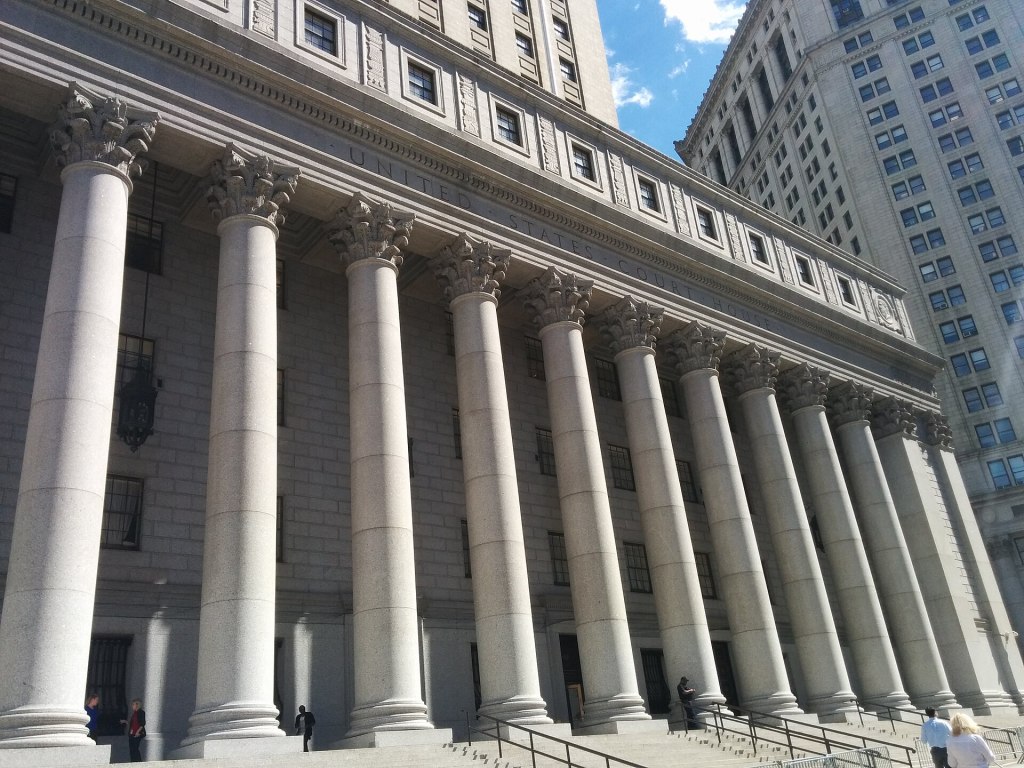
Featured image: The Thurgood Marshall United States Courthouse in Manhattan. Photo by aismallard via Wikimedia Commons, CC BY-SA 3.0.


Leave a Reply