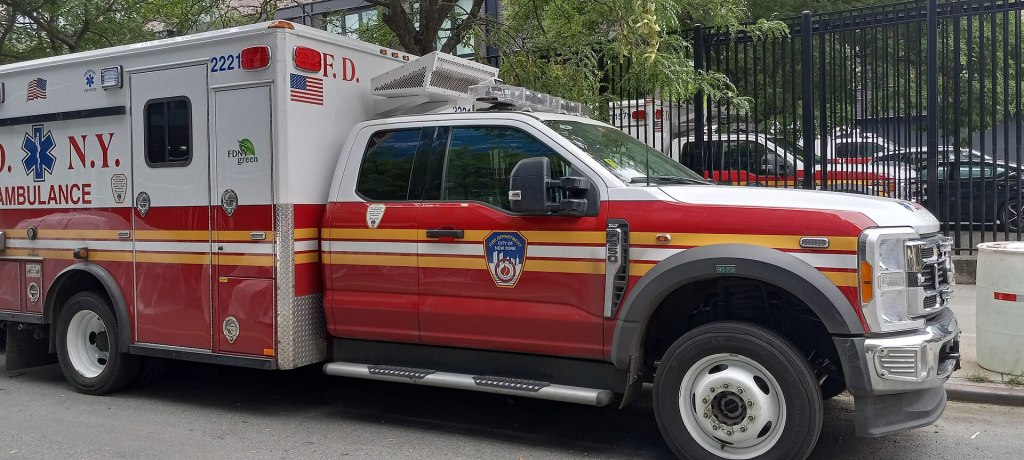
The Fire Department of New York is famous for its firefighters. Most of what it does, however, is medical work. More than three-quarters of the department’s emergency responses are medical calls, according to a report released Oct. 16 by Comptroller Mark Levine. Yet the emergency medical technicians and paramedics who answer those calls make up less than a third of its workforce and are paid far less than the firefighters they work beside.
The report is titled “A System Under Strain: FDNY EMS Operations and Fiscal Pressures.” Its conclusions are about as gentle as the title.
The clock
Between fiscal 2015 and fiscal 2026, the Comptroller’s office found, the average ambulance response to a life-threatening emergency grew by 3 minutes and 50 seconds, an increase of 41.2 percent. In fiscal 2026 it reached 13 minutes and 9 seconds, measured from the moment a 911 call enters the phone system to the moment a unit arrives. Responses to non-life-threatening calls more than doubled, rising by 14 minutes and 49 seconds.
In fiscal 2026, the report says, life-threatening emergencies took nearly as long to reach as non-life-threatening ones did in fiscal 2015. The largest contributors were the dispatch and travel segments: the time between the creation of a job and the assignment of a unit, and the drive itself.
The demand side has grown, but not as dramatically as the delays. Ambulance-handled medical incidents rose 11 percent over the period, to 1.14 million. Life-threatening incidents rose 22.9 percent. Paramedics are the only FDNY personnel credentialed to staff Advanced Life Support ambulances, and their number is about where it was a decade ago: 900 at the end of fiscal 2026.
The ambulances themselves are another constraint. On Jan. 8, 2026, the department reported 360 ambulances in service, against a daily target of 488 and a fleet roster of 651, according to the report. In the spring the target was cut to 332, a change the Comptroller’s office says it could not explain. By Sept. 14, 416 were in service.
The pay
The report’s sharpest numbers concern salaries. A first-year EMT earns $43,932. That is less than a starting sanitation worker ($47,752), firefighter ($54,122), police officer ($55,942) or correction officer ($56,838). Paramedics, who need EMT experience first, start at $58,088.
The gap widens with time. From hire through year five, EMT pay rises 56 percent and paramedic pay 49 percent, compared with 94 percent for firefighters. After five and a half years, an EMT earns a base salary of $68,700 and a firefighter $105,146.
Some of this reflects the absence of a contract. The EMS union, Local 2507 of District Council 37, has been working without one since July 29, 2022, and its current salaries reflect 2022 wage levels. The union is seeking parity with firefighters.
The exits
Unsurprisingly, people leave. From fiscal 2019 through fiscal 2026, roughly 4,300 EMTs and paramedics left their titles. That is about the same number as firefighters over the same period, even though firefighters outnumber EMTs and paramedics combined by more than two to one. Counting internal transfers, about 15 percent of EMTs and 12 percent of paramedics left their titles each year, against about 7 percent of firefighters.
Many of them did not go far. In fiscal 2026, 58 percent of EMTs who left their title became firefighters. The department’s promotional exam, given about every four years, offers EMS workers the most reliable path to a raise. When they take it, the city loses their medical training. Firefighters must hold only a basic certification, Certified First Responder with Defibrillation, rather than the EMT or paramedic credentials.
The turnover is expensive. The median EMT has spent 3.8 years in the title, compared with 8.1 years for a firefighter. EMS overtime roughly doubled between fiscal 2015 and fiscal 2026, to $69.6 million. Training costs for new EMTs rose from $15 million to more than $62 million. Fire Commissioner Lillian Bonsignore, the first former EMS responder to run the department, told a Council budget hearing in May that training a new EMT costs $41,000 and a paramedic $130,000, according to the report.
The bill
How much would it cost to stop the bleeding? The Comptroller’s office estimates that bringing EMS salaries up to firefighter levels, with the uniformed pattern of raises, would add about $289 million a year in net costs by fiscal 2027, after accounting for money already budgeted. The cumulative cost for fiscal 2023 through 2027, the contract period, would be about $1.23 billion. A more modest benchmark, matching pay at several of the city’s voluntary hospitals, would add $98 million in fiscal 2027 and $352 million over the period.
The money would have to come from the city. Ambulance billing will not cover it. Medicare pays $517 for a basic life support transport that the FDNY bills at $1,793, and Medicaid pays $250. A long-pending application to collect more federal Medicaid money has gone nowhere, and the city finally stopped counting on it in its May 2026 financial plan.
The politics
The report notes that former Mayor Eric Adams promised EMS pay equity before his election. It says Mayor Zohran Mamdani’s administration “has appeared supportive of pay raises, while falling short of calling for parity.” Changing the pay pattern would require the city’s Office of Labor Relations and DC 37 to agree to raises for EMS workers larger than those given to other civilian employees, a precedent the city’s other unions would study closely.
Mr. Levine’s office recommends that the city move quickly to a contract “with the objective of bringing EMS salaries considerably higher.” It is careful to say that pay parity alone is unlikely to substantially lower response times, and it urges the city to consider broader changes to how emergency medical service is structured and delivered.
The report was prepared by Jack Kern, a principal budget and policy analyst in the Comptroller’s office. For anyone who has waited on a curb for an ambulance lately, its central finding will not come as news. What is new is the price tag attached to fixing it.
Featured image: An FDNY ambulance in Gowanus, Brooklyn. Photo by Kidfly182 via Wikimedia Commons, CC BY 4.0.


Leave a Reply