When the tenants of Rutland Plaza went to Brooklyn Housing Court this spring, they wanted more than a repair order. They also sued the agencies that regulate and finance their building. On Oct. 18, a Housing Court judge held that a repair case cannot reach that far.
In a decision in Rutland Plaza Tenant Assn. v East 93rd St. Assoc. LP, 2026 NY Slip Op 51738(U), Judge Logan J. Schiff of the Civil Court of the City of New York, Kings County, dismissed the petition against three respondents. They are the state Division of Housing and Community Renewal; the New York State Housing Finance Agency; and Community Development of Long Island, which administers a project-based Section 8 subsidy at the complex. The case continues against the titled owner and the managing agent.
The building and the complaint
Rutland Plaza is a 438-unit, five-building Mitchell-Lama development in Brownsville. Under the state’s Private Housing Finance Law, it is a state-assisted limited-profit project. The proceeding was brought under the Housing Maintenance Code by the tenant association and 44 individual tenants, through an order to show cause dated May 22, the decision says. It seeks “to correct hazardous conditions, restore essential services, and bring the subject premises into compliance with the Housing Maintenance Code.” The index number is L&T 314452-26.
The tenants’ accounts of conditions in the complex are allegations, made in court papers and at a press conference. The court has not ruled on them.
At a June 29 rally on the courthouse steps, announced by Legal Services NYC, tenants described raw sewage on the floors, brown water from the taps, mold, broken elevators, doors that do not lock and failed security systems. According to amNewYork, the court papers say that in early May the Postal Service found the sewage smell outside the complex too hazardous for mail delivery. amNewYork also reported that the papers describe water tests finding Legionella bacteria. In the petition, amNewYork reported, the tenants’ lawyers called the agencies’ oversight “insufficient to compel meaningful compliance by owner respondents.”
The tenants and their lawyers say the landlord is Robyn Lucas-Cora, who leads the Amistad Management Corporation. She is listed as No. 6 on the city’s Worst Landlords List. Legal Services NYC also notes that in 2016 the state announced a $96 million investment to preserve Rutland Plaza. According to the tenants, that money has bought only cosmetic repairs.
amNewYork reported in June that legal representatives of the management company did not respond to its request for comment, and that a spokesperson for the state housing agency said it does not comment on pending litigation. No response from the owners to the tenants’ allegations appears in the decision.
What “owner” means
The Housing Maintenance Code defines “owner” broadly. The definition covers mortgagees and vendees in possession, receivers, executors, trustees, lessees, agents, and “any other person, firm or corporation, directly or indirectly in control of a dwelling.”
Judge Schiff agreed that the definition is broad. He wrote that the City Council had given tenants, the Department of Housing Preservation and Development and the courts “the flexibility to hold accountable any responsible party.” Officers and other stakeholders who exercise operational control, he wrote, “cannot escape liability merely by virtue of opaque corporate structures or an inaccurate HPD registration.” He also gave examples of people who can be owners: a relative managing a building for an incapacitated family member, and the executor of an estate.
But regulators, he concluded, are not owners. “With respect to the movants, there is no dispute that they have no ownership interest in the premises or any contractual or legal right to effectuate repairs or physical improvements,” the judge wrote. The agencies’ oversight is “primarily of a financial nature.” To treat that oversight as operational control “would be to stretch the statutory definition of owner in the HMC beyond its ‘natural and ordinary meaning.’”
He relied in part on a 1998 Appellate Division decision, Greenpoint Bank v John, which held that a mortgagee that is not in possession of a building is not its owner under the Multiple Dwelling Law.
The joinder argument
The tenants had a fallback argument. Section 110(d) of the New York City Civil Court Act lets the court “join any other person or city department as a party in order to effectuate proper housing maintenance standards and to promote the public interest.”
The judge rejected it for two reasons. First, he wrote, the statute “contemplates joinder by motion after commencement. It is not a license to name non-owner parties without leave of court.” Second, the provision mentions only “city department[s].” Because state entities are left out, he inferred that the legislature did not intend to allow the joinder of a state agency such as the housing division.
The finance agency and the Section 8 administrator might in theory be joined as “persons,” the court said. But the tenants had not shown how their presence in a case about conditions they do not directly oversee would improve housing standards. The judge contrasted a Kings County case from this year in which the city Department of Buildings was properly joined to an HP case about an elevator violation the department had itself issued.
He also left the tenants one opening. In a footnote, he wrote that to the extent the housing division approves repair spending at the complex, the tenants may seek “limited discovery of the relevant documentation upon a showing of ample need via subpoena.” The decision notes they have already used that tool.
What comes next
The motions were granted, and the clerk was directed to enter judgments of dismissal for the three agencies. The remaining parties are due back in court on Oct. 28 at 9:30 a.m. for a status conference.
The tenants are represented by Brooklyn Legal Services. The housing division was represented by the state Attorney General’s office, Community Development of Long Island by Farrell Fritz, P.C., and the Housing Finance Agency by Elliot Carl Edwards. The decision lists Gutman Mintz Baker & Sonnenfeldt LLP as counsel for the owners.
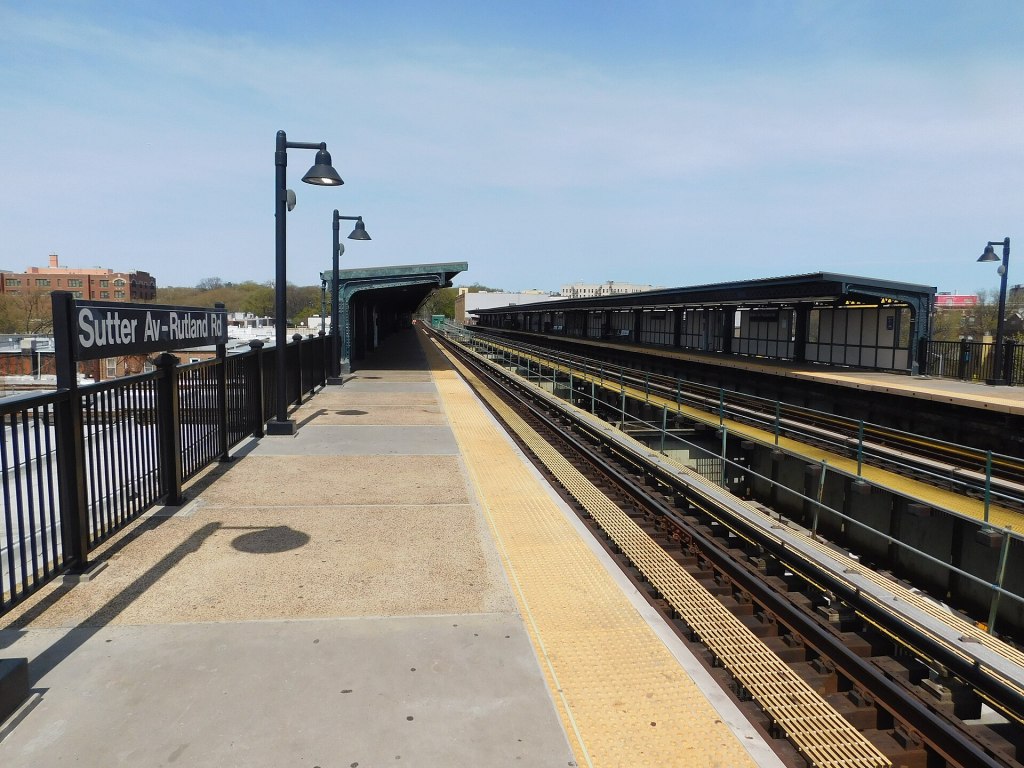
Featured image: The Sutter Avenue–Rutland Road subway station in Brownsville, Brooklyn. Photo by Adam Moss via Wikimedia Commons, CC BY-SA 2.0.


Leave a Reply