On the evening of Sept. 19, U.S. Customs and Border Protection asked the Office of Management and Budget to move $20 million into a line item for “commemorative events.” According to sworn declarations the government filed in federal court in Manhattan, OMB approved the request at 7:50 p.m., less than two hours later. The next day, CBP issued a $20 million purchase order to a contractor for a “National Media Campaign.”
The resulting television ads featured President Donald Trump. One, titled “The Country He Loves,” mixed images of the president with text such as “Largest Tax Cuts in History” and, as the plaintiffs’ complaint describes it, repeatedly flashed the words “AMERICA WILL NEVER BE A COMMUNIST COUNTRY.” The ads ran on cable news, Sunday shows and football telecasts in the weeks before the Nov. 3 midterm elections.
They are now the subject of Common Cause et al. v. Department of Homeland Security et al., No. 1:26-cv-08882 (JLR), in the Southern District of New York. For the moment, they are off the air by court order.
The parties
The plaintiffs are Common Cause; Robert Hunter, the Democratic nominee for Alabama House District 28; Service Employees International Union Local 32BJ, the building-workers’ union based in New York; and its political action committee, Empire State 32BJ SEIU PAC. The defendants are DHS and its secretary, Markwayne Mullin; OMB and its director, Russell Vought; the Executive Office of the President; and White House Chief of Staff Susie Wiles, all in their official capacities. The suit was filed Oct. 7. The Democratic National Committee filed a separate suit in Washington the same day, CNBC reported.
The order
On Sunday, Oct. 11, Judge Jennifer L. Rochon granted a temporary restraining order and a stay under Section 705 of the Administrative Procedure Act, effective at 6:45 p.m. She stayed the Sept. 20 purchase order between CBP and Lepugh, Inc., doing business as LMD Agency, Inc., and OMB’s $20 million apportionment. She barred the use of DHS funds to create or air five named ads: “The Country He Loves,” “Celebrating the Enduring Spirit,” “Final Battle,” “To the Great Proud People of Iran,” and “Maduro.” She ordered all placements canceled, including those scheduled for that evening, and enjoined LMD directly as a contractor “in active concert and participation” with the government.
The judge found the motion was not moot, despite the government’s statement that the ads would stop that day, and that the plaintiffs had standing. She found they were likely to succeed on the merits and would suffer irreparable harm. A full 40-page opinion followed on Oct. 12.
The appropriation
The money’s origin is the heart of the case. According to the opinion, it came from the July 2025 reconciliation law, which appropriated $6.168 billion to CBP for “border security, technology, and screening.” One listed category is “[c]ommemorating efforts and events related to border security.” The House Budget Committee’s report had described that category as covering line-of-duty death memorials, agency anniversaries and commendation ceremonies, with money for venues, plaques, flags and honor guards. OMB first apportioned $500,000 to it in November 2025.
The plaintiffs argue that spending it on television ads violates the Purpose Statute, 31 U.S.C. § 1301, which requires appropriations to be used for the purposes Congress set, and a rider in the appropriations act that restricts publicity and propaganda. Judge Rochon wrote that “Defendants do not contest that Plaintiffs are likely to succeed on the merits of their claims.” Their defense rested on mootness and standing.
According to CNBC, about $19 million of the $20 million had already been spent. President Trump said on Oct. 5 that he or his super PAC would pay for the ads going forward, and the White House later said he would not reimburse the government for those already aired.
The ads that kept running
The order did not reach everyone quickly. In a status letter on Oct. 12, the U.S. Attorney’s Office reported that the court had emailed the TRO at 6:46 p.m. Government counsel forwarded it to agency counsel at 7:58 p.m., but agency counsel did not see it until the next morning. “The undersigned apologizes to the Court and the plaintiffs,” wrote Jeffrey Oestericher, the assistant U.S. attorney.
Common Cause told the court that, according to AdImpact data, 570 ads ran after 6:46 p.m. that Sunday, Courthouse News reported. Mr. Oestericher told the judge at an Oct. 14 conference that he had been at a theater performance. “It was my bad,” he said, according to Courthouse News. “I messed up compliance with the TRO on Sunday night.” He suggested local broadcasters may have run “make goods,” replacement airings for preempted spots. Common Cause did not seek sanctions.
The calendar
On Oct. 14, the judge extended the order to Nov. 8, allowed limited expedited discovery, and ordered the government to explain by Oct. 15 why the ads aired on Oct. 12 despite its representations. The schedule has since shifted twice. On Oct. 22, at the government’s request and with the plaintiffs’ consent, she moved the preliminary injunction hearing to Nov. 13 at 2 p.m. and extended the restraining order to Nov. 20.
That keeps DHS money from paying for the challenged ads through Election Day. The White House, according to Courthouse News, has pointed to the president’s Oct. 5 description of them as “positive promotion for our great U.S.A.” The court’s view of whether Congress agreed to pay for that promotion will come in November.
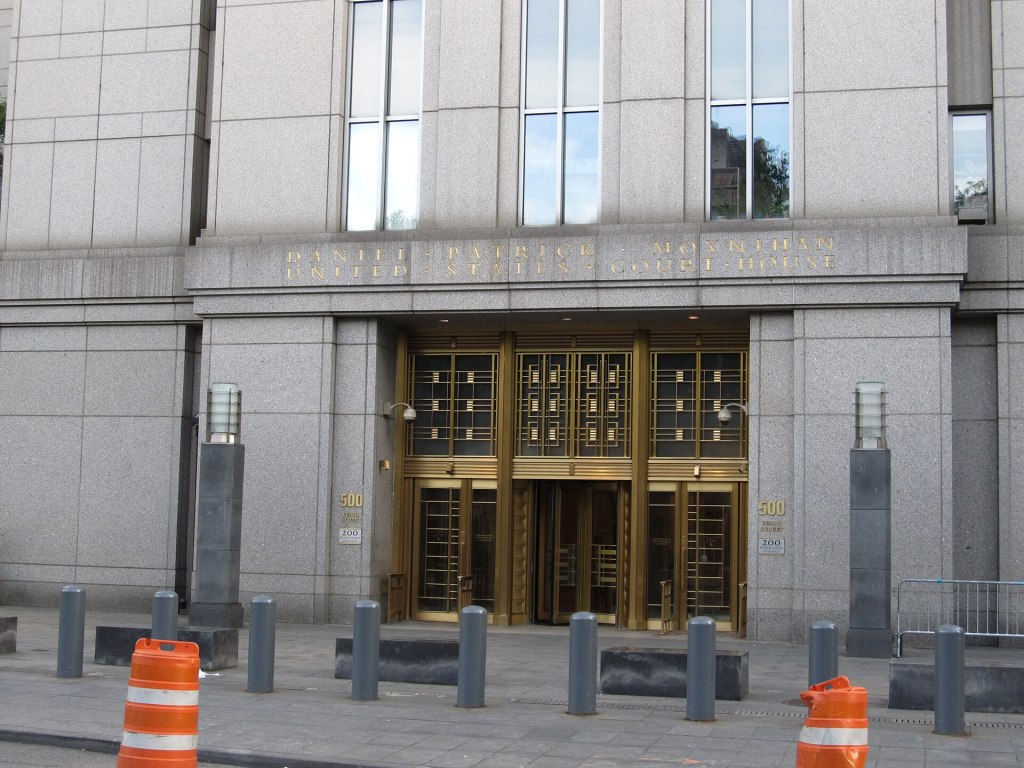
Featured image: The Daniel Patrick Moynihan U.S. Courthouse at 500 Pearl Street. Photo by Ken Lund via Wikimedia Commons, CC BY-SA 2.0.


Leave a Reply