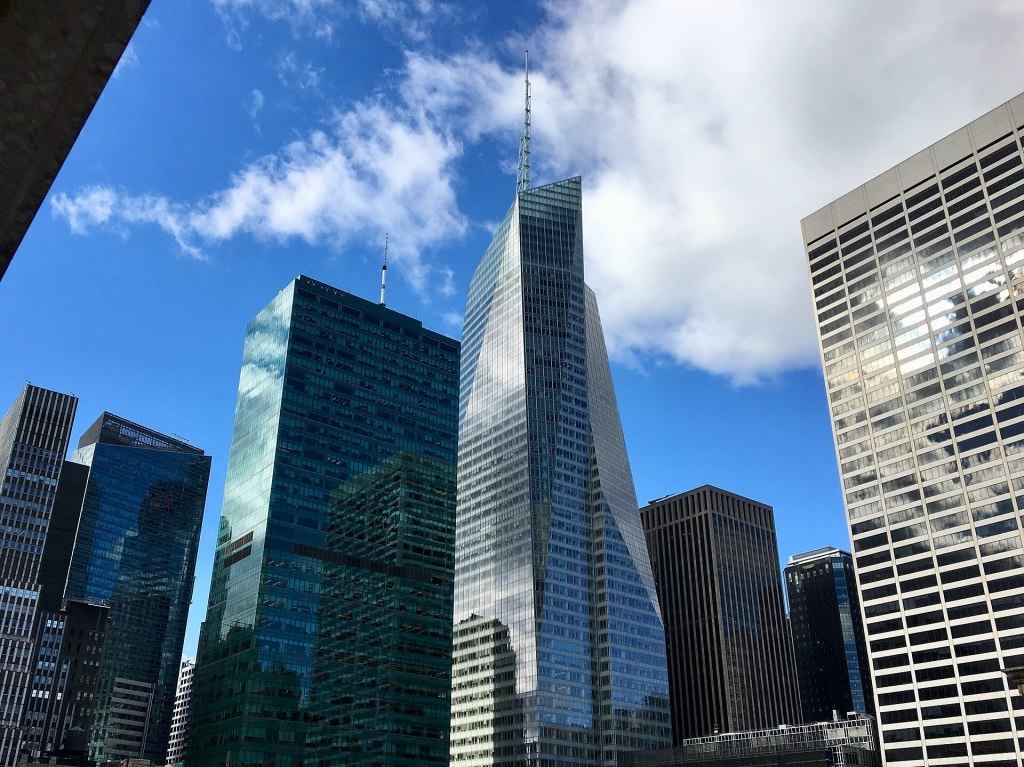
For fifteen years, the ground floor of the Bank of America Tower was where Midtown went to expense a porterhouse. Charlie Palmer’s Aureole held the rooms from 2009 until 2020, when it became Charlie Palmer Steak, which served its last plate on Feb. 29, 2024, according to The Banquet. For the next year and a half, 135 West 42nd Street was a very expensive vestibule.
On Thursday, Oct. 15, it became something considerably more ambitious, and considerably more Japanese. One Bryant Park, the restaurant that takes the tower’s name, opened its kaiseki dining room alongside Kumiko Room, a 14-seat sushi counter, with a third restaurant, Kappo Sono, to follow. The man behind all three is KwangHo Lee, who also runs Momoya, and who has evidently decided that the answer to the question “what does Midtown want for dinner?” is “three different things, each with its own reservation.”
One floor, three chefs, no compromises
Lee explained the logic to Crain’s New York Business in September, in a quote The Banquet reprinted: “We didn’t create three restaurants to cover more ground. We did it because our three chefs, Chikara Sono, Yoshihiko Kousaka, and Tadaaki Ishizaki, each had a distinct vision, and each deserved a room of their own.” Crain’s put the tenancy at about 10,000 square feet on a 15-year lease, the sort of commitment any Midtown landlord, the Durst Organization included, is pleased to see these days.
The flagship room is the kaiseki dining room. Culinary director Tadaaki Ishizaki comes from Odo, the Flatiron kaiseki restaurant, where he was culinary director under chef Hiroki Odo, and before that from Joël Robuchon’s château restaurant in Tokyo. Executive chef Shuji Furukawa, The Banquet notes, is listed by the house as a former executive chef of Restaurant Yuu, Gallery by Odo and Kyo Ya. The restaurant describes eight seasonal menus drawn from Japan’s 72 microseasons, which is seven more seasons than most New Yorkers recognize and roughly 70 more than the MTA does.
The prices, reported by Grub Street the week before opening, are $175 for five courses and $265 for eleven. That is not cheap, but in a city where a tasting counter can run well past $300 before sake, it is something like approachable, at least for a tower full of bankers.
Bread, of all things
The detail that has every food writer in town reaching for a superlative is the bread, which is strange, because kaiseki has no bread. As Grub Street’s Cathy Erway pointed out, the form traditionally rests on five techniques (raw, simmering, grilling, steaming and frying), and baking is not one of them.
Daichi Ebato, the in-house baker, has decided this is a technicality. Each kaiseki menu includes a bread course: individual loaves of kabocha brioche à tête, a sesame-ginger-raisin pain d’épi, a koji petit baguette and a scallion-poppy-seed cube, with a seaweed naruto croissant promised soon after opening. The signature is a loaf baked in an individual clay vessel from stone-ground whole wheat and Hokkaido brown mochi rice, served with komekoji-laced butter. “I really wanted that perfect balance of ‘It’s bread but it’s also rice,’” Ebato told Grub Street.
Ebato, born in New York, has worked at Runner & Stone, Hot Bread Kitchen, Daniel Boulud’s Dinex group and, he cheerfully admits, Le Pain Quotidien. “Being Japanese American was always a big part of my identity,” he told Grub Street. The bread, he suggested, is how he explores that. And then the restaurant sends you home with more of it: a parting box with a walnut-and-red-bean anpan, a black-and-white melon pan that nods to the New York cookie, and a small buckwheat focaccia topped with shishito peppers. One imagines a great many of these being eaten on the 7 train platform.
The counter and the one still coming
Kumiko Room, named for the Japanese wood lattice that lines it, has its own website, its own Resy page and its own reputation. Its chef, Yoshihiko Kousaka, spent 11 years as head sushi chef at Jewel Bako before opening Kosaka, which Michelin gave a star. Robb Report, cited by The Banquet, put the seasonal omakase at $325: three small dishes, 10 to 14 pieces of sushi, soup and dessert. Kousaka has said he is returning to an older style of omakase built around rice and fish, rather than the snack parade that precedes nigiri at many counters.
The third room, Kappo Sono, is a relocation of chef Chikara Sono’s former 12-seat counter on East 13th Street. Eater has its opening in mid-November; on opening day, The Banquet found its site giving only the new address.
Drinks come from a list of more than 500 wines and sakes, plus Japanese whisky, with cocktails by John Shin, who opened the bar at Torrisi. There is some confusion about scale: The Banquet reports the house lists the dining room at 60 seats plus a 20-seat bar, while other reports have given larger figures for the whole floor. Either way, it is a lot of omakase for one block of 42nd Street.
Why it matters
Midtown has spent five years being told it is over: the offices empty, the lunch trade gone, the steakhouses shuttered. A restaurateur signing a 15-year lease for three serious Japanese rooms across from the New York Public Library is a wager against that narrative, and an elegant one. Lee is betting that the people who still work in the towers want something more interesting than the porterhouse that used to occupy this space.
Will they come for eleven courses on a Tuesday? The early evidence is that the bread alone may do the trick.
The City Politic has reached out to One Bryant Park and KwangHo Lee for comment and will update this story with any response.
Photo: The Bank of America Tower at One Bryant Park. Zheng Zhou / Wikimedia Commons, CC BY-SA 4.0.


Leave a Reply