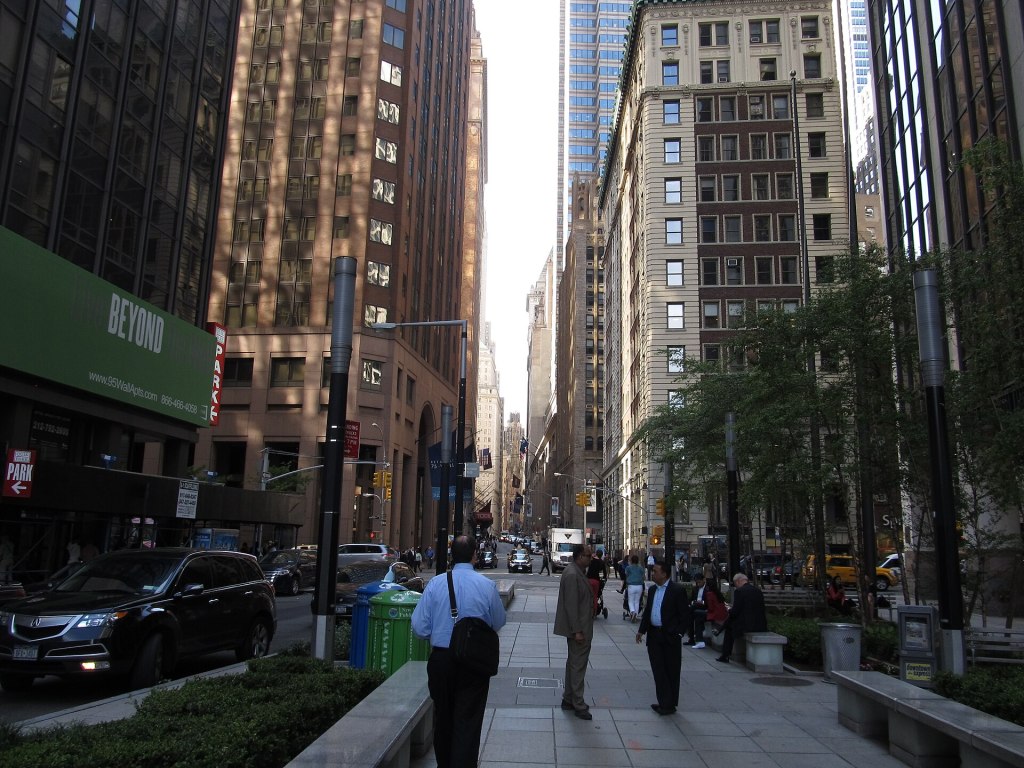
For most of the last century, the surest way to empty a Midtown office building was to wait for a recession. The newer method is to wait for a lender. In the space of a few October days, three separate Manhattan office properties, on East 57th Street, on East 59th Street and on Wall Street itself, have moved decisively toward a second life as apartments, and the money behind them suggests that the office-to-residential conversion has graduated from a panel-discussion talking point to a line of business.
Fifty-Seventh Street, minus the cubicles
The largest of the bets is on the Upper East Side’s commercial fringe. As Commercial Observer’s Andrew Coen reported on Oct. 15, CSC Real Estate, the firm of Alberto and Salo Smeke, has landed $83.5 million from BridgeCity Capital to turn 136 East 57th Street into a 136-unit rental building. The 20-story, 92,582-square-foot tower went up in 1931; CSC bought it in March from Cerco Funding for $10 million, and the loan closed on Oct. 13, according to the trade paper.
Do the arithmetic and the story tells itself. A building that changed hands for roughly $108 a square foot this spring now carries a loan more than eight times its purchase price, which is another way of saying that nobody involved thinks the value is in the existing offices. The value is in the bedrooms that do not yet exist. BridgeCity’s EJ Ehrlich, quoted by Commercial Observer, put it in the language lenders prefer: “BridgeCity is excited about this transaction, given the property’s exceptional location and the strength of the underlying business plan.”
The location is, in fact, the argument. Commercial Observer notes that the building sits across the street from TF Cornerstone‘s Tower 57 at 135 East 57th Street, a block of Lexington-adjacent Manhattan that has spent decades as a corridor of dentists, showrooms and mid-tier corporate leases. What it lacks in glamour it makes up for in subway lines.
Two blocks north, a filing in 24 hours
A short walk away, a smaller operator has moved at a speed that would impress a day trader. The American Developer, working from public records, reports that Astor & Rowe paid $9,072,581 for 330 East 59th Street, with the deed dated Sept. 10, and that a Department of Buildings application to convert the eight-story office building into 24 apartments, adding a ninth story, was filed the very next day, with Palette Architecture listed as applicant. The New York Business Journal reported the plan in September, and the deal-tracking site Traded lists an $8 million acquisition loan from Derby Copeland Capital.
The filing, per The American Developer, describes duplexes, fitness space and ground-floor retail, and it remains in plan-examiner review rather than approved. That caveat matters: a DOB application is a statement of intent, not a certificate of occupancy. But closing on a Thursday and filing on a Friday is not the behavior of a buyer who intends to re-lease the fourth floor to an accounting firm.
Wall Street keeps the top, sells the bottom
Downtown, the conversion is literally half-hearted, and the more interesting for it. Northwind Group announced in a press release that it has provided a $219 million first-mortgage construction loan for 100 Wall Street, the 29-story, roughly 463,000-square-foot tower owned by a joint venture of BLDG Management and David Werner Real Estate Investments. Floors two through 11 are to become 168 rental apartments; floors 15 through 29 stay offices and, according to the release, are more than 95 percent occupied. The new loan replaces existing debt and expands an earlier $95 million Northwind acquisition loan on the same building. The American Developer, which headlined it as Northwind’s second conversion loan in four days, clearly noticed the pattern too.
The split is the tell. The upper floors of a Financial District tower, with views and light, still lease. The lower floors, with deep, dim floor plates that once suited trading desks, apparently pencil better as apartments than as offices. It is the real estate equivalent of a family selling the downstairs of the townhouse to pay for the upstairs.
What the market is actually saying
None of this is new in concept. Lower Manhattan has been turning bank buildings into lofts since the 1990s, and every recent mayor has given a speech about it. What has changed is the financing. In each of these three deals, the headline is not a developer’s rendering but a lender’s check, and lenders are not, as a class, sentimental. They are betting that rent from a studio on East 57th Street, or a one-bedroom on Wall Street, will reliably exceed what the same square footage could earn as a Class B office.
There are, as always, reasons for caution. Conversions are notoriously expensive; plumbing, light and air requirements do not care how cheaply the shell was bought, and a 1931 building has its own opinions about where kitchens can go. Construction timelines run long, and the political conversation about how much of any new housing should be affordable has not gone away. The figures above describe financing and filings, not finished apartments, and The City Politic would not advise anyone to sign a lease at 330 East 59th Street just yet.
But as a reading of the market, these deals are hard to misinterpret. A $10 million office building on 57th Street is being financed as a $90-plus million residential project. An eight-story office building on 59th Street was bought and refiled for apartments inside a single business day. And one of Wall Street’s office towers has decided that it would rather be two-thirds office and one-third home than all office and partly empty.
The old joke was that the only thing harder than finding an apartment in Manhattan was finding a tenant for a Midtown office. It appears someone has finally solved both problems at once, one capital stack at a time.
The City Politic has reached out to CSC Real Estate, BridgeCity Capital, Astor & Rowe, Palette Architecture, Northwind Group, BLDG Management and David Werner Real Estate Investments for comment, and will update this story with any response.
Photo: Looking down Wall Street, Manhattan, by Ken Lund via Wikimedia Commons, CC BY-SA 2.0.


.jpg)
Leave a Reply