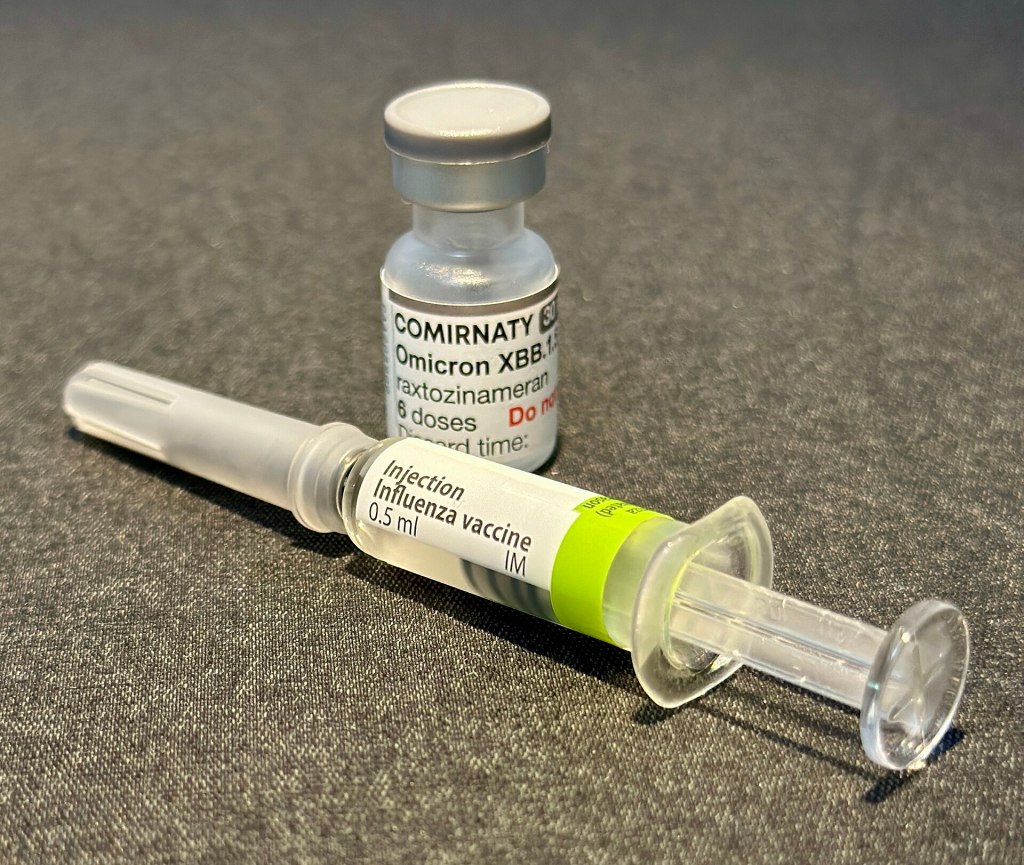
There are certain rituals that mark the true start of a New York autumn: the first night the radiator clanks on, the first sighting of a Canada Goose parka on the 1 train, the first sneeze in a crowded elevator followed by a silence of almost Victorian disapproval. Officially, the season has another marker, and the state’s top doctor rolled up his sleeve for it last week.
On Oct. 9, State Health Commissioner Dr. James McDonald received his 2026-2027 COVID and flu vaccines and urged New Yorkers to do the same, the New York State Department of Health announced; Governor Kathy Hochul also got her flu shot, the department said. “Last year, thousands of New Yorkers were hospitalized and more than 1,000 died from flu and COVID,” McDonald said. “Last year does not have to be this year.”
The numbers behind the needle
The state’s figures for the 2025-2026 respiratory season are sobering. Nearly 27,000 New Yorkers were hospitalized with influenza and nearly 600 died, the department said; more than 13,000 were hospitalized with COVID-19 and nearly 500 died. A September release from the city and state put last season’s RSV hospitalizations at 14,000.
In the city specifically, the New York City Health Department recalls the timing as much as the totals. “This past winter, New York City saw a sharp increase in reported flu cases in late November and December,” Health Commissioner Dr. Alister F. Martin said in a joint city-state announcement on Sept. 10. That is, precisely, the season of office parties, crowded flights home and the Rockefeller Center tree. The state notes that flu season usually runs October through May and typically peaks between December and February; the city’s guidance to providers calls September and October the best months to get vaccinated.
Whose guidance, exactly
The most interesting thing about this year’s campaign is not what officials recommended but whom they cited. In September, the city and state jointly endorsed the respiratory virus immunization recommendations released by the American Academy of Pediatrics, the American Academy of Family Physicians, the American College of Obstetricians and Gynecologists and the Infectious Diseases Society of America, in collaboration with the American Medical Association and the Vaccine Integrity Project. Those recommendations, the release said, rest on “peer-reviewed scientific data from nearly 300 studies.”
The state’s October release adds that its COVID guidance also aligns with consensus recommendations from the Northeast Public Health Collaborative, a group of Northeastern states and municipalities that includes New Jersey, Pennsylvania, Massachusetts, Connecticut, Maine, Rhode Island and New York City.
That a city and state should turn for vaccine guidance to medical societies and a regional compact of neighbors, rather than leaning on federal advice alone, says a good deal about the current climate in national vaccine policy without anyone saying it out loud. For New Yorkers, the practical upshot is clarity. The city’s guidance: everyone 6 months and older should get an annual flu shot. Most people 6 months and older should get a COVID-19 vaccine, which is especially important for children 6 to 23 months, older adults, pregnant people, people with weakened immune systems and those at high risk. RSV immunization is recommended for infants whose mothers weren’t vaccinated in pregnancy, certain higher-risk toddlers, adults 75 and older and higher-risk adults 50 to 74 who haven’t had one, and pregnant people in their first eligible pregnancy.
And you can get the flu and COVID shots at the same time, which, for a population that regards any errand requiring two trips as a personal affront, may be the most persuasive fact of all.
The new shot in the room
There is genuine novelty this year. In August, the Food and Drug Administration approved Moderna‘s mFLUSIVA, the first mRNA influenza vaccine, for people 50 and older. The state’s release notes that trial results suggest it is as effective as a high-dose vaccine for adults over 65 and may offer greater protection against laboratory-confirmed flu than a standard-dose shot in adults. It is covered by commercial insurance, Medicaid and Medicare and available at participating pharmacies. The state advises adults over 50 to ask a provider or pharmacist whether it’s right for them.
Where and what it costs
Under the Affordable Care Act, the state notes, most private plans, Medicare and Medicaid cover flu, COVID and RSV vaccines without cost-sharing at in-network providers and pharmacies. The uninsured can get shots free through participating community health centers and local health departments. In the city, the NYC Health Map lists vaccination sites and will be updated as supplies arrive; most neighborhood pharmacies have walk-in shots. Flu vaccine is available at pharmacies without a prescription for anyone over 2; younger children get it at the pediatrician.
The doctors, meanwhile, are making the rounds. Dr. Isaac Dapkins, chief medical officer of the Family Health Centers at NYU Langone, appeared on NY1 on Oct. 14 to encourage viewers to get their flu and COVID shots.
Wellness, the unglamorous kind
This magazine has spent a good deal of ink lately on the city’s more fashionable forms of self-care: the cold plunge, the communal sauna, the members-only bathhouse. All of it has its place. But the most effective wellness intervention available to a New Yorker this month costs, for most people, nothing, takes about fifteen minutes at the Duane Reade on the corner, and doesn’t require a membership committee.
“Vaccination is the best protection to help keep ourselves and our families healthy,” McDonald said. It is not, admittedly, a very sexy sentence. Neither is spending the second week of December in bed.
The City Politic has reached out to the New York City Health Department and the New York State Department of Health for comment and will update this story with any response.
Photo: A COVID-19 vaccine vial and a flu vaccine. Whispyhistory / Wikimedia Commons, CC BY-SA 4.0.


Leave a Reply