Two weeks from tomorrow, tens of thousands of people will stand on the Verrazzano-Narrows Bridge in the early-morning cold, wearing garbage bags and expressions of grim optimism, and wait for a cannon. This is the week they are supposed to be resting. It is also, for many of them, the hardest part of the training: the taper, when the miles drop, the nerves rise, and every twinge in the left knee becomes a subject of intense private study.
The 2026 TCS New York City Marathon runs on Sunday, Nov. 1. It is, by the numbers, the most coveted race in the world’s most running-obsessed city, and this year it carries an anniversary: 50 years since the race first left Central Park to cross all five boroughs, on Oct. 24, 1976, as Gothamist noted.
One percent
Getting to the start line has never been harder. New York Road Runners, the race’s organizer, received more than 240,000 applications for this year’s drawing, almost 20 percent more than last year’s record, and accepted about 1 percent of them, the lowest rate ever, Runner’s World reported in March. Time qualifiers did not have it much easier: NYRR took only the top 10 percent of non-NYRR marathon qualifiers, meaning runners needed to beat their age-group standard by at least 22 minutes and 52 seconds.
The alternative routes are their own sociology. A record 670 charity partners are fielding runners this year, Runner’s World reported; last year, charity runners raised a record $80 million for more than 600 charities. NYRR members could enter a second-chance drawing with acceptance of up to 2 percent. There was even a sweepstakes.
“Year after year, the TCS New York City Marathon unites runners of all ages and abilities who believe in the power of every step to transform lives,” NYRR chief executive Rob Simmelkjaer said in announcing the drawing.
Last year’s race set the record as the largest marathon in history, with 59,226 finishers in Central Park, according to Runner’s World, of whom 2,396 broke three hours and 20,047 broke four.
A new route through the Bronx
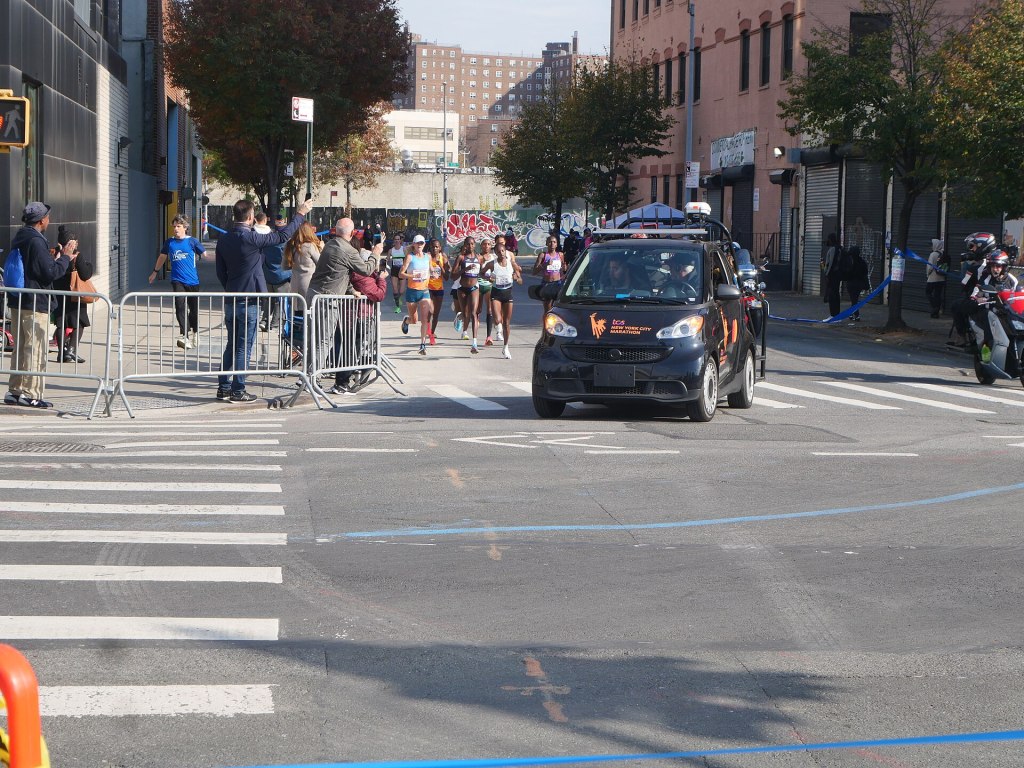
For the first time in 15 years, the course itself has changed, if only a little. NYRR announced in September that runners will take a slightly different path through the South Bronx, Gothamist reported, to “minimize the race’s impacts on the Bronx, as the neighborhood has evolved over the past 50 years.” Runners still enter the borough over the Willis Avenue Bridge, turn onto East 135th Street and then Alexander Avenue. But instead of turning left on East 138th, they now continue up Alexander to East 141st Street, then turn onto Third Avenue and back onto East 138th, into Manhattan over the Madison Avenue Bridge.
NYRR spokesperson Liv Ren told Gothamist the change, the product of a lengthy 2024 assessment, will improve access to local businesses. Justin Mashia, co-founder of the Bronx running and walking group Bronx Sole, welcomed it, noting that the area’s only supermarket sits on East 140th Street. “I’m glad they’re listening to the Bronxites in that community because our voices often times go unheard,” he told Gothamist. “There’s no energy like big Bronx energy so I believe the new path is just going to shift, not stop the crowd support.”
For runners, the practical note is simple: mile 20 has a new shape. Study the map.
The field up front
At the sharp end, NYRR has assembled what it billed in August as a deep anniversary field: three defending champions, 40 Olympians and Paralympians, 25 Olympic, Paralympic and World Championships medalists and 22 national record holders, per ABC7. Hellen Obiri and Benson Kipruto of Kenya and Marcel Hug of Switzerland return to defend their titles, joined by former champions including Sheila Chepkirui, Geoffrey Kamworor, Tatyana McFadden and David Weir. The Americans are led by Weini Kelati in her marathon debut, with Conner Mantz, Joe Klecker, Jess McClain and Zouhair Talbi. Finishers will receive a medal designed to honor 50 years of medals, which Simmelkjaer unveiled on ABC7 this month.
The wellness religion
What the numbers describe is something bigger than a race. Running has become New York’s dominant wellness faith, practiced at dawn along the West Side Highway and in Prospect Park by run clubs that double as dating apps and networking events. The marathon is its high holy day, and the lottery its velvet rope. In a city that has spent this fall debating the price of a sauna session and the exclusivity of private clubs, it is worth noting that the most oversubscribed membership in New York is the right to run 26.2 miles for free, or at least for the price of an entry fee and four months of early mornings.
For those who got in, the advice from every coach is the same: trust the taper, sleep more than you think you need, don’t try anything new on race day, and ignore whatever your colleague says about carbo-loading. For the other 99 percent, there is a different assignment. The race begins on Staten Island at 8 a.m., Gothamist reports, and the field, ABC7 notes, numbers nearly 60,000 participants. Pick a corner, preferably in the Bronx, where the course is new, and cheer. More than two million spectators line the route, ABC7 reports. It is the single best day to be a New Yorker, and it requires no lottery at all.
The City Politic has reached out to New York Road Runners for comment and will update this story with any response.
Photo: The women’s leaders on East 138th Street in the Bronx during the 2023 marathon. Jim.henderson / Wikimedia Commons, CC BY 4.0.


_jeh.jpg)
Leave a Reply