Tonight, if the schedule holds, the New York Philharmonic plays Berlin. It is the latest stop on a ten-concert European tour, the orchestra’s first under its new music and artistic director, Gustavo Dudamel, and it comes at the end of a first month in New York that the orchestra itself has documented with the breathless enthusiasm of a wedding album. Having now read the album, we can report that the enthusiasm is, for once, mostly earned.
A month, in order
The Philharmonic’s own chronicle of the opening month, published Oct. 7, is worth reading in full, not least for its photographs. The broad outline: on Sept. 10, Dudamel opened the season not at David Geffen Hall but at Radio City Music Hall, in a concert hosted by Liev Schreiber with guest turns from Lizzo, St. Vincent, Aaron Tveit and Joaquina, and orchestral works by Gershwin, Jessie Montgomery, Philip Glass and Arturo Márquez. The after-party, at the Rainbow Room, had a DJ set by Mark Ronson, who, the orchestra helpfully notes, is a Philharmonic board member.
The next day, the mood turned. On Sept. 11, at the Perelman Performing Arts Center at the World Trade Center, the orchestra marked the 25th anniversary of the attacks with a memorial concert that included Bernstein’s “Make Our Garden Grow” and the world premiere of We the Living, with music by Julia Adolphe and text by Safiya Sinclair. Five days after that, the subscription season opened with John Adams’s On the Transmigration of Souls, the Philharmonic’s 9/11 commission and a Pulitzer winner, performed by the orchestra for the first time since its 2002 premiere. Adams came to the stage afterward.
Then came, in the orchestra’s tally, “the third World Premiere in as many weeks”: Tania León’s Imágenes Mestizas on Sept. 24, paired with Mahler’s Fifth Symphony, the piece with which Dudamel won the inaugural Mahler Conducting Competition in 2004. Zosha Di Castri’s Invisible House, a co-commission with the LA Phil, had been premiered on Sept. 16. Between those concerts, Dudamel sat down with Lin-Manuel Miranda for a conversation at the Delacorte Theater in Central Park.
The gala, and the guests
The Sept. 30 Inaugural Gala, presented in partnership with Rolex, is where the society pages and the music pages converge. Per the Philharmonic, the program, titled La PanAmericana, included Ginastera, J.B. Plaza, Gabriela Ortiz, Gabriela Lena Frank and Ellington, with Brian Stokes Mitchell singing Sondheim and Strayhorn and the pianist Sergio Tiempo giving the U.S. premiere of a suite by, of all people, Anthony Hopkins. Steven Spielberg was in the audience and was surprised, the orchestra says, when Dudamel conducted a selection from John Williams’s score for Spielberg’s latest film. Governor Kathy Hochul presented Dudamel with a plaque at the dinner celebrating his arrival as an adopted New Yorker. Alec Baldwin, board member and radio host, gave remarks.
The next two nights brought Lang Lang in Beethoven’s “Emperor” Concerto and Yo-Yo Ma in Osvaldo Golijov’s Azul, the latter attended by Mayor Zohran Mamdani, who visited Ma backstage. On Oct. 3, the orchestra screened a new director’s cut of Alberto Arvelo’s documentary Tocar y Luchar, about Venezuela’s El Sistema, the program that produced Dudamel.
What it adds up to
A cynic would note that a first month assembled from Radio City, Lizzo, Spielberg, Lang Lang, Yo-Yo Ma and a governor’s plaque is less a season than a coronation, and that coronations are easy. The test of a music director is not the first month; it is the third February. That cynic would not be wrong.
But the substance of the month is more interesting than its glitter. Three world premieres in three weeks, by Di Castri, León and Adolphe, is a serious commitment to living composers, and putting León, a Pulitzer winner and Philharmonic board member, next to Mahler on a subscription program sends a message about what Dudamel thinks belongs together. Reviving the Adams for the 25th anniversary was the right call. And the PanAmerican gala program, Ginastera to Ellington, was a statement of identity: Dudamel is telling New York that the Philharmonic is an orchestra of the Americas, not merely an outpost of Vienna on Broadway.
It also matters, in a city that has spent years arguing about the renovated Geffen Hall, that the new director began by taking the orchestra out of it, to Radio City, to the World Trade Center, to the Delacorte. A music director who treats the whole city as his concert hall is doing something his predecessors talked about more than they did.
On the road
The orchestra describes the current tour, EUROPE 2026, as ten concerts in cultural capitals over less than two weeks. It began in Paris on Oct. 9 and 10, with programs drawn from the opening month, León and Mahler on one night and Prokofiev, Adams and Di Castri on the other, and its itinerary takes in Barcelona, Madrid, Berlin and Hamburg before it closes in Vienna on Oct. 21 and 22. Taking the 9/11 piece and three new American-commissioned works to European audiences is an unusually confident touring repertoire. There is Mahler and Prokofiev in the bags, too, but the headline is that this orchestra is touring its own news.
When the orchestra returns, the harder part begins: the long middle of the season, the weeknight subscription concerts, the patience of the city’s most demanding audience. For now, though, Dudamel has done the thing that new music directors in New York rarely manage. He has made the Philharmonic a story people outside the concert hall want to follow.
The City Politic has reached out to the New York Philharmonic and to representatives for Gustavo Dudamel for comment, and will update this story with any response.
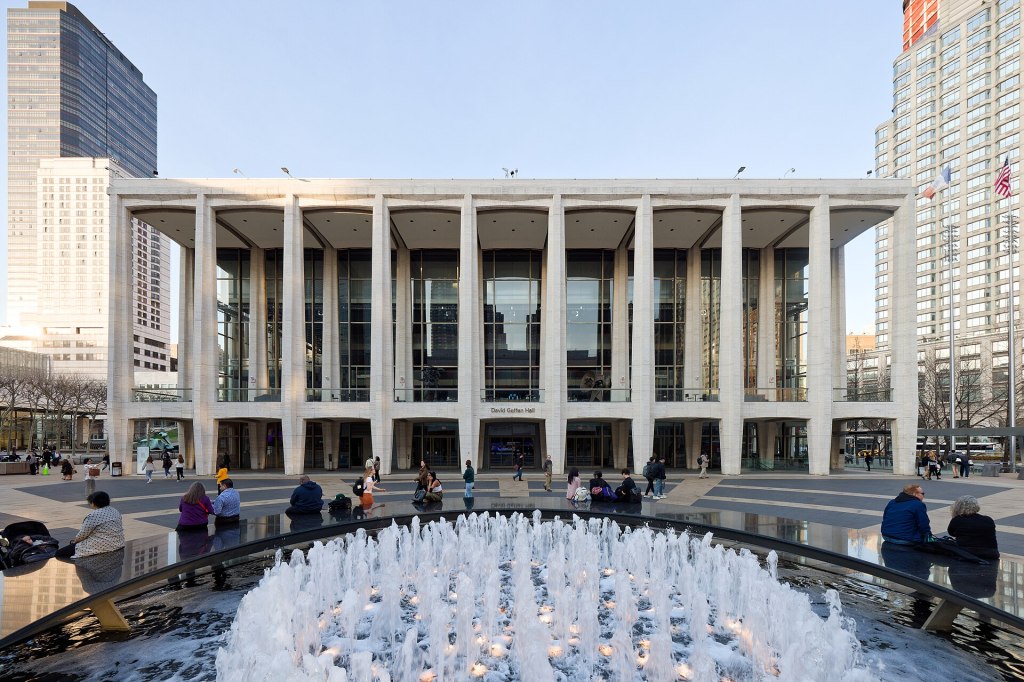
Photo: David Geffen Hall, March 14, 2024, by D. Benjamin Miller via Wikimedia Commons, CC0 (public domain dedication).


Leave a Reply