There is a particular kind of farewell tour that New York does better than anyone: the kind where the person leaving built the building. On Jan. 29, Jazz at Lincoln Center announced that Wynton Marsalis, its founder and artistic leader for nearly 40 years, would step down as artistic director after the current season. Now that season, titled “Come Home,” is in full swing, and the October calendar reads less like a concert schedule than a family reunion with a horn section.
The plan
The terms of the transition, as laid out in the organization’s January announcement, are notably gentle. Marsalis remains artistic director through the 2026–27 season. Beginning in July 2027, he moves into an advisory role on staff, as founder, through the end of his contract in June 2028, after which he will serve on the board “as Founder in perpetuity.” He will also step back from his duties with the Jazz at Lincoln Center Orchestra, though the organization says he will still play with it “on occasion and at select concerts.”
The board set up two committees: one to work with Marsalis on identifying the next generation of artistic leadership, and another to find a new executive director to replace Greg Scholl, whose resignation took effect in June. That second search has concluded; Marsalis’s official site reports that the organization named Weston Sprott executive director. The first search is still open. The January announcement set a goal of “identifying a new Artistic Director by fall 2026,” and in the new structure the artistic director and executive director will serve “as equal partners reporting to the Board.” It is now fall 2026. The jazz world is, to put it mildly, watching the door.
October, in the House of Swing
The October calendar, announced Sept. 28, is a showcase of the people and traditions Marsalis championed. Catherine Russell opened the month on Oct. 2 and 3, marking her 70th birthday with Cyndi Lauper as special guest. Steve Miller returned on Oct. 9 and 10 for his tenth year on the Rose Theater stage, the same nights trombonist Wycliffe Gordon, an original member of the Wynton Marsalis Septet and the Jazz at Lincoln Center Orchestra, presented his musical autobiography, Welcome to Georgia Town, in the Appel Room.
This weekend belongs to Chucho Valdés, who celebrates his 85th birthday in Rose Theater on Oct. 16 and 17, with Joe Lovano, Terence Blanchard, John Patitucci, Marcus Gilmore and Roberto Jr. Vizcaino Torre. The press release calls Valdés “one of the great and true maestros of the world,” a phrase which, for once, contains no exaggeration.
Then, on Oct. 23 and 24, Marsalis himself leads the orchestra in “From Cuba to the Crescent City,” a program built from three of his own suites, Ochas, Afro! and Congo Square, with guests Pedrito Martinez, Weedie Braimah and the vocalist Shenel Johns. Before the Saturday concert, the organization has partnered with HeadCount to register voters in the atrium, part of what it calls its JazzCall for Freedom initiative, which, per the release, “uses jazz to reaffirm democratic values throughout America during this period of extreme political polarization.” That is a sentence few arts institutions would put in a press release this year. Marsalis has never been shy.
The man and the institution
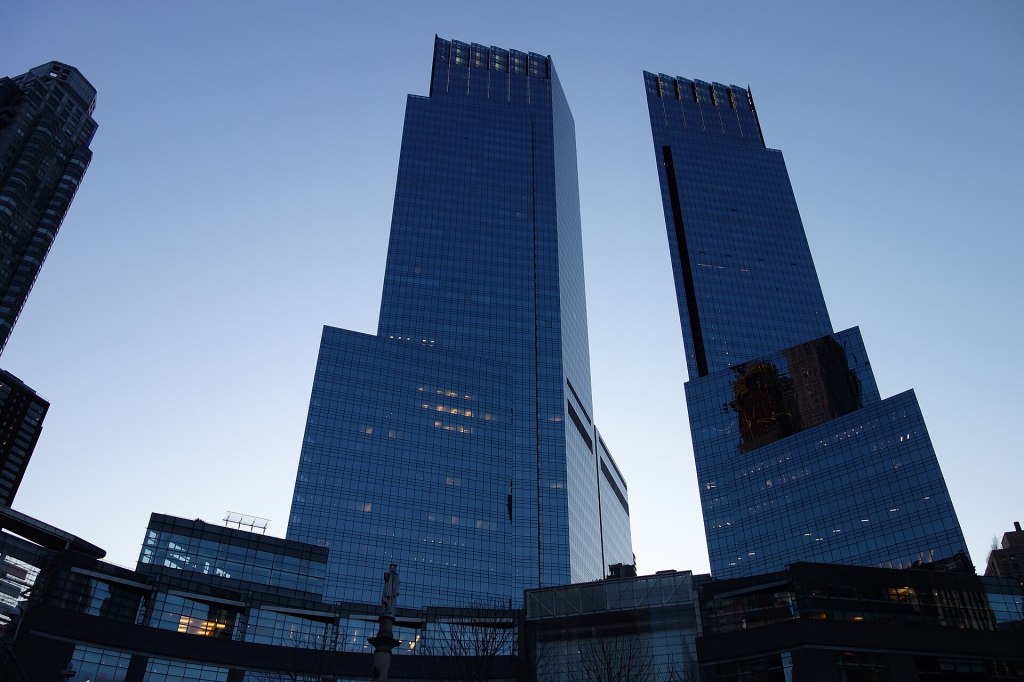
It is hard to overstate how unusual the Marsalis story is. As the January announcement recounts, Jazz at Lincoln Center began as a summer concert series in 1987, and under his leadership became an institution owning and operating Frederick P. Rose Hall, the House of Swing, at Columbus Circle. It has a resident orchestra, a record label, the Essentially Ellington high school competition and a recognized place as a Lincoln Center constituent alongside the opera, the ballet and the Philharmonic. That is not a career; it is a civic project.
It has also, over the years, attracted its share of argument. Marsalis’s definition of jazz, rooted in swing, blues and the New Orleans tradition, has been praised as a necessary act of preservation and criticized as narrow. That debate is old, and it is not The City Politic’s to settle. What can be said is that the October programming, with its Cuban maestro, its Georgia gospel, its New Orleans suites and its Cyndi Lauper cameo, is a broader tent than the caricature allows.
His own words, in the January release, were characteristically direct. “It is time for new leadership to take the institution to even higher ground,” he said. “We are rich in emerging, extremely talented, capable, and inspired musicians and advocates. I’m very confident about the future.” Clarence Otis, the board chairman, said in the same release: “While Wynton’s shoes will be challenging to fill, we are confident that we will bring in the right leader.”
A month of farewells
Marsalis will be busy elsewhere this month, too. He is among the speakers at the New Yorker Festival, Oct. 23 to 25, where, according to Variety, he is scheduled to appear in conversation with the magazine’s Nick Trautwein. Expect the question of succession to come up. Expect him to answer it with a story about Louis Armstrong.
The season runs through June 19, 2027. That leaves eight months for the board to name a successor, and for the rest of us to take stock of what one trumpeter built at the corner of Broadway and 60th Street. The concerts, as ever, start at 7:30. The tickets, for once, feel like history.
The City Politic has reached out to Jazz at Lincoln Center and to representatives for Wynton Marsalis for comment, and will update this story with any response.
Photo: Columbus Circle and the former Time Warner Center, home of Frederick P. Rose Hall, by Tdorante10 via Wikimedia Commons, CC BY-SA 4.0.


Leave a Reply