Madison Avenue has never lacked for places to buy a $500 pair of jeans. What it has lacked, until this week, is a place to buy them, order a barley cappuccino and line up a shot at a pool table built in Naples by a company older than the Brooklyn Bridge. Today, Tuesday, Oct. 27, the Italian denim house Jacob Cohën opens its first American store at 790 Madison Avenue, on the corner of 67th Street, and it has arrived with the air of a guest who intends to stay for dinner.
The store, first detailed by WWD’s Jean E. Palmieri and reported by FashionUnited and FashionNetwork, is a 3,121-square-foot corner space in a 1960s modernist building, with a dozen large windows, six on each floor. Women’s clothes are on the ground floor. Men’s are upstairs, in what the brand’s president, Jennifer Tommasi Bardelle, describes to WWD as a “gentleman’s club.”
A denim dynasty, a long way from Long Island
The story of how a Long Island-born, Milan-based executive came to open a jeans store on Madison Avenue is more operatic than most retail announcements, and Tommasi Bardelle tells it with the candor of someone who has outlasted most of it.
According to WWD, the brand was founded in 1985 by Tato Bardelle, whose family manufactured jeans for some of the world’s best-known labels and created the Americanino line. He named the new premium label for Jacob Davis, the tailor who invented the riveted jean, and added “Cohën” to honor the Jewish heritage of Levi Strauss. The family’s fortunes collapsed in the 1990s; they filed for bankruptcy, and the name went dormant.
In 2002, Tato’s son, Nicola Bardelle, revived it as a luxury men’s jean, cut from Japanese fabrics and finished with jeweled buttons, shirt-fabric linings and pony-hair back labels. “He started with two fabrics in three washes,” his widow told WWD. Then, in August 2012, while visiting Saint-Tropez, where the brand had just opened a store, he was killed in a motorcycle accident, leaving her with two small children.
“Jacob Cohën was our third child,” she said. Getting it back took a dozen lawsuits over the license, according to WWD. When they were resolved in 2023, she took control of the brand and named Luca Roda, a longtime supporter of the company, chief executive.
The gentleman’s club, upholstered
The store, designed by Storage Milano with Tommasi Bardelle, is a study in expensive textures. Walls and ceilings are finished in hand-applied cement plaster. The floor is gray klinker tile laid in herringbone. Leather covers the walls, the displays and, most dramatically, a staircase with hand-wrapped wood moldings under a backlit skylight. That staircase alone took a month and a half to complete, WWD reported, and pushed back the opening.
Denim, naturally, upholsters the wall panels. The upstairs bar is finished in denim and wood, set against orange-toned textured glass, with furnishings made in collaboration with the Italian furniture maker Asnaghi. The fitting rooms have ribbed velvet walls in beige and blue, which, Tommasi Bardelle told WWD, staff will need to comb several times a day. There are, one suspects, few retail jobs in Manhattan whose duties include grooming the walls.
The barley cappuccino, she said, is something she discovered at a European spa and already serves at the company’s Milan store. It is a pointed choice: caffeine-free, faintly virtuous, and exactly the sort of thing a man in a $500 pair of jeans can order while his wife shops downstairs, or vice versa.
The jeans themselves
None of this would matter if the product were ordinary, and Jacob Cohën’s selling point is that no two pairs feel quite alike. Each pair has its own patch and buttons, the linings are individualized, and the men’s jeans come with a matching bandana, details that change every season. Most styles retail for around $500, according to WWD, with limited editions going higher.
The store is also a hedge. “Denim is still at our core, but how many jeans can people have,” Tommasi Bardelle said, which is why the racks also carry outerwear, knitwear, blazers, trousers and T-shirts. The brand already sells wholesale at Bergdorf Goodman and Neiman Marcus, and operates stores in Paris, Milan, Saint-Tropez, Geneva, Tokyo and elsewhere. Rather than open a showroom, the company will use Madison Avenue as its American calling card. “This is my business card,” she said. As for why New York first: it is the state where she was born, and, as she put it, “It’s a statement.” Miami, Palm Beach and Aspen are next on her wish list.
Madison’s men’s-club moment
Jacob Cohën is landing on a street in the middle of a very particular kind of reinvention. For much of the past decade, upper Madison was a byword for empty storefronts. This fall, it looks more like a land rush, and a noticeably masculine one.
The Strategist’s fall store roundup counts Dunhill heading to 821 Madison, near Paul Smith and the bespoke tailor Thom Sweeney, which opened in June, forming what the site calls “a semi–Savile Row.” Paul Smith’s new two-story flagship, as FashionNetwork described it on Oct. 15, is modeled on the designer’s own house in London’s Holland Park, complete with a study, a “Jet Lag Room” for tailoring and a speaking tube to the cash desk. Danny Power, Paul Smith’s regional president, called it “a commitment to our ambitious plans for growth.” Meanwhile, WWD reports that Etro is marking 30 years on the avenue.
What these stores have in common is that they are not really selling clothes, or not only. They are selling rooms: a London townhouse, an Italian club, a place to sit down. In an era when anyone can order a pair of jeans from a phone, the luxury store’s job is to be the one thing the phone cannot be, which is somewhere to go. On Madison, that increasingly means somewhere to go if you are a man of means who would rather not be dragged to Fifth Avenue.
Will it work?
The risk is obvious. American denim is the most crowded category in fashion, and Jacob Cohën is asking New Yorkers, who own more jeans than they will admit, to pay a premium for an Italian take on an American invention. Tommasi Bardelle knows it. In a statement quoted by WWD, she called the opening “a major milestone” that means “competing in the home market of denim.”
But the store’s real wager is on the Upper East Side’s oldest instinct: that a good room, a good drink and a well-cut pair of trousers are worth crossing the park for. If the velvet walls stay combed and the cappuccino stays hot, it may be a sound bet.
Storage Milano, the store’s architects, did not respond to a request for comment.
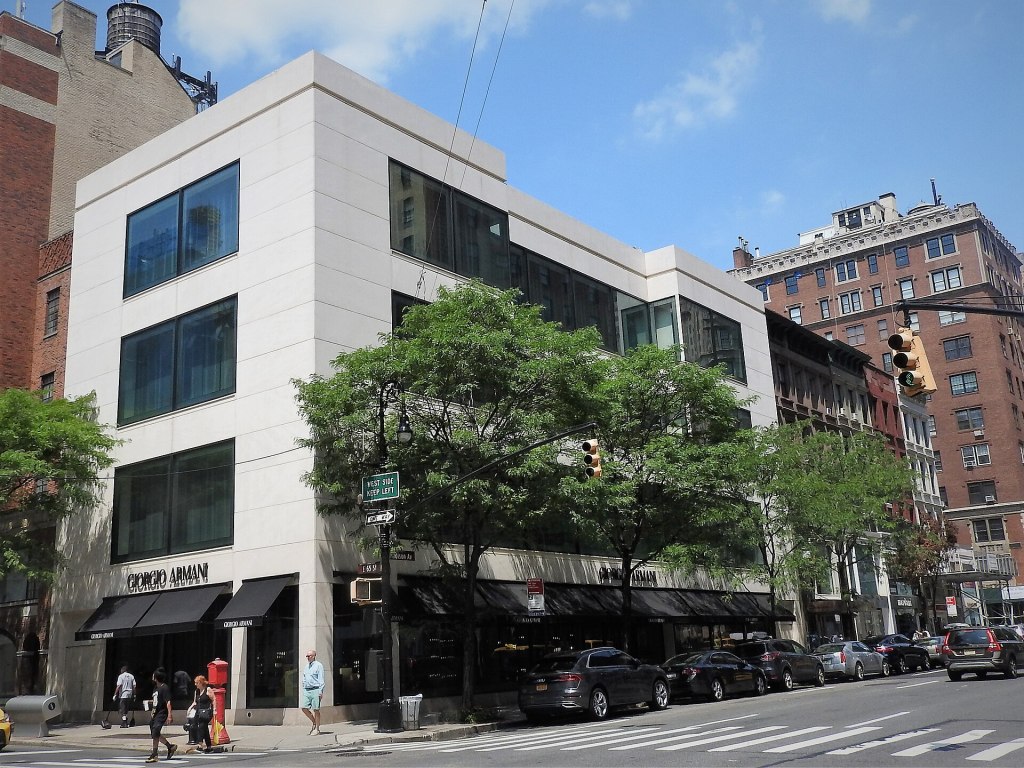
Featured image: Madison Avenue at East 65th Street, two blocks south of Jacob Cohën’s new flagship, in August 2019. Photo by Jim Henderson via Wikimedia Commons, CC BY-SA 4.0.


Leave a Reply