For most of the last four years, Rep. Tom Kean Jr. was the kind of Republican the party’s strategists liked to build a majority around: a known name in a swing seat, the son of former Gov. Thomas H. Kean, fiscally conservative and socially moderate, comfortable in the country clubs of Westfield and the farm towns of Hunterdon and Warren counties alike.
With early voting under way in New Jersey as of Saturday and Election Day on November 3, that profile has not kept two of the party’s biggest outside groups in his corner. The party’s House campaign committee has stayed, and Kean’s campaign insists the race is going down to the wire.
The money walks
On October 13, the New Jersey Globe reported, following The New York Times, that the Congressional Leadership Fund, the super PAC aligned with Speaker Mike Johnson, and President Trump’s Affordability and Safety PAC were withdrawing their remaining advertising investments in New Jersey’s Seventh District. The money was redirected to defend Republican incumbents in districts Trump carried by far larger margins. The Seventh, by the Globe’s count, went for Trump by about a point in 2024.
The National Republican Congressional Committee has not left. It has promised to match Bennett’s spending down the stretch, and Kean has pointed to $6.2 million in NRCC support, The Guardian reported on Saturday.
Kean’s top strategist, Harrison Neely, told the Globe the withdrawals changed little. “Anyone who understands this race knows it’s going down to the wire — including the Bennett campaign,” he said. “If Bennett’s team was popping champagne at headquarters this morning, I suspect they’ll be reaching for a mop once reality sets in.”
Neely made the same case to The Guardian. “If you take a step back and look at the facts, Republicans have outspent Democrats in this district to this point,” he said. “Our campaign is fully funded down the home stretch, and will be matching the Bennett campaign dollar for dollar on the airwaves.”
Bennett’s spokesperson, Carly Jones, answered on X that the CLF pullout represented “at most, 13% of R’s total spend against Rebecca,” The Philadelphia Inquirer reported.
The numbers
The Federal Election Commission’s pre-general reports, covering activity through October 14, show a challenger who has outraised an incumbent, though Kean ended the period with more cash in the bank. Rebecca Bennett, the Democratic nominee, has raised about $8.76 million this cycle and had about $1.05 million on hand, according to FEC data. Kean has raised about $6.13 million and had about $1.37 million on hand. He had raised $4.89 million as of June 30, so the last three and a half months brought in roughly $1.2 million. Bennett announced $4 million raised since the start of July.
The forecasters have moved with the money. The Cook Political Report shifted the race from toss-up to lean Democratic last month, and the Inquirer reported that three prominent forecasters now rate it that way. Trump’s approval in New Jersey stood at 24 percent in an October 1 Rutgers-Eagleton poll.
The absence
The other storyline in this race is one that Kean himself put on the record. He was absent from Congress and largely from public view for more than three months earlier this year, missing about 100 votes, The Guardian reported. When he returned at the end of June, he said he had been hospitalized for depression.
The candor was welcome; the timing drew criticism, including from his own party’s leader. “You know, if it were me, I would have done it a little sooner,” Johnson told The New York Times in August, according to The Guardian. Ashley Koning, director of Rutgers’ Eagleton Center for Public Interest Polling, told the Inquirer that the combination of national frustration and his absence was “a perfect storm against Kean.”
The campaign has since been accused by national outlets of keeping reporters at arm’s length. Neely rejects that. “I think the narrative that congressman Kean doesn’t engage with the press is simply false,” he told The Guardian, adding that Kean “does more local press engagements than any sitting member of the New Jersey delegation.” Neely said the campaign had most recently challenged Bennett to a debate on WRNJ, a local radio station, and that her campaign declined.
The challenger
Bennett, 39, is a former Navy helicopter pilot and aircraft commander from Bridgewater and a former executive at Midi Health, a telemedicine company focused on women’s health. Even Republican strategists describe her as a nominee in the moderate mold of Gov. Mikie Sherrill, also a former Navy helicopter pilot, who won the governorship by 14 points last year and carried Kean’s home turf of Westfield and Summit.
She has run on affordability, gun safety and stock trading. “I approve this message because the Navy taught me service over self. So I’ll never take corporate money. I already sold my stocks,” she says in one ad. At a September debate she accused Kean of signing off on stock trades during his leave; Kean replied that his signature is legally required but he has no input into how his money is invested. “I’ve not traded an individual stock since I’ve been a member of Congress,” he said. His attorney told the New Jersey Monitor an outside firm manages the investments independently.
Kean’s own ads have gone after Bennett’s business record, calling her “a greedy, liberal millionaire who doesn’t care about you” and tying her to a Midi Health partnership with Lifepoint Health, a private equity-owned hospital chain, the Inquirer reported.
The issues where Kean breaks
Kean has also used the campaign to put daylight between himself and the president on a few home-state issues. At the September 28 debate, he spoke out for the first time against a proposed Immigration and Customs Enforcement detention center in Roxbury, in the district, and stressed his support for the Gateway tunnel. “I will make sure that I counter anybody who gets in my way, including this president,” he said.
On the defining vote of the year, though, he has stayed with his party. Kean voted against both House resolutions to direct the removal of U.S. forces from hostilities with Iran, in March and September. He also voted for the One Big Beautiful Bill Act, and Bennett has promised to roll back its Medicaid cuts. Kean, for his part, has touted his role in restoring the state and local tax deduction through 2029, a real win in a high-tax district.
What to watch
The Seventh has flipped back and forth since 2018. Kean’s allies argue his roots run deep enough to outrun the national tide. “I’d put this in the toss-up category,” Bill Palatucci, a Republican National Committee member close to the family, told the Inquirer, pointing to Warren and Sussex counties, which he called “deep, deep red.”
Watch the early-vote numbers in Somerset and Union, where Bennett needs a Sherrill-sized margin, and turnout in Warren, Sussex and Hunterdon, where Kean needs his base to show up in force. If the super PACs’ decision to leave proves right, it will be one of the clearest signals of the night that the House is changing hands. If Kean holds on, it will be a reminder that a family name, a local base and a few well-chosen breaks with the White House can still outrun a national tide.
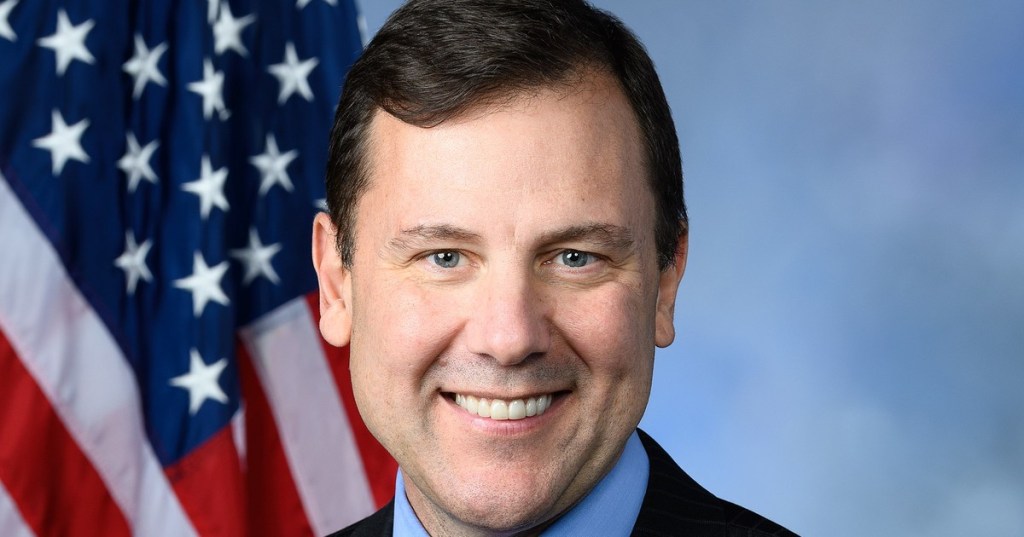
Featured image: Rep. Tom Kean Jr., official portrait, 118th Congress. Photo by Office of Congressman Tom Kean via Wikimedia Commons, public domain.


Leave a Reply