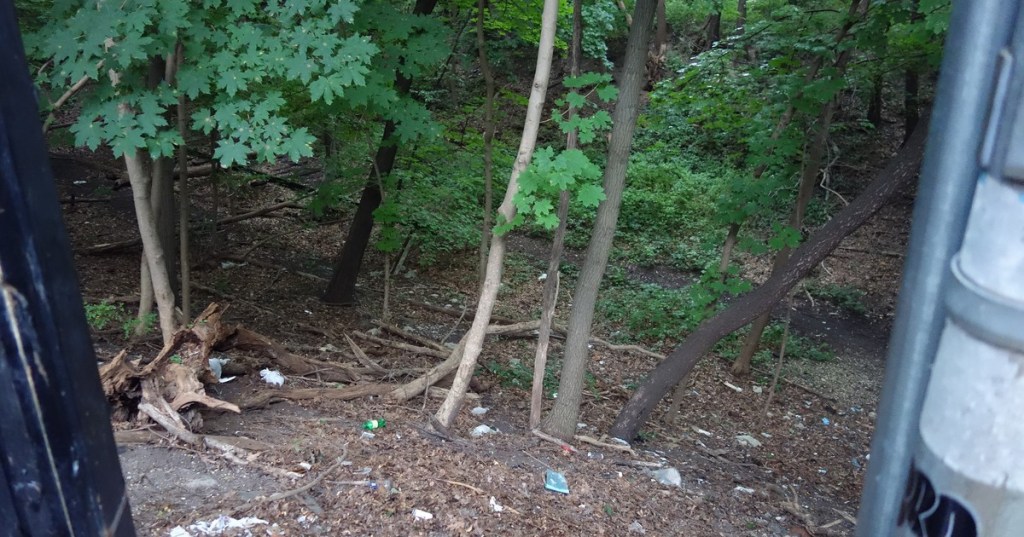
Since 1962, a 3.5-mile ribbon of former Long Island Rail Road track has run through central Queens, carrying nothing but sumac, ailanthus and an argument. The argument, in its modern form, goes like this: the old Rockaway Beach Branch should become a park, the QueensWay, or it should become a train line again, the QueensLink. Each side has spent the better part of a decade explaining why the other is a fantasy.
On October 14, at Borough Hall in Kew Gardens, Queens Community Board 6, which covers Forest Hills and Rego Park, tried something more Queens than either. By a vote of 26 to 9, it endorsed the first phase of the park, and then, in the same resolution, asked the city and state to take the train seriously too, the Queens Chronicle reported.
What the board actually said
The resolution backs QueensWay Phase 1, which the city calls the Metropolitan Hub: a five-acre stretch of park running from Metropolitan Avenue to Union Turnpike, with $43 million in the city’s capital budget and construction expected this fiscal year. It also calls for planning on a second phase of the park, for a city-state interagency panel to study reactivating rail service, and for the QueensLink to be included in both the city budget and the Metropolitan Transportation Authority’s capital plan.
John Dereszewski, who chairs the committee that drafted the resolution, steered it through a debate that the Chronicle’s account suggests was civil but not quite settled. Heather Beers-Dimitriadis argued that the language had a “slant towards the QueensWay.” Peter Beadle defended it as “realistic,” on the theory that a funded park in hand beats a rail line in a study. Latrice Davis put the board’s thesis most simply: there is “room for both.”
The two advocacy camps both heard what they wanted. A QueensLink spokesperson called the vote a “landslide win” for transit. John Surico of Friends of the QueensWay was more diplomatic about the rail question: “we leave that decision-making to the MTA and New York State.”
The money and the mayor
The park has the money; the train has the momentum of an idea that refuses to die. When Mayor Zohran Mamdani released his budget this spring, Streetsblog reported, it preserved roughly $43 million for the Metropolitan Hub, more than the $35 million his predecessor, Eric Adams, had promised. That alarmed rail advocates, including Andrew Lynch, who argued that building park infrastructure on the right-of-way would make a train harder to build later.
The irony was not lost on anyone. Mamdani, a Queens assembly member before he was mayor, appeared at a QueensLink rally in 2023 and told the Queens Eagle in 2025 that the project was “very important to me,” according to Streetsblog. His spokesperson, Jeremy Edwards, said at the time that “The City remains committed to expanding green and open space,” a sentence that commits the city to exactly as much as it says.
The numbers on the rail side are contested in the way transit numbers usually are. QueensLink’s advocates project about 75,000 daily riders, with the M train rerouted from 63rd Drive–Rego Park down to Rockaway Park–Beach 116th Street. The MTA’s 20-Year Needs Assessment put the cost at $5.9 billion and estimated about half the ridership advocates claim. Janno Lieber, the MTA’s chief, has been skeptical, though Streetsblog noted he called the advocates’ approach “legit,” which from Lieber is practically a love letter.
The QueensLink did get a modest federal boost: $500,000 for studies through an agreement with the Federal Highway Administration, the Chronicle reported. Half a million dollars is a lot of money for a study and not much money for a subway.
Why the vote matters
Community boards in New York are advisory. They cannot fund anything, build anything or stop anything. What they can do is tell the people who fund, build and stop things what the neighborhood will tolerate, and Board 6’s message was that it will not accept being made to choose.
That position has costs. A park built on the right-of-way may complicate a future rail line; a rail line held open indefinitely may mean a right-of-way that stays fenced and overgrown for another decade. The board’s answer is to build the park’s first phase where the money already is, and to push Albany and the MTA to answer the rail question on its merits instead of letting it die by default. It is, in short, an attempt to make the agencies do the hard part.
The politics, notably, do not sort neatly by party. The park appeals to neighbors who want green space now; the train appeals to transit advocates and to the Rockaways, whose trips into Manhattan are among the longest in the city. Neither cause belongs to the left or the right, which may be why the issue has outlasted several mayors.
What’s next
Construction on the Metropolitan Hub is expected to begin within the fiscal year, which ends next June. The interagency panel the board requested has not been announced. The MTA’s next capital plan will be the real test of whether the QueensLink is a project or a slogan.
Queens has not settled what to do with an old railroad. Board 6 has at least made sure that whoever settles it will have to say so out loud.
Featured image: The former Rockaway Beach Branch right-of-way seen from Myrtle Avenue in Forest Park, Queens, in 2019. Photo by Tdorante10 via Wikimedia Commons, CC BY-SA 4.0.


Leave a Reply