There are few rooms in New York politics as reliably cheerful as a room full of toddlers, and Mayor Zohran Mamdani and Gov. Kathy Hochul chose one with trampolines. At a Bronx trampoline park on Oct. 19, the mayor and the governor announced that the city’s free child care program for 2-year-olds, known as 2-K, will grow by 10,000 seats in the fall of 2027. It will reach 17 more school districts, including every district in the Bronx and on Staten Island.
The math, laid out in a City Hall release, is the kind a campaign manager dreams about. The program now runs in five districts: 6, 10, 18, 23 and 27. Next fall it will run in 22 of the city’s 32. More than 12,000 children are expected to be enrolled. Beyond the Bronx and Staten Island, the expansion reaches Manhattan’s Districts 4 and 5, Brooklyn’s Districts 16, 17, 19, 20, 21 and 32, and Queens’ Districts 24, 28 and 29.
“From Co-op City in the Bronx to Staten Island’s South Shore, we’re bringing 2-K to every borough,” the mayor said. That is the sort of line meant to be repeated on doorsteps. It also describes a geography that does not usually vote the same way twice.
The demand was never in question
The first round of 2-K, announced on the eighth day of the Mamdani administration, offered 2,000 seats in five districts. Families submitted more than 5,700 applications for them, according to the administration. A waiting list nearly three times the size of the program is not proof that a policy works. It is proof that families want it, and the administration has spent the weeks since treating that number as a mandate.
The money is the more interesting story. The expansion runs on $1.2 billion in state funding that Ms. Hochul committed to the city’s child care push. The governor has spent much of her tenure trying to persuade suburban and upstate voters that she understands what it costs to raise a child in this state. Being photographed beside the city’s democratic-socialist mayor at a children’s attraction in the Bronx is not, on its face, an obvious way to do that. That both of them showed up says something about where each thinks the votes are on child care.
Schools Chancellor Kamar Samuels offered his blessing, as did Emmy Liss, executive director of the Mayor’s Office of Child Care and Early Childhood Education. “We have learned valuable lessons from parents and providers as we launched the first 2,000 seats this year,” Ms. Liss said. The release also carried endorsements from Council Speaker Julie Menin, Public Advocate Jumaane D. Williams and Comptroller Mark Levine, followed by roughly three dozen more from legislators, unions and advocates. In this City Hall, that counts as a quorum.
The two-year question
The cheerful part of the announcement ends where the funding does. Tara N. Gardner, who speaks for the Day Care Council of New York, put it plainly in a statement included with the city’s release. “With funding identified for only two years, community-based providers need a long-term commitment,” she said.
That sentence is worth reading twice. Under the city’s plan, 2-K is delivered through center-based child care programs and licensed family child care programs, as a full-day, full-year service. Much of that network is community-based: the nonprofit centers and home-based providers that carried the city’s early-childhood system long before anyone called it universal. Ms. Gardner’s statement also called for “equitable compensation” for a workforce she described as underpaid. Those providers sign leases, hire teachers and buy cribs on a timeline longer than a state budget cycle. A program that doubles and then doubles again needs them to keep saying yes. A two-year funding window gives them reason to hesitate.
The administration appears to know this. The release says the city will, within a week, issue a survey to providers that already contract with the school system and a request for information to new providers interested in offering 2-K. It also points to an August overhaul of early-childhood contracting and a plan to hire more than 200 staff at the school system to process it. That is the right order of operations. It is also an admission that the city does not yet know how many seats the existing network can absorb, or where.
Where the districts fall
Choosing whole boroughs is a political statement as much as a logistical one. The Bronx was the natural first stop. Raysa S. Rodriguez of the Citizens’ Committee for Children noted in the release that 47.3 percent of children in East Tremont lived in poverty in 2024. Staten Island is another matter. It has rarely been friendly territory for a progressive mayor, and putting the South Shore in the first sentence of the mayor’s quote was not an accident.
The Brooklyn list leans toward the borough’s eastern and southern districts. In Queens, the program goes to Districts 24, 28 and 29, a belt of the borough’s working- and middle-class neighborhoods. Manhattan’s two additions, Districts 4 and 5, cover East and Central Harlem.
That leaves 10 districts out of the program even after next fall. They include much of brownstone Brooklyn, most of Manhattan below 96th Street and a stretch of northeast Queens. Parents there may notice. So will the Council members who represent them. Council Member Simcha Felder, whose southern Brooklyn district is getting seats, has already said he wants 2-K made “truly universal, including for children with special needs.”
What to watch
The next milestones are bureaucratic, not ceremonial. The provider survey and request for information will show whether the community-based network can scale. The application timeline for fall 2027, which the city says it will announce in the coming weeks, will show whether demand in the new districts matches the original five. And the state’s next budget, negotiated in Albany next spring, will show whether the $1.2 billion becomes a down payment or a ceiling.
For now, 10,000 more families have something to plan around, and the people who will care for their children have a two-year promise. In this business, a two-year promise is a good start. It is not a finished policy.
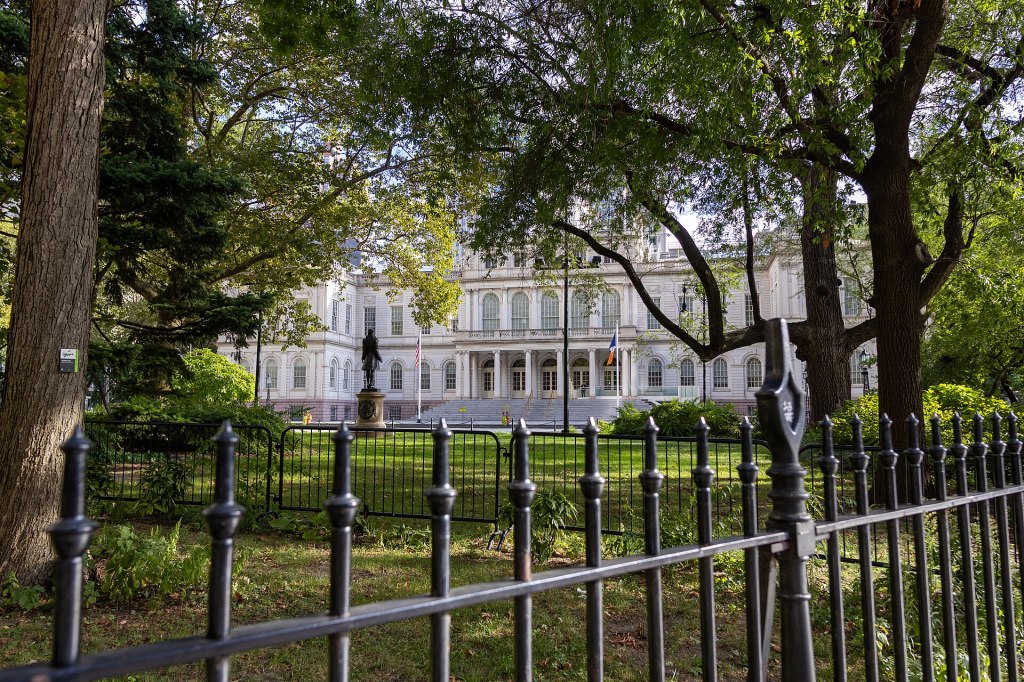
Featured image: New York City Hall, September 2025. Photo by Nielsoncaetanosalmeron via Wikimedia Commons, CC BY 4.0.


Leave a Reply