Harvard University has an endowment of about $68 billion. On Tuesday, the people who cook and serve its undergraduates’ meals voted, by a wide margin, to authorize a strike over wages, health insurance and the summer months when many of them have no income.
The vote was 548 to 67, with two ballots spoiled, according to UNITE HERE Local 26 as reported by The Harvard Crimson. That is 89 percent of those who cast ballots. The authorization does not start a strike. It gives the union’s bargaining committee the power to call one at any time. No deadline has been set.
Three unions, one autumn
Harvard Dining Services workers are not alone. As Harvard Magazine reported on Oct. 23, the University could soon face several simultaneous strikes. The graduate workers’ union has set a strike deadline of Tuesday, Oct. 27. A day before the dining vote, Harvard Academic Workers-United Auto Workers, which represents about 2,500 non-tenure-track faculty, postdoctoral fellows, research associates and others, announced that its members would walk off the job on Nov. 10 if no agreement is reached. That union, certified in 2024, is still seeking its first contract.
The money
The dining workers have been without a contract since June 19, according to The Crimson. The union and the University have met seven times since talks began in March.
Local 26 represents nearly 900 campus dining workers, according to Harvard Magazine. Full-time workers earn slightly more than $30 an hour, but because most dining employees work only during the academic year, that comes to less than $46,000 a year. Part-time workers make closer to $18,000. The union says dining workers at Northeastern make about a dollar more per hour and those at MIT about $5 more.
“For many, many, many years, Harvard had a wage scale significantly above other universities and colleges in the Boston area,” Carlos Aramayo, the president of Local 26, told Harvard Magazine, “and that’s frankly no longer the case.”
“A university that has over 60 billion dollars in its endowment should do everything it possibly can to make sure all these folks who work hard to feed the students get paid not just what somebody at Lesley gets paid down the street, but frankly, more,” he said at a press conference on Tuesday night, according to The Crimson.
The second issue is health insurance. A union steward said at a September rally that Harvard dining employees already pay more for coverage than dining workers at any other Boston university, The Crimson reported, and that Harvard’s latest proposal would raise costs further. “People don’t want to get a wage increase and then use all of that wage increase to keep their healthcare,” Mr. Aramayo said.
The third is the summer. Harvard dining workers are employed directly by the University and technically remain employed all year, so they cannot collect state unemployment when the dining halls close, Harvard Magazine explained. At many institutions, dining is run by outside contractors whose workers can collect benefits in the off months.
Harvard’s position
A Harvard spokesperson told Harvard Magazine that the University had offered a 6.9 percent wage increase through July 1, 2027, which would bring the average hourly wage to just over $32, and an increase of 18.7 percent over six years. “We believe that a strike is unwarranted and ask union leadership to continue meeting in good faith to reach a deal soon,” the statement said. The University said it was waiting for a response to its latest wage proposal.
Mr. Aramayo told The Crimson the union was considering a deadline. “I do think the clock is ticking a little bit here,” he said. “Folks have been working without a contract now for the entire semester.”
The 2016 precedent
Harvard has been here before. In October 2016, dining workers stayed off the job for 22 days. The walkout forced the University to close several dining halls and run the rest with managers, reassigned staff and temporary workers, The Crimson recalled. The union won a new contract. Undergraduates organized in support then, and they are doing so again. More than 1,000 Harvard College students have signed a petition from the Student Labor Action Movement, a program of the Phillips Brooks House Association, urging a fair contract.
“Today, these workers are ready to do that again,” Mr. Aramayo said.
The academic workers
The non-tenure-track faculty union is closer to a deal on some issues, according to Harvard Magazine. Julien Foriel, a member of its bargaining committee and a research scientist in Earth and Planetary Sciences, said the University has shown willingness to eliminate the “time caps” that force some non-tenure-track faculty to leave after two, three or eight years. Harvard’s offer of Oct. 19 would give union members a 3.5 percent raise on ratification and 15.75 percent over six years. Mr. Foriel said salaries have been frozen for two years.
A Harvard spokesperson said in that case that the two sides “have made significant movement toward an agreement” and that the University does not believe a strike “is warranted or necessary.”
“We hope that we can reach a deal,” Mr. Foriel said. “But if administration will not give us the basic demands that we have, we will have to strike, and we will.”
The graduate workers’ deadline arrives Tuesday. The academic workers’ follows on Nov. 10. The dining workers can choose their own moment. Harvard’s administration may soon learn how many of its employees can stop work at once.
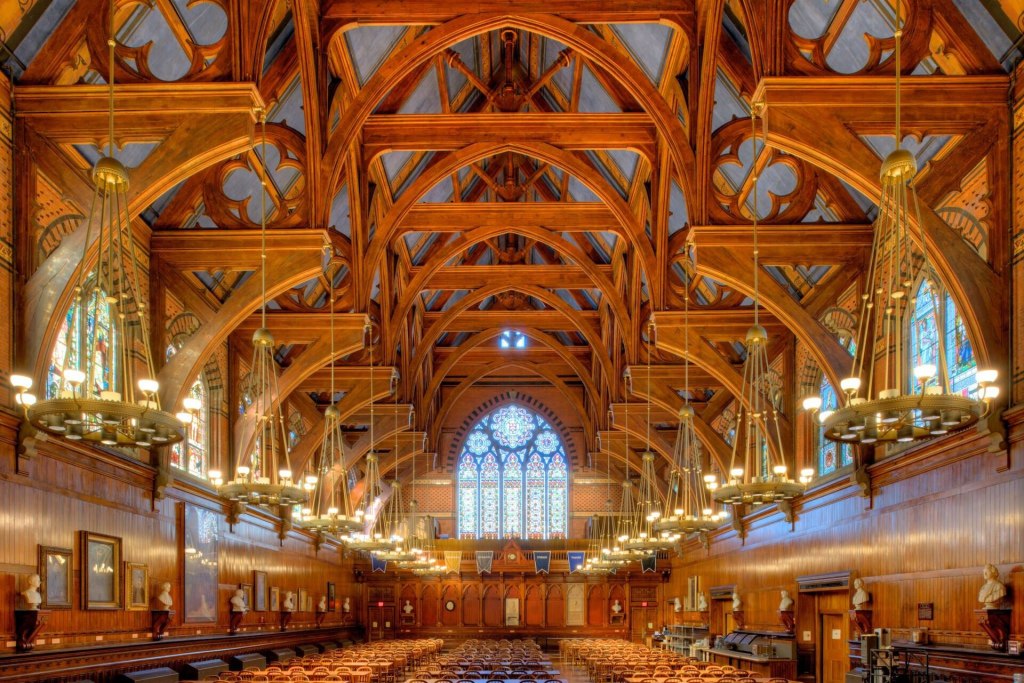
Featured image: Annenberg Hall in Memorial Hall, Harvard University. Photo by Bestbudbrian via Wikimedia Commons, CC BY-SA 4.0.


Leave a Reply