At 345 Park Avenue, the third quarter has a way of clarifying things. This year it clarified the central fact of the private-equity business in late 2026: raising money is easy for the biggest firm in the world, and getting it back out is still hard.
Blackstone, the largest alternative asset manager on earth by its own description, reported its results on October 22. Inflows were $63.3 billion in the quarter and $271.6 billion over the trailing twelve months. Total assets under management reached $1.368 trillion, up 10 percent from a year earlier, and perpetual capital, the money that does not need to be returned on a fund schedule, stood at $562.3 billion.
Then the less festive number. Distributable earnings, the measure the firm uses to set its dividend and the one Blackstone’s shareholders watch most closely, were $1.7 billion, or $1.32 a share, down from $1.89 billion a year earlier. That is a 9 percent decline in total and roughly 13 percent per share. Net realizations, the profits Blackstone books when it sells investments, fell 34 percent firm-wide and 49 percent in private equity. The quarterly dividend will be $1.12 a share, payable November 9.
The chairman’s frame
Stephen A. Schwarzman, the firm’s co-founder, chairman and chief executive, described the quarter as “strong” in the release. “Blackstone delivered strong third-quarter results amid a volatile external environment,” he said. “Our flagship strategies outperformed comparable public market indices and inflows reached $63 billion, with positive momentum across our major fund-raising channels. We’ve established leading platforms to address the key investment themes powering the global economy and markets today – including AI and energy infrastructure – which gives our investors unique access to remarkable opportunities.”
There is evidence for that view. Blackstone’s corporate private-equity portfolio appreciated 2.8 percent in the quarter and 14.7 percent over twelve months. Infrastructure, the strategy Schwarzman’s lieutenants have been building into a second engine, appreciated 6.4 percent in the quarter and 28.9 percent over the year. Secondaries, the business of buying other investors’ fund stakes, gained 4.3 percent.
And there is evidence for patience. Opportunistic real-estate funds, the business that made Blackstone’s name in the last decade, declined 3.2 percent in the quarter. Real-estate assets under management fell 4 percent from a year earlier, to roughly $309 billion. Office towers and warehouses do not reprice as fast as data centers.
The wealthy individual
The structural story of Blackstone’s quarter is who is writing the checks. The firm raised $2.9 billion in the quarter for BXPE, its private-equity vehicle for individual investors, and $1.1 billion for BXINFRA, its infrastructure equivalent. Those are perpetual vehicles, sold through brokerage platforms and private banks to wealthy families who once could not get into a Blackstone buyout fund at any price.
This is the business model Blackstone’s president, Jonathan Gray, has spent years advocating, and the quarter suggests it is working at scale. It is also the part of the business that draws the most scrutiny. Individual investors expect liquidity on terms institutional limited partners do not; they are less able to absorb a bad vintage; and they depend on the manager’s valuations more than a pension fund with its own consultants does. The Securities and Exchange Commission has signaled renewed attention to valuation practices across private markets, Bloomberg reported this month, and wealth-channel growth is where that interest will concentrate. Blackstone has argued for years that its semi-liquid vehicles have performed as designed, including through redemption pressure at its real-estate trust in 2022 and 2023. The firm’s critics argue the test is not over. Both statements can be true.
Where the exits went
The realizations the firm did achieve were telling. Blackstone said its $9.8 billion of private-equity realizations in the quarter included Recognition Music Group, Ennovi and SP.LINKS. Firm-wide realizations were $33.1 billion in the quarter and $147 billion over twelve months, while deployment, new money put to work, was $30.1 billion in the quarter. Dry powder, the uncalled commitments waiting to be invested, stood at $228.9 billion.
That last number is the one that makes competitors uneasy. Blackstone can afford to wait for exits because it does not need to raise its next fund in a hurry; it can afford to buy because it already has. Mergermarket counted $605.3 billion of private-equity exits globally in the first nine months of 2026, up 12 percent, against $584.2 billion of buyouts, down 11 percent. By that measure the industry is now selling more than it is buying, and Blackstone’s numbers show why: the buyers of last resort for private-equity assets are increasingly other private-equity vehicles, including continuation funds and secondaries funds like Blackstone’s own.
The view from Park Avenue
For a firm of Blackstone’s size, the market judges quarterly earnings less on any single figure than on direction. Fee-related earnings, the steady management-fee income that does not depend on deal timing, were $1.6 billion in the quarter and $6.4 billion over twelve months. Those numbers are the floor; realizations are the ceiling. When the exit market reopens fully, the ceiling rises quickly.
Schwarzman, who turns 80 in February, has run Blackstone through four decades of cycles, and the firm’s public posture in this one has been consistent: AI infrastructure and energy are the investment themes of the decade, wealthy individuals are the fund-raising channel of the decade, and patience is a competitive advantage. On the evidence of the third quarter, the first two propositions are showing up in the numbers. The third is being tested in real time.
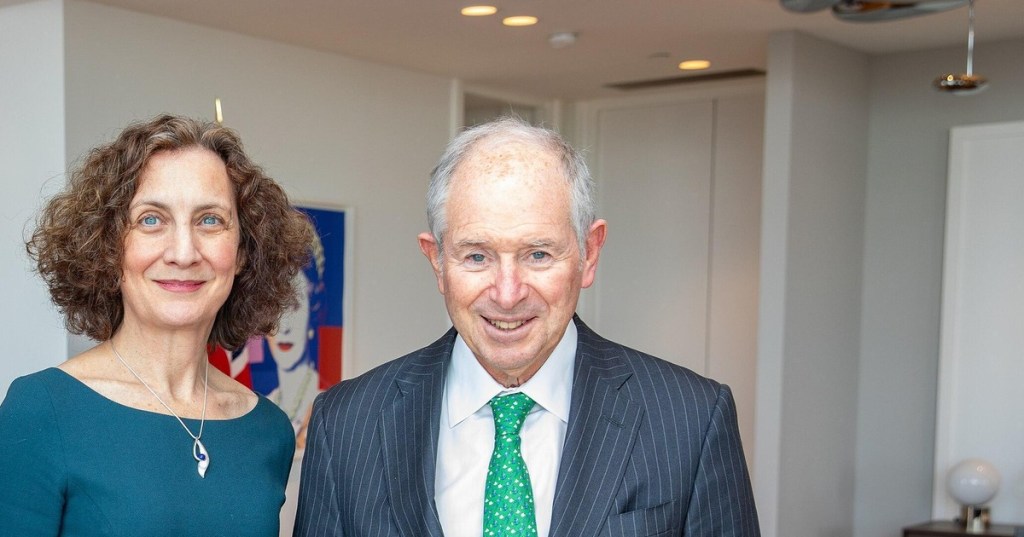
Featured image: Stephen A. Schwarzman, co-founder, chairman and chief executive of Blackstone, at Magdalen College, Oxford, in March 2024. Photo by UKinUSA via Wikimedia Commons, CC BY-SA 2.0.


Leave a Reply