Amazon has a way of turning municipal politics into a logistics problem. Seven years ago it walked away from a second headquarters in Long Island City after the City Council and a freshly elected congresswoman made clear they would not rubber-stamp a $3 billion subsidy package. This month the company is telegraphing another departure, of a different kind: if the City Council passes the Delivery Protection Act, Amazon has signaled it may move thousands of contracted delivery jobs out of the city, and industry experts say it could shutter all fifteen of its last-mile warehouses in the five boroughs.
The mayor is not flinching. Zohran Mamdani has made the bill a test of whether City Hall can tell a trillion-dollar retailer how to hire. Speaker Julie Menin, whose Upper East Side district is now being door-knocked by Teamsters and DSA canvassers, has not scheduled a floor vote. Between them sits the oldest New York question in a new uniform: who gets to decide what a job is.
What the bill actually does
Introduced on Feb. 12, 2026, by Queens Council Member Tiffany Cabán as Int. No. 518, the Delivery Protection Act would require operators of certain last-mile warehouses and distribution facilities to obtain a license from the Department of Consumer and Worker Protection. The license would come with safety, training and labor standards. Most consequentially, workers providing “core delivery services” or “core warehouse services” would have to be “directly employed by the facility operator.” The subcontracting model that underwrites Amazon’s Delivery Service Partner network — and that FedEx and others also use for ground deliveries — would, inside city limits, be illegal.
Thirty-four Council members have signed on, by the New York Post’s count, a veto-proof majority on paper. The bill was heard by the Committee on Consumer and Worker Protection on April 9 and laid over. No vote has been calendared. Mamdani endorsed it on Aug. 10 in a City Hall release that also dropped a campaign-style video; Cabán, Deputy Mayor for Economic Justice Julie Su, DCWP Commissioner Samuel A.A. Levine, Teamsters General President Sean O’Brien, and ALIGN’s Theodore Moore all piled on. “Corporations like Amazon build billion-dollar business models by insulating themselves from accountability through a system of exploitative subcontracting,” the mayor said. “New Yorkers should not be forced to subsidize corporate profits with less safe streets and more precarious jobs.”
The safety case rests on numbers the city has spent years compiling. A 2025 report from Comptroller Mark Levine found that 78 percent of neighborhoods around large last-mile facilities saw an increase in injury-causing crashes after the warehouses opened; near Amazon and FedEx sites in Maspeth, the increases were roughly 50 percent. An advocacy group’s analysis of city data, reported by Business Insider, counted more than 14,000 citations against vehicles delivering Amazon packages between July 2020 and June 2025, for offenses ranging from blocking emergency vehicles to speeding in school zones. Amazon’s reply is that it works with its contractors “to promote safe delivery practices, from hands-on driver training to in-vehicle safety technology.”
The Quebec precedent, and the New Jersey Turnpike
What has concentrated minds this month is Amazon’s willingness to leave. The New York Post, citing industry experts, reported that the company has said it may move thousands of workers out of the city if the bill passes in its current form, and experts told the paper it could go further, closing its fifteen last-mile facilities here and firing the 2,000 people who staff them. In Quebec early last year, amid a labor fight after the CSN union organized a Laval warehouse, Amazon closed seven facilities; by March 2025 some 1,900 warehouse jobs and 2,800 delivery contractors were gone. (Amazon, still in litigation there, denies the closures were about the union.) Marc Wulfraat of the Montreal consultancy MWPVL International told the Post that Amazon “will retaliate, because it has to send a firm message to the rest of the country.” Brittain Ladd, a former Amazon executive turned logistics consultant, was equally blunt: the company “wouldn’t blink about shutting down the 15 facilities in New York City if it felt that the legislation was a threat to its business model.”
Amazon spokesperson Steve Kelly drew a distinction. New York, he said, is “fundamentally different” from Quebec, where the company ran “far fewer sites.” The city, he said, is “one of the largest and most complex delivery regions in the country,” best served “by a network of local small businesses deeply embedded in their communities.” Amazon also cites a study by the consultancy AKRF, commissioned by the Five Borough Jobs Campaign, a business coalition, projecting that the bill would cost households an extra $664 a year, or about $5.20 a package. Experts told the Post that nothing would stop Amazon from replacing its city stations with warehouses being built along the New Jersey Turnpike; Amazon says deliveries would slow and costs would rise if it did.
Kelly responded to The City Politic’s questions by asking to discuss them by phone; Amazon had not provided a further statement by press time.
The contractors in the middle
Lost in the mayor-versus-Bezos framing are the forty or so Delivery Service Providers who actually write the paychecks. They employ the five thousand drivers; Amazon employs the two thousand or so workers inside the last-mile stations themselves. (The 5,500 hourly workers at the JFK8 fulfillment center on Staten Island, who voted to unionize in 2022 and still lack a contract, would not be covered.)
Kris Basmagy, who runs DashWave Delivery on the Upper East Side with 150 drivers, pointed the Post to Quebec: “There was pressure on Amazon’s model, and it pulled out.” Joe Artus of WGA Transit, which has recruited formerly incarcerated and homeless workers for Amazon routes in Harlem, told the paper that if the bill passes as written, “there is no way for my company to exist or to keep my 189 employees.” In the Bronx, Ty Barnes of NorthStar Logistics and Rudy Cazares of Cazar Logistics told the Bronx Times that they see themselves as the community layer Amazon does not provide — Barnes covers civil-service exam fees for employees who live in shelters; Cazares, a Marine veteran, contracts with FedEx as well. “Amazon’s a trillion dollar company. I’m not worried about Amazon,” Cazares said. “For me, it’s my team. It’s my family.”
Drivers tell a different story. Luc Albert Rene, who delivers out of Amazon’s DBQ4 in Maspeth and supports the bill, told the Bronx Times he works without proper insurance, benefits or wages, and that when he hurt his knee on a rainy delivery in 2023, his DSP said it would not pay him for the rest of the shift. Jerome Sloss told the Indypendent that the vans are “not maintained well” and many of their doors do not lock, and that the answer is always “talk to your DSP.” Matt Multari, who organized with co-workers at DBK4 in Queens, put the political point cleanly: “If we’re not even employees, and yet we’re trying to demand for better conditions, better safety, at a company. How are you going to negotiate with them if you don’t have the floor established that you’re even working for them?”
The door-knocking and the Speaker
Since late summer, Teamsters Local 804, Amazon drivers, and the NYC-DSA Labor Working Group have knocked on more than 11,000 doors, the Indypendent reported; organizers say they flipped three Council members and now concentrating on Menin’s Upper East Side. Organizers claim 91 percent of the voters they spoke with support the bill. A City Hall rally is set for Oct. 22. Amazon has put $5 million into the Five Borough Jobs Campaign to fund opposition ads. A source close to Council negotiations told the Post that the bill “will have to pass in some form,” given the mayor’s support, but that Menin and others are “uncomfortable” with the job-loss risk, and that compromises discussed include letting independent contractors keep delivering while requiring Amazon to provide more safety guarantees.
New York has seen this movie. Amazon left Queens once and the sky did not fall; it also left Quebec and kept delivering packages, just more slowly for a while. The Delivery Protection Act asks whether a city that lives on next-day cardboard is willing to price the vans, the crashes and the subcontractors into the invoice. Menin holds the calendar. Mamdani holds the pen. Amazon holds fifteen leases and a well-practiced exit. The packages, as ever, will find a way. The question is whose name will be on the W-2.
The mayor’s press office, Council Member Tiffany Cabán, Speaker Julie Menin’s office, the Department of Consumer and Worker Protection, Teamsters Local 804, NYC-DSA, ALIGN, the Five Borough Jobs Campaign, DashWave Delivery, Cazar Logistics and NorthStar Logistics did not respond to requests for comment from The City Politic by press time. We will update this story with any response.
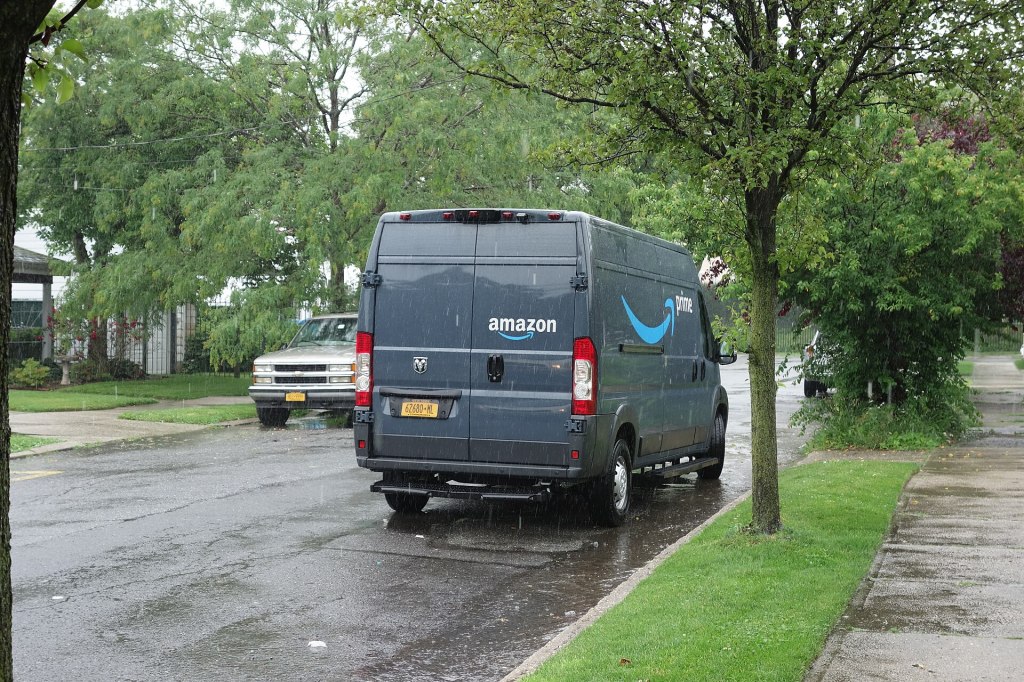
Photo: An Amazon delivery van in Hillcrest, Queens, by Tdorante10 via Wikimedia Commons, CC BY-SA 4.0.


Leave a Reply