The New York City Council has issued many things in its history: proclamations, parking placards, an inexhaustible supply of ceremonial street names. Until this fall it had never issued a subpoena to a private company. On Friday, the first company to receive one finally showed up, and it did not go especially well for the company.
The company was SpaceXAI, Elon Musk’s artificial-intelligence venture and the maker of the chatbot Grok, which had skipped the Council’s marathon Oct. 5 hearing on AI safety while Anthropic, Google, Meta and OpenAI testified under oath. The Council’s Committee on Technology, chaired by Council Member Carmen De La Rosa, had subpoenaed the company. According to amNewYork, SpaceXAI agreed to appear only after the Council threatened to seek court enforcement.
What followed was the kind of hearing that gets clipped and reposted, and likely will be for some time.
Thirty seconds, one phone
SpaceXAI sent Gabriela Castillo Madrid, its senior manager of global government affairs, who testified virtually. Under oath, she said safety is “core” to the company’s development of Grok, amNY reported. Asked by Speaker Julie Menin whether Grok could currently show a real person nude, in underwear or in a sexualized pose, Castillo Madrid said the platform has “strict controls in place to prevent the sexualization of children or real people.”
Menin then picked up her phone. Earlier that morning, she said, her team had typed her name into Grok, and the chatbot had produced a sexualized image of the Speaker. Later in the hearing she specified that she had used the regular free version of Grok, not its so-called “spicy mode,” and that the image appeared in under 30 seconds.
“We literally asked regular Grok to pull up a sexualized image, and a sexualized image comes up that is available for all to see, for my daughter to see, for anyone to see,” Menin said, according to amNY.
Castillo Madrid said she could not speak to the specific image and offered to have the company’s safety team examine it. “I don’t think anybody should be put in that position,” she said. The Council’s own account of the hearing records that she said her safety team “could look into that specific instance.”
The whistleblower in the next chair
If the image was the moment, the testimony of Devin Kim was the argument. Kim, who told the Council he was one of xAI’s first employees and built systems used to train and evaluate Grok, is now, per amNY, president of the Center for AI Safety and is suing xAI and SpaceX for retaliation, represented by Ella Zheng of Sanford Heisler Sharp McKnight. “I’m suing xAI for retaliation, so I’ll stick to my public complaint,” he told members, before laying out its contents.
Kim said he began raising concerns in January 2025 that Grok could help users create bombs and biological weapons, and that a supervisor responded that “AI safety was useless and that AI would kill us all, anyways.” He alleged that models were released without the safeguards he sought, that he was pressured to circumvent European safety rules, and that he was fired in September 2025 in the same week he was scheduled to present safety findings to company leadership. He told the Council that during his tenure only three of the company’s roughly 200 technical employees worked on AI safety. On explicit imagery, amNY reported, he said the directive shared with staff at the time was that “tasteful nudity” was acceptable and the goal, and that no one had been designated to decide what “tasteful” meant. He stressed that he could not speak to the company’s current practices.
Asked earlier whether she was aware of Kim’s termination, Castillo Madrid testified that she was not. Asked how many employees currently work specifically on safety, she said “everybody is in charge of safety” and agreed to get the Council a number. Asked whether the company would accept responsibility if one of its systems caused injury or death, she replied: “We’re responsible for following the law.” She did not know the specifics of the company’s insurance for catastrophic AI events.
In fairness to the witness, she did bring numbers of her own. Castillo Madrid told members the company had made more than 100,000 reports to the National Center for Missing and Exploited Children this year, which she said had led to nearly 300 arrests, and that SpaceXAI is “working on partnerships with independent external auditors or evaluators.”
The Council’s next moves
The Speaker was not mollified. “It took a subpoena and the threat of continued legal action to compel SpaceXAI to show up and testify before New Yorkers today, and yet their testimony was simply unacceptable,” Menin said in the Council’s statement. “Self-regulation is not enough.”
De La Rosa said the companies “were unable to produce answers to basic questions around privacy protections for users, guardrails against harassment, whistleblower protections, and the risks associated with rogue operations of their technology,” and promised follow-up letters and legislation.
There is already a docket. Intro 504, sponsored by Deputy Speaker Nantasha Williams, would ban unauthorized AI depictions of elected officials. Intro 2605, introduced last week by Menin and billed as first-in-the-nation, would let whistleblowers collect a share of fines recovered from AI companies that break the law. amNY also notes a bill that would let people sue AI companies over certain foreseeable harms caused by third-party misuse of their models. At the Oct. 5 hearing, the Council heard from British MP Jess Asato, who is suing over sexualized deepfakes she says were created with Grok.
A municipal body, a global industry
There is an obvious question about what a city council can actually do to a company whose servers are not on Chambers Street. The answer, so far, is: compel attendance, create a record under oath, and legislate where the city has jurisdiction, over its own elections, its own contractors and its own residents’ remedies. Friday’s hearing was a demonstration that the first two, at least, work.
It was also, not incidentally, excellent politics. A Speaker in her first year confronting Elon Musk’s company with her own phone is the sort of image that travels. The question for the Council is whether Intro 504 and Intro 2605 travel as far.
Castillo Madrid left with a list of promised follow-ups: a safety headcount, a look at the Speaker’s image, and more. The Council, for its part, now knows that a subpoena works. It seems unlikely to be the last.
The City Politic has reached out to SpaceXAI, Speaker Julie Menin’s office, Council Member Carmen De La Rosa and Sanford Heisler Sharp McKnight, on behalf of Devin Kim, for comment and will update this story with any response.
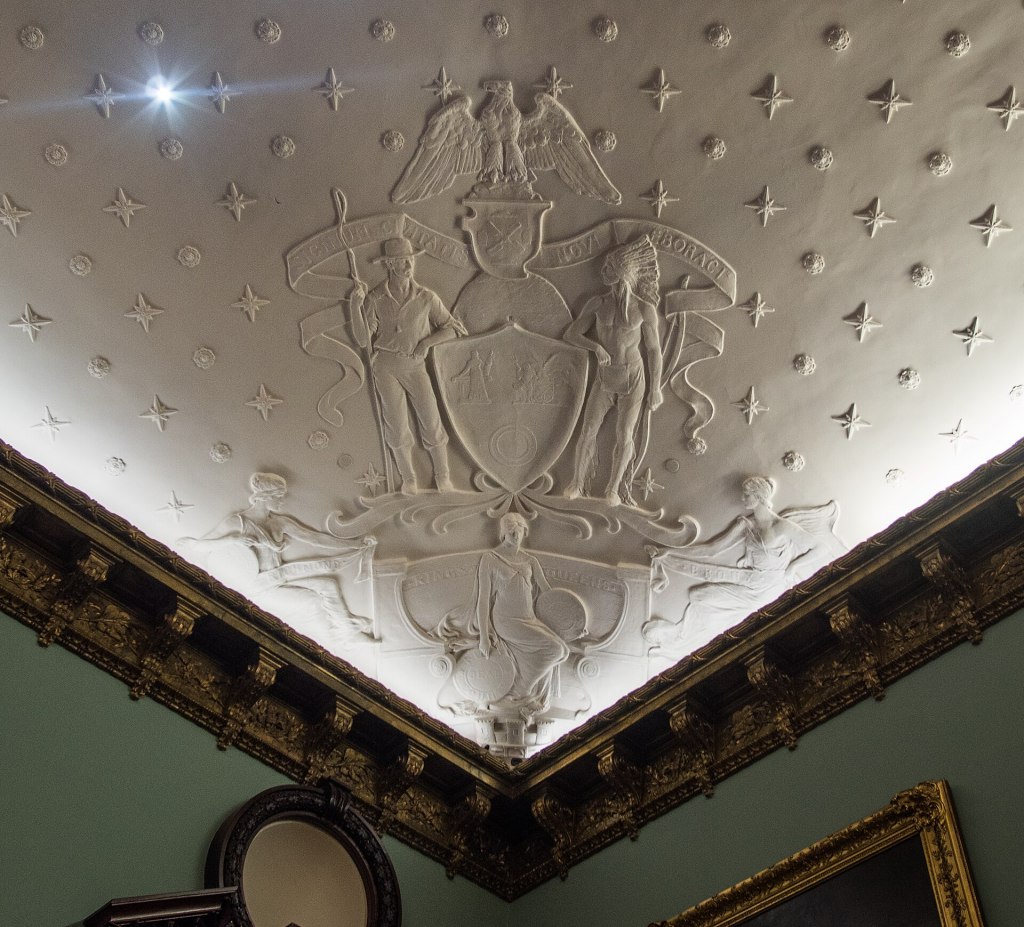
Photo: The ceiling of the City Council Chamber at City Hall. Rhododendrites / Wikimedia Commons, CC BY-SA 4.0.


.jpg)
Leave a Reply