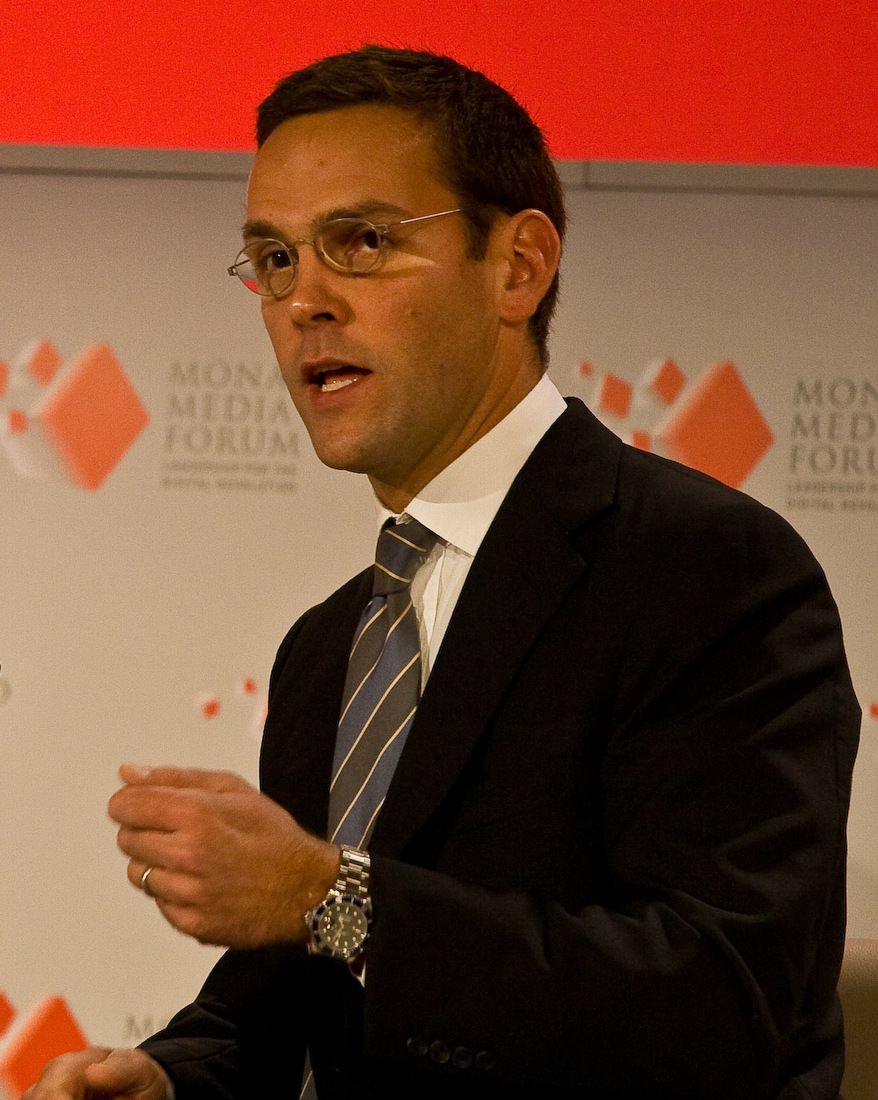
There are few things New York media enjoys more than writing about itself, and few subjects it enjoys more than a Murdoch. So Vanity Fair’s Oct. 5 profile of James and Kathryn Murdoch, the new owners of New York magazine, arrived with the force of a double espresso. Written by Lachlan Cartwright and photographed by Annie Leibovitz for the magazine’s New Establishment portfolio, it is a portrait of a couple building what Vanity Fair calls “a culture company spanning art, film, and media,” and of a family member who would very much prefer not to discuss the rest of his family.
The deal
The facts, as Vanity Fair lays them out, are these. In mid-May, James Murdoch announced that he had acquired New York magazine, the Vox Media Podcast Network and Vox.com from Vox Media, in a purchase Vanity Fair puts at more than $300 million, made through the couple’s investment company, Lupa Systems. Vanity Fair describes the couple’s holdings as also including the Tribeca Film Festival and Art Basel, and reports that they have launched something called the Futurific Institute.
Hours after the announcement, Vanity Fair reports, the couple toured the magazine’s downtown offices with Vox Media CEO Jim Bankoff, stopping in the climate-controlled archive that holds 58 years of New York back issues. Kathryn and James, the magazine says, “were excited to look at the issues from when they were born.” Staffers, per Vanity Fair, took the archival detour as a sign that the purchase “was not a vanity play.”
There will be no immediate shake-up. Vanity Fair reports that New York’s editor, David Haskell, stays in the top job, as do Bankoff and podcast chief Ray Chao.
The family business, minus the family
The irony that makes the story irresistible is historical. James was four years old, Vanity Fair notes, when his father, Rupert Murdoch, bought New York, and 18 when Rupert sold it. Asked about that era, James, in Cartwright’s telling, speaks haltingly, “careful not to reference his estranged father in even a pronoun.” He describes the old portfolio, “the San Antonio Express-News. The Star. The Village Voice. New York magazine,” as “ancient history.”
Asked whether his sisters grew closer to him after the family’s Nevada trust battle, he offers what may be the best line in the piece: “It was nice to be able to spend a bunch of weeks together in Nevada.” Asked about Fox, he declines: “I’m not commenting on that whole world. I’m sorry.” He tells Cartwright he has never watched an episode of Succession. One believes him. One also suspects he has been told about it.
What they say they want
The substantive part of the interview is about journalism, and it is more interesting than the gossip. James praises New York’s model as “really unique,” arguing that the magazine “didn’t go down the road of just search engine optimization” and instead “doubled down on the commitment to this thoughtful long-form journalism.” In an age of AI, he says, that kind of work becomes more valuable: “The sort of authentic authorship by humans, of things, the observational kind of ability.” The pieces he admires, he says, “are characterized by wit and sharpness, insight,” and are “worth investing in.”
He also offers a cheerful anecdote about AI’s limits. He once sent his family an AI-generated disco parody of The Lord of the Rings, he tells Vanity Fair. “It was rejected by my entire family,” who found it “appalling.”
Revisiting his 2009 MacTaggart Lecture, in which he argued that “the only reliable, durable, and perpetual guarantor of independence is profit,” James now draws a distinction. “Maximizing profit is about taking advantage of your customers,” he says. Profit, properly understood, “is about durability and independence.” Asked whether a media owner has responsibilities beyond shareholder value, he answers: “One hundred percent, yeah.”
Kathryn, a former public relations executive, tells Vanity Fair the couple is drawn to “the business of ideas.” The two also fund a centrist political group, Majority Democrats, the magazine reports.
Why it matters here
For readers of a magazine like this one, the Murdochs’ purchase is not a distant media-business story. New York magazine is one of the city’s essential civic institutions, the publication that, for better and worse, taught Manhattan how to talk about itself: its restaurants, its real estate, its power, its neuroses. Vulture, its culture site, is where much of the city’s theater and art criticism now lives; its senior art critic’s review of the Whitney’s Lichtenstein retrospective appeared there this week. Who owns it, and what they intend to do with it, is a question about what kind of conversation the city will have.
The early signals are reassuring, at least on paper. An owner who leaves the editor in place, praises long-form journalism and talks about responsibility to the community is better than many alternatives. Vanity Fair notes that the couple is buying in at a moment when other billionaires have been criticized for “reorienting many storied institutions in their own image.” The Murdochs, by their own account, want to be the exception.
Promises are cheap, of course, and the real test will come the first time New York publishes something its owners dislike. But it is worth noting, with a certain affection for the absurd, that the most prominent new champion of independent, witty, human-written long-form journalism in New York is a man named Murdoch. Somewhere, a copy editor at the old New York Post is laughing into a highball.
The City Politic has reached out to Lupa Systems, New York magazine and Vox Media for comment, and will update this story with any response.
Photo: James Murdoch in 2008, by Eirik Solheim/NRKbeta via Wikimedia Commons, CC BY-SA 2.0.


.jpg)
Leave a Reply