For a year, the endowment tax in President Trump’s One Big Beautiful Bill Act was a forecast at Yale. Since July 1 it has been a line item, and Yale’s budget book for fiscal 2027 now shows what it costs.
According to the Yale Daily News, which reported on the budget on Oct. 2, the tax on the University’s endowment investment income jumped from 1.4 percent to 8 percent. Yale’s bill rose from $52 million to $299 million, an increase of $247 million. The higher figure is 3.6 percent of the University’s total spending this year. Administrators had estimated last year that the tax would cost about $300 million a year. They were close.
The cuts
Yale did not wait for the bill. Last year, it set three-year targets for budget reductions. According to the new budget, it has already achieved 78 percent of them. The remaining 22 percent is to come over the next two years.
The measures announced last year included a 5 percent reduction in non-salary spending, a 1 percent cut to the salary pool for faculty and managerial and professional staff, and fewer graduate students. In Yale College, the cuts included a 7.5 percent reduction in staffing, less financial aid for summer opportunities, and the non-renewal of contracts for some instructional faculty.
“This increase and the continued uncertainty around federal research support—a crucial funding source—prompted the university to establish three-year budget reduction targets, enabling schools and units to adapt gradually to new financial constraints,” Provost Scott Strobel and Geoff Chatas, senior vice president for operations, wrote in the budget book.
Revenue from grants and contracts fell for a second year, the News reported, down $9 million, or 0.7 percent.
Who feels it
The tax is not shared evenly, because Yale’s schools are not funded evenly. A spokesperson, Karen Peart, told the News that “some areas of the university will feel more financial strain than others.”
The budget shows the School of Music gets 98 percent of its income from the endowment, and the tax will consume 12.4 percent of its planned spending. The School of Medicine, by contrast, gets 7 percent of its income from the endowment. Most of its money comes from grants and patient care, and the tax amounts to less than 1 percent of its spending. The Jackson School of Global Affairs, the Divinity School, the Law School and the Faculty of Arts and Sciences all get more than half their income from the endowment.
At the David Geffen School of Drama, the tax accounts for $2.9 million of $47.7 million in spending, or 6.1 percent. The dean, Evan Yionoulis, told the News that department heads had “made difficult cuts to the budget with an eye to preserving jobs and maintaining the excellence of the student educational experience.”
The tax appears this year as a line item, a “tax reserve charge,” in the budget. Last year the smaller 1.4 percent tax was simply netted out of endowment income.
The scale
Some perspective is in order. Yale’s endowment is $44 billion, according to the budget, and will produce $2.33 billion in revenue for the University in fiscal 2027. That is its largest source of income. Total external revenue is $6.732 billion. Yale is not in danger. But a $247 million increase in a single tax is the kind of number that ends up in the staffing tables.
Washington and Hartford
Yale is no longer trying to reverse the tax. President Maurie McInnis told the News in September that lowering or reforming the rate is “off the table” as a lobbying goal for now. “There may come a day again where we could revisit the tax on university investment income,” she said. Yale is focused instead on how the Treasury Department writes regulations implementing it, and on protecting research funding and increasing Pell Grants.
The University faces a separate fight closer to home. In July, a group of Democratic state legislators, most of them Yale alumni, warned in a letter that they might challenge Yale’s state tax exemption if it reaches a settlement with the Trump administration, the News reported. The administration’s Justice Department said in May that the Yale School of Medicine discriminates against white and Asian applicants. Yale is negotiating with the federal government.
Gov. Ned Lamont, a Yale School of Management graduate, told the News on Oct. 6 that he would “probably not” support changes to the exemption even if Yale settles. He said Yale should do “nothing to compromise academic integrity” and should not give the federal government a say in admissions. “With those guardrails, you can do anything, but you have to have those guardrails,” he said. “I’m trying my best to keep our colleges afloat.”
Not everyone in Connecticut politics agrees. Senator Richard Blumenthal, Representative Rosa DeLauro and New Haven Mayor Justin Elicker joined a protest at Beinecke Plaza against the negotiations, the News reported. Mr. Blumenthal urged Yale to resist “tyranny.”
So Yale has paid the bill it could not avoid and cut most of what it said it would cut. It is negotiating the dispute it has not resolved. And it still needs an exemption from a state legislature where some members are watching those negotiations closely.
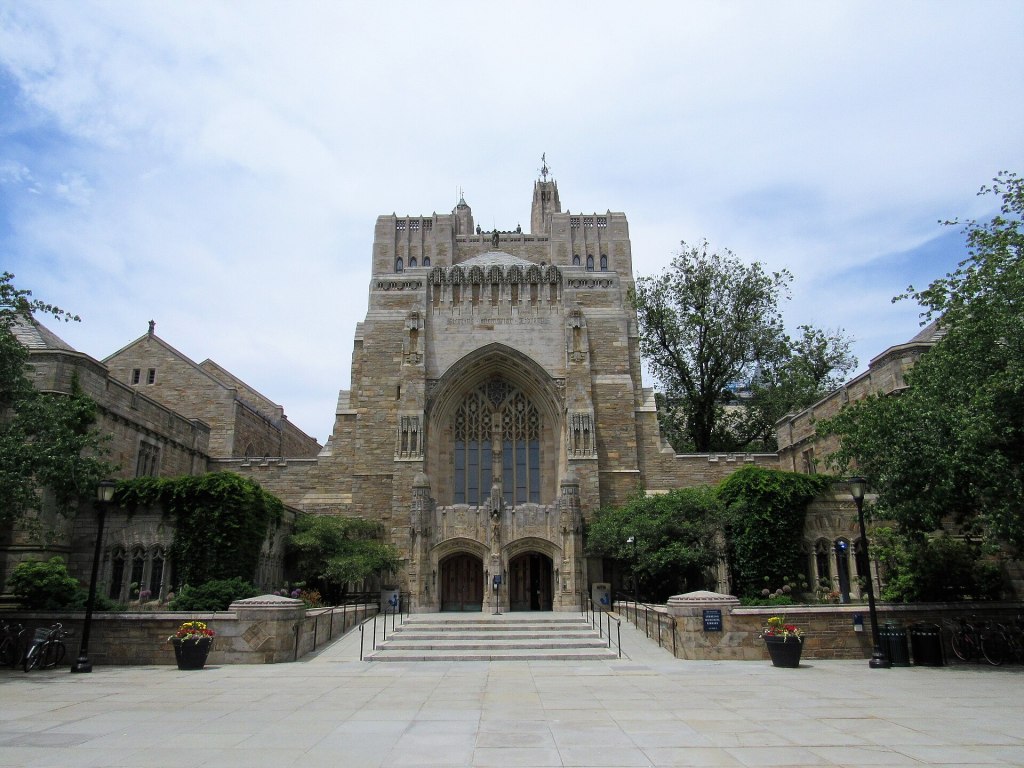
Featured image: Sterling Memorial Library, Yale University. Photo by Farragutful via Wikimedia Commons, CC BY-SA 4.0.


Leave a Reply