There are a handful of issues that unite the New York and New Jersey congressional delegation from Montauk to the Delaware Water Gap. The Gateway Hudson Tunnel Project is first among them. It is also the issue that has most tested what a delegation can actually do when the executive branch decides to stop paying for something Congress already funded.
A year ago this month, the answer seemed to be: not much. Today, with construction continuing and the last legal challenge withdrawn, the answer looks more like this: write letters, hold the line in public, and let the states’ attorneys general win in court.
The freeze
The trouble began on September 30, 2025, when the U.S. Department of Transportation suspended grant payments to the Gateway Development Commission, the bistate agency building the tunnels. The next day, White House budget director Russell Vought announced that roughly $18 billion in New York infrastructure money, covering Gateway and the Second Avenue Subway, was on hold, NBC News reported. Vought said the pause was meant to ensure federal dollars did not flow to “unconstitutional DEI principles.” President Trump, for his part, repeatedly described the freeze as punishment for Democrats during the federal government shutdown, according to the New Jersey Monitor.
The politics were unusual from the start. The project’s most prominent champion, Senate Minority Leader Chuck Schumer, was also leading his party’s side of the shutdown fight against the White House. But the money also ran through some of the most competitive Republican-held House seats in the country, and those members spoke up for it.
Rep. Mike Lawler of Rockland and Westchester was among the first. He criticized the funding threat while also blaming Schumer for the shutdown, Bloomberg Government reported, a position, for the project and against the shutdown, that has defined the swing-seat Republican approach to Gateway ever since.
The letter
By January, the risk was no longer theoretical. On January 28, 2026, Schumer and Sens. Kirsten Gillibrand, Cory Booker and Andy Kim led a New York and New Jersey delegation letter demanding that the president immediately release the withheld money. In a press release, the senators warned that work would be forced to stop the following week, with union job losses and what they called catastrophic economic risk to the Northeast Corridor. The letter itself made a simple legal point: the $16.1 billion project was fully funded, permitted and under construction, and the money had already been appropriated and obligated.
Letters do not move budget offices. Lawsuits sometimes do. New York and New Jersey sued, and on February 6 U.S. District Judge Jeannette Vargas issued a temporary restraining order that kept money moving while the case proceeded.
The ruling
On June 29, Vargas issued her decision. She found that the Transportation Department’s suspension of Gateway grant payments was contrary to law, vacated it and permanently barred the department from relying on it to withhold funds. The ruling found that the department had made no compliance finding and had denied the commission the opportunity to object that its own grant rules required. Engineering News-Record summarized it as a permanent bar; Bloomberg’s headline called the freeze “flagrantly illegal.”
The administration did not go quietly. On August 28 it appealed to the Second Circuit, Reuters reported. Three weeks later it gave up. A mandate issued September 18 by the Second Circuit’s clerk recorded that New York, New Jersey and the federal government had agreed to dismiss the appeal. The order does not say how the parties got there.
Gov. Mikie Sherrill, who left the House to win the governorship last year, claimed the win in a statement: “The Trump Administration has tried, over and over again, to illegally stop the funding for the nation’s most urgent infrastructure project. We took them to court and we won for New Jerseyans, five times.”
What the delegation learned
The lesson for the delegation is sobering. Its members did the things members do: they wrote, they spoke, they appropriated. But it was the grant agreement and federal administrative law, enforced by two state attorneys general and a federal judge, that kept the money flowing. Congress’s power of the purse turned out to mean less than the fine print of a Full Funding Grant Agreement.
That has policy consequences. The obvious legislative response would be language in future transportation and appropriations bills that limits the department’s ability to suspend payments on signed megaproject agreements without a formal finding and a chance to respond, essentially writing Vargas’s reasoning into statute. Whether it could pass depends on who controls the House after November 3.
The politics of a tunnel
Which is why Gateway has become a campaign issue in a way that a tunnel rarely does. In New Jersey’s Seventh District, Rep. Tom Kean Jr. used a September 28 debate to stress his support for the project, saying, as The Philadelphia Inquirer reported, “I will make sure that I counter anybody who gets in my way, including this president.” His Democratic challenger, Rebecca Bennett, has told voters Kean did not do enough to stop the funding halt, The Guardian reported on Saturday.
The New Jersey Monitor made the same connection when the appeal was dropped, noting that the freeze threatened political consequences in competitive House districts on both sides of the Hudson.
For now the tunnels are being dug, the money is moving, and every member of the delegation, Republican or Democrat, can say they were for it. The harder question is what happens the next time a White House decides that a project in a blue state is a bargaining chip. On that, a court victory is not a statute, and the next freeze may not land in front of the same judge.
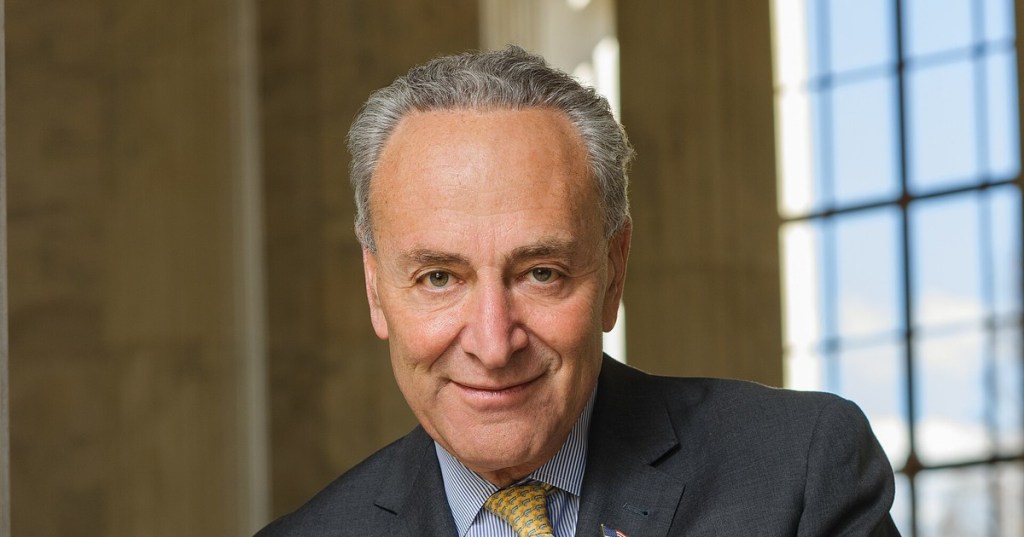
Featured image: Sen. Chuck Schumer, official portrait. Photo by U.S. Senate Photographic Studio/Jeff McEvoy via Wikimedia Commons, public domain.


Leave a Reply