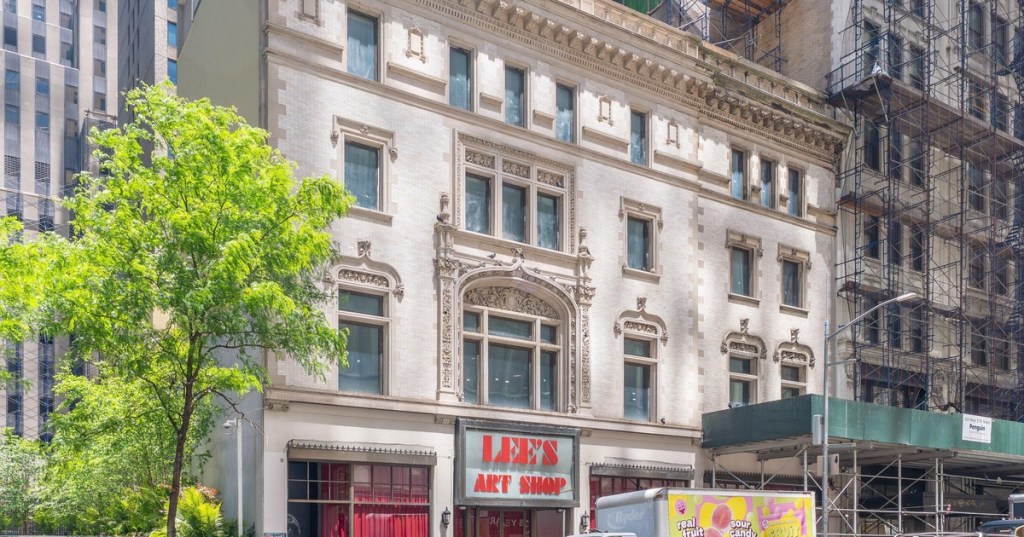
When “The Phantom of the Opera” closed on Broadway in April 2023 after 35 years, the obituaries were premature. The show reopened, in a sense, two summers later, five blocks south of Central Park, in a building where generations of New York artists once bought their paint.
“Masquerade,” the immersive reimagining of Andrew Lloyd Webber’s musical, began previews on July 31, 2025, and opened on September 29, 2025, at 218 West 57th Street, the former home of Lee’s Art Shop. Its director is Diane Paulus, who earned an M.F.A. in directing from Columbia University School of the Arts in 1997, and its concept and production come from Randy Weiner, the producer behind “Sleep No More” and The Box.
On October 5, Broadway.com reported that the production had extended its run for the seventh time, now through May 30, 2027. For an Off-Broadway production with an apparent cost of about $25 million, as New York Stage Review put it, that is the kind of news that gets a producer through the winter.
How it works
“Masquerade” is not a revival but a dispersal. Audiences arrive in groups of about 60, at 15-minute intervals, wearing masks and dressed, by request, in black, white or silver. They are led through the building’s floors, which have been transformed into rooms of the Paris Opera House: dressing rooms, rehearsal spaces, the managers’ offices, the cellars beneath the stage. The story is told in fragments, scene by scene, with the score sung live a few feet from the audience. The choreographer is Sidi Larbi Cherkaoui.
Tickets started at $199. This month, prime performances were selling for $495 and more.
The production has rotated a series of Phantoms, including Nick Cartell, Austin Colby, Derrick Davis and Nik Walker. It has also given Columbia another alumni story: Hannah Shealy, a 2023 graduate of the School of the Arts acting program, made what the school called her Broadway debut in the production, as the school noted with pride.
The critics were mostly won over. Adam Feldman, in Time Out New York, wrote that “somehow, they pull it off.” Frank Scheck gave it four stars in New York Stage Review: “it works exceedingly well.” The Guardian was cooler, describing a beloved musical “back with a new gimmick.” All three were right about something. “Masquerade” is a gimmick, and it works.
Paulus’s long apprenticeship in the immersive
For Paulus, the show is a homecoming of a particular kind. Long before immersive theater became a real-estate category, she and Weiner, whom she married in 1995, created “The Donkey Show,” a disco riff on “A Midsummer Night’s Dream” in which the audience danced among the actors. It began in New York in 1999 and ran for two decades in various incarnations, including at the American Repertory Theater in Cambridge, where Paulus has been artistic director since 2008. Her company from those years, Project 400, staged experimental work around the city.
Her résumé since then has been more conventional and very successful. She won the Tony Award for directing the 2013 Broadway revival of “Pippin,” and she has directed revivals of “Hair” and “Porgy and Bess” and the original Broadway productions of “Waitress” and “Jagged Little Pill.” Paulus, a 1988 Harvard graduate who now teaches there, came to Columbia for her graduate training in directing.
“Masquerade” combines the two halves of that career: the commercial confidence of a Broadway hit-maker and the downtown instinct to put the audience inside the show.
The economics of a sold-out labyrinth
The immersive model is a different business from a Broadway house. Capacity is lower, because each group of 60 needs its own track through the building; ticket prices are correspondingly higher. The building itself is a fixed cost that Broadway producers, who rent theaters from the Shuberts, Nederlanders and Jujamcyn, never carry in the same way. And the brand does much of the marketing: Lloyd Webber’s score, one of the most commercially successful in theater history, sells itself to tourists and locals alike.
Weiner learned that model with “Sleep No More,” the immersive “Macbeth” that ran in Chelsea’s McKittrick Hotel for more than a decade before closing in 2025. “Masquerade” applies it to a property with far greater name recognition. The seven extensions suggest that the audience exists. Whether it exists for a decade, as it did for “Sleep No More,” or for 35 years, as it did for the original “Phantom,” will be decided by the next few seasons on 57th Street.
For now, the chandelier is still hanging, and the Columbia School of the Arts has a reasonable claim on the most talked-about Off-Broadway production of the past year.
Featured image: 218 West 57th Street, the former Lee’s Art Shop building and home of Masquerade. Photo by Ajay Suresh via Wikimedia Commons, CC BY 4.0.


Leave a Reply