Federal judges do not usually announce at the outset that they are going to keep things short. In the case of United States of America v. City of New York, No. 25-CV-04084 (RER) (PK), in the Eastern District of New York, Judge Ramón E. Reyes Jr. did so in a footnote. The Trump administration’s challenge to New York City’s so-called sanctuary laws, he wrote, “is among nearly a dozen recent cases” in which the United States has attacked state and local limits on immigration cooperation. “In all prior cases, the United States’ challenges to such provisions have been rejected.”
“Because much has already been written about these issues with which this Court agrees,” he continued, “this decision will be relatively brief.”
It was 25 pages. On Oct. 15, Judge Reyes granted the city’s motion to dismiss and directed the clerk to close the case.
What Washington wanted
The Justice Department sued in July 2025. It named the city, its Department of Correction, Department of Probation, the NYPD and the City Council, along with their leaders. Mayor Zohran Mamdani, Speaker Julie Menin, Correction Commissioner Stanley Richards, Probation Commissioner Sharun Goodwin and Police Commissioner Jessica S. Tisch are now the named defendants in their official capacities, substituted as the offices changed hands.
The suit targeted sections 9-131, 9-205, 14-154 and 10-178 of the city’s Administrative Code, along with NYPD Operations Order No. 4. These rules limit when city agencies may honor federal “detainers,” which are requests to hold someone in custody for up to 48 hours so immigration agents can pick them up. Under city law, the jails, probation department and police can generally honor a detainer only if immigration authorities present a judicial warrant and the person has been convicted of a violent or serious crime or is a possible match in the terrorist screening database. Another provision bars spending city resources on immigration enforcement. The NYPD order tells officers not to contact federal civil immigration authorities to say where someone is.
The government argued that these provisions violate the Constitution’s Supremacy Clause because they are preempted by federal law, discriminate against the federal government and directly regulate it.
Standing
The judge began with the threshold question of whether the United States could sue at all. He concluded that it could not.
On detainers, the problem is state law. New York law does not authorize state and local officers to make arrests for civil immigration violations, as the Appellate Division held in People ex rel. Wells v. DeMarco in 2018. So even if the court struck down the city’s detainer rules, city officers still could not hold someone on a detainer without a judicial warrant. The injury, the court said, is not redressable by the relief sought. The New York Legislature or Congress could change that, the judge wrote, quoting an earlier ruling in a Boston case, “but not this Court.”
On information sharing, the government relied on 8 U.S.C. § 1373, which bars localities from restricting the sharing of “information regarding the citizenship or immigration status” of any individual. The judge, following other courts, read that phrase to mean a person’s legal classification under federal law. It does not cover release dates or whereabouts. The city’s rules expressly allow sharing immigration-status information, so any injury was not traceable to them.
The merits, anyway
The judge went on to say that the government would lose even if it had standing. The preemption claims failed. Then came the Tenth Amendment.
The anticommandeering doctrine bars Washington from ordering states and localities to carry out federal programs. The government argued that it was not trying to compel the city to help, only to remove obstacles. The judge called that “a backdoor around the Tenth Amendment” resting on “a false distinction.” He wrote that if states cannot “remain free to control their agencies and employees to resist federal immigration enforcement, which is within states’ constitutional prerogatives, the Tenth Amendment anticommandeering doctrine means nothing.”
The government also claimed the city’s laws discriminate against federal officers. The judge said that claim fails without a comparator, someone else treated better, and the United States could not identify one. As the government itself conceded, it holds “exclusive charge of enforcing immigration law.” He also declined to find that the city’s provisions directly regulate the federal government.
The pattern
The ruling joins a long list. The footnote cites decisions rejecting similar federal suits against New Jersey, Rochester, Washtenaw County in Michigan, Minnesota, Newark, Los Angeles, Boston, Colorado, New York State and Illinois, all of them decided in 2025 or 2026.
As Reuters summarized it, the judge found the government “did not have a valid basis to sue,” and said the federal government “could not force local governments to assist with immigration enforcement.” Reuters reported that the Justice Department did not immediately respond to its request for comment.
The administration can appeal to the Second Circuit. Whatever comes next, the ruling leaves New York’s detainer and information-sharing rules in force, and the city’s officers still bound by state law that, the court found, keeps them out of civil immigration arrests no matter what happens to the city code.
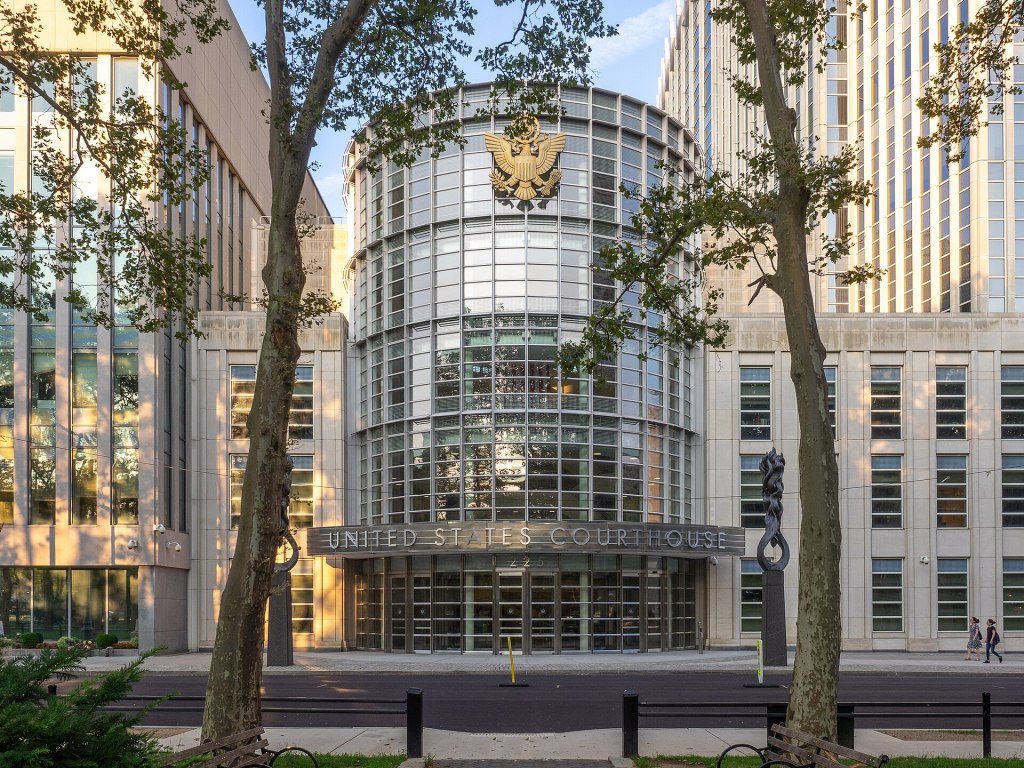
Featured image: The United States Courthouse for the Eastern District of New York in Downtown Brooklyn. Photo by Ajay Suresh from New York, NY, USA via Wikimedia Commons, CC BY 2.0.


Leave a Reply