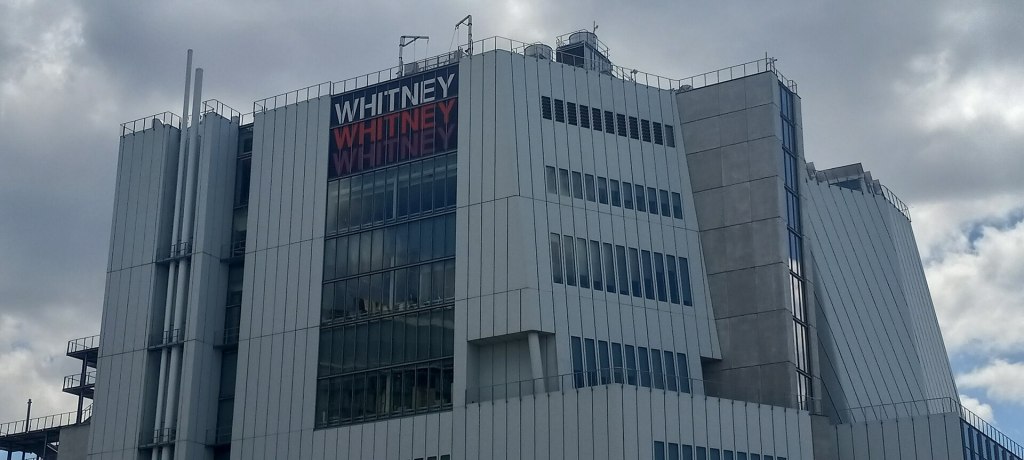
It has been 33 years since New York last mounted a full retrospective of Roy Lichtenstein, and in that time the Ben-Day dot has escaped the museum entirely. It is on throw pillows, sneakers, tote bags and, courtesy of the Whitney itself, an 18-piece clothing and accessories collaboration with Gap. So the Whitney Museum of American Art has set itself a peculiar challenge with “Roy Lichtenstein: Like New,” which opened Oct. 11 on its fifth floor and runs through May 10, 2027: to make the most copied style in postwar American art look, somehow, original again.
The critics have now weighed in, and the verdict is a split decision of the most entertaining kind.
The thesis
The Whitney’s argument, laid out on its exhibition page, is that Lichtenstein was “an appropriation artist long before the term was used by art historians,” and that “in an era when pictures are endlessly generated, copied, altered, filtered, and reposted across screens, Lichtenstein’s art is strikingly prescient.” Translation: the man who enlarged comic-book panels by hand saw the age of AI image generators coming, and answered it in advance with paint.
The show, organized by Meg Onli, the Whitney’s Nancy and Fred Poses Curator, and the artist Alex Da Corte as guest curator, is billed as the first New York retrospective since 1993. It spans six decades of painting, drawing, sculpture, film and prints, along with four re-created murals, and it is supported in part by the Roy Lichtenstein Foundation, which, per Vulture, made a large gift of the artist’s work to the museum.
The Whitney’s exhibition page lists leadership support from the Jerome L. Greene Foundation, Kenneth C. Griffin and Griffin Catalyst, and Susan and John Hess, among a long roster of patrons, with BBDO as the show’s official marketing agency partner. The accompanying catalogue, designed by the Dutch book designer Irma Boom, promises to eschew “traditional chronology in favor of unexpected pairings and groupings.” A Pop retrospective with an ad agency partner and a clothing line is, one might argue, the most Lichtenstein thing imaginable.
The case for
ARTnews’s Alex Greenberger was largely persuaded. He called it a “stylish show” and argued that it restores “some sangfroid” to Lichtenstein by suggesting he “was really interested in mean-spirited aesthetic thievery more so than anything else.” He singled out the curators’ reconstruction of the artist’s early Leo Castelli Gallery debut, housed in a walk-in room within the show, “so faithful that even the gallery’s parquet floor has been reconstructed,” and the inclusion of works by Richard Pettibone, Sturtevant and Louise Lawler that copy Lichtenstein in turn, which make the show a hall of mirrors.
Greenberger’s enthusiasm had limits. He found the exhibition’s apex in Lichtenstein’s Rouen Cathedral variations after Monet and wrote that it “never quite again reaches the heights of that series.” His advice, which we pass along with admiration for its candor: “skim the last third of the show and head outdoors,” where Da Corte and his studio assistants have painted a 32-foot-tall version of Lichtenstein’s mural for the 1963 New York World’s Fair on the museum’s facade. The title, he added, is “something of a misnomer, given that it doesn’t radically upend one’s understanding of Lichtenstein.”
The New York Times gave its review the approving headline “Connecting the Dots Between Roy Lichtenstein and Today,” and The Wall Street Journal’s Brian P. Kelly called the show a “paean to a Pop artist” in his headline.
The case against
Then there is Jerry Saltz, New York magazine’s senior art critic, whose Oct. 16 review carried the headline “Oh, Rats! The Whitney’s Lichtenstein Show Is a Letdown.” Saltz does not dispute Lichtenstein’s importance; he calls the work “radical” and the style “one of the most recognizable in all of art history.” His complaint is with the show’s effect. “The Roy Lichtenstein retrospective at the Whitney Museum is jazzy, bright, snappy, and packed to the rafters,” he writes. “Every Lichtenstein looks instantaneously like a Lichtenstein. Paintings jump off the walls. But the show never lands.”
His larger argument is the more provocative one. Lichtenstein, Saltz suggests, may suffer “that peculiar fate of an artist who wins so completely that their work can no longer surprise us.” Museums, he writes, “need to complicate their work. Challenge it. Make them strange again.” His last line is a perfectly built kiss-off: “This show leaves Lichtenstein right where it found him.”
Our view
Both critics are right, which is the most interesting thing about the show. Greenberger and Saltz agree on more than their headlines suggest: the installation is handsome, the work is formally brilliant, and the AI-age framing is a smart hook. Greenberger thinks the show sags in its later decades; Saltz thinks the whole thing never quite takes off. Where they differ is on whether clever is enough. For Greenberger, the curators have found a new key to an old house. For Saltz, they have simply redecorated it.
What neither verdict changes is the experience of standing in front of Drowning Girl, or the Rouen Cathedrals, and noticing, up close, that every dot was put there by a human being who could have put it somewhere else. In a season when arguments about authorship and copies are everywhere, that is not a small thing to be reminded of. It is also a strong reason to take the Whitney’s elevator to the fifth floor and decide for yourself.
There is a footnote for the truly devoted. As CityRealty noted in its guide to this weekend’s Open House New York, Lichtenstein’s former studio, which ARTnews notes is owned by the Whitney and now houses its Independent Study Program, is among the sites on the festival’s list, with a tour led by a Whitney art historian. If the retrospective leaves you wondering where all those dots came from, there, briefly, is the room.
The City Politic has reached out to the Whitney Museum of American Art, Alex Da Corte and the Roy Lichtenstein Foundation for comment, and will update this story with any response.
Photo: The Whitney Museum of American Art, August 2024, by Kidfly182 via Wikimedia Commons, CC BY 4.0.


Leave a Reply