In 1978, an interviewer on a local television program called Inside New York’s Art World asked Lee Krasner what she had been doing while her husband, Jackson Pollock, was becoming the most famous painter in America. “I was working all the time,” she said, as NPR recounted last weekend. “In terms of what other people think, I can’t do anything about that. You know, that’s not my preoccupation anyway. As long as I was able to work, I went about my business.”
Forty-eight years later, the Metropolitan Museum of Art has finally done the arithmetic in her favor. “Krasner and Pollock: Past Continuous,” which opened Oct. 4 and runs through Jan. 31, 2027, assembles more than 120 works across 12 rooms. By NPR’s count, 74 of them are Krasner’s. Forty-eight are Pollock’s. On Fifth Avenue, at least, Mrs. Jackson Pollock has top billing.
Starting with the scissors
The curators, David Breslin and Brinda Kumar, open not with a drip but with a cut. The first room, as Frieze‘s C. Francis Fisher describes it, holds six large Krasner collages from the early-to-mid 1950s, among them Bald Eagle and Porcelain, both 1955. The detail every visitor will repeat at dinner is that Bald Eagle was built partly from Pollock’s discarded drawings. “Krasner has very intentionally and deliberately cut up discarded Pollock works from this era in the 1950s, where you can see his distinctive drip still evident,” Ms. Kumar told NPR. “She was literally sometimes tearing up older bodies of work to create a new chapter.”
It is hard to think of a more pointed curatorial overture. Mr. Breslin, for his part, offered NPR the diplomatic reading, that the juxtapositions are “almost a metaphor for couples in relationships as well. You form a unit, yet you also have all the things in your head, in your mind, in your heart that are your own.” Married readers may decide for themselves which curator has the better grasp of the institution.
The barn and the kitchen
The marriage itself is the show’s unavoidable subtext, and the Met does not pretend otherwise; Frieze reports the entrance is a dark hallway playing film of the couple near their house in Springs, out on the South Fork. It was Krasner, NPR notes, who chose Springs, to get Pollock away from the business and the booze of Manhattan. Pollock took the barn for his enormous canvases. Krasner painted in the kitchen, and later a small upstairs bedroom. Ms. Fisher makes the material point well: Krasner’s late-1940s canvases chase Pollock’s inventions “on a smaller scale,” a scale “she was confined to due to material circumstances.”
The early rooms are, by most accounts, Pollock’s. Ms. Fisher, who is not inclined to flatter him, found his pre-drip paintings, Birth, Stenographic Figure, Pasiphaë, “feral and alive in a way his more famous pieces aren’t.” The middle of the show is the greatest-hits reel: Lavender Mist, Number 28, and the Met’s own Autumn Rhythm (Number 30), which has been pulled off its customary wall and set on a freestanding slate-gray partition. “The swirling blacks get animated in a whole new way,” Ms. Kumar told NPR. Pollock’s 1952 Convergence, meanwhile, stands near the windows in daylight, its orange and yellow so loud that NPR’s Anastasia Tsioulcas compared it to 1980s subway graffiti.
There is a wonderful bit of market history hidden in that Autumn Rhythm wall. After Pollock’s death in a car crash in 1956, NPR reports, Krasner more than tripled the price of the painting before selling it to the Met, a sum that set the pace not only for Pollock’s market but for a generation of modern artists. The widow, in other words, was also the dealer, and a very good one. Anyone who still thinks of her as the helpmeet should spend a moment in front of that canvas and consider who negotiated the invoice.
After 1956
Then the show turns, and it turns entirely to her. Ms. Fisher admits that, halfway through, she wrote in her notebook, “It’s too bad for feminism that Pollock was simply the better painter.” She then spent the second half of the exhibition being proved wrong, and says so with admirable grace: the late Krasners, from the mid-1950s to the late 1970s, reveal “a mature and confident master painter.” She singles out The Eye Is the First Circle (1960), where the paint “looks almost as if it’s been blown onto the canvas by the wind.”
The showstopper is The Seasons, painted in 1957, the year after Pollock died, on loan from the Whitney Museum of American Art. It is nearly 17 feet wide. Krasner had moved into the barn. “She makes, almost in a contradictory way, some of the brightest, most vibrant paintings the year after his death,” Mr. Breslin told NPR. The journalist Mary Gabriel, author of Ninth Street Women, put Krasner’s restlessness more simply to the network: “Every few years, she tries something new. She was always searching.”
Born Lena Krassner in Brooklyn to Orthodox Jewish parents from what is now Ukraine, she renamed herself twice, first Lenore, then Lee, and became, in NPR’s phrase, “a quintessential networker who knew everybody in New York’s art scene.” She was a New Yorker’s New Yorker, and it took a Fifth Avenue museum the better part of half a century to give her the room she earned.
The dialogue-show problem
There is a reasonable objection to all this, and Ms. Fisher raises it herself: “why, in 2026, must Krasner still be exhibited alongside her husband?” The husband-and-wife blockbuster has become its own genre. Her answer, and ours, is that perhaps this show had to happen so that the next one won’t have to. “Perhaps the real revelation,” she writes, “is that each of these giants is too big for a dialogue show, with even the Met no longer big enough for both of them.”
The Met’s stewardship of this particular estate is, it should be said, a family affair of its own. The Pollock-Krasner Foundation, which Krasner’s will established, holds the copyrights credited on nearly every image of the show, and the couple’s house and studio in Springs is preserved by Stony Brook University as the Pollock-Krasner House and Study Center, where the barn floor still carries Pollock’s paint. A trip out to see it, after a morning at the Met, is the most rewarding way we can think of to spend an off-season Saturday on the East End.
Elsewhere this fall
The Met has company. Downtown, the Whitney has “Roy Lichtenstein: Like New,” which The Wall Street Journal called a “paean to a Pop artist.” On the Bowery, the New Museum is showing Arthur Jafa’s retrospective “I Am Tony,” which The New Yorker found provocative enough to wonder aloud about “the moat of praise around his work.” But it is the Krasner rooms that people will be arguing about at dinner through the winter, and they should be.
“Krasner and Pollock: Past Continuous” is in Gallery 899 at The Met Fifth Avenue and is included with museum admission.
The City Politic has reached out to the Metropolitan Museum of Art, the Pollock-Krasner Foundation, the Pollock-Krasner House and Study Center, and the Whitney Museum of American Art for comment, and will update this story with any response.
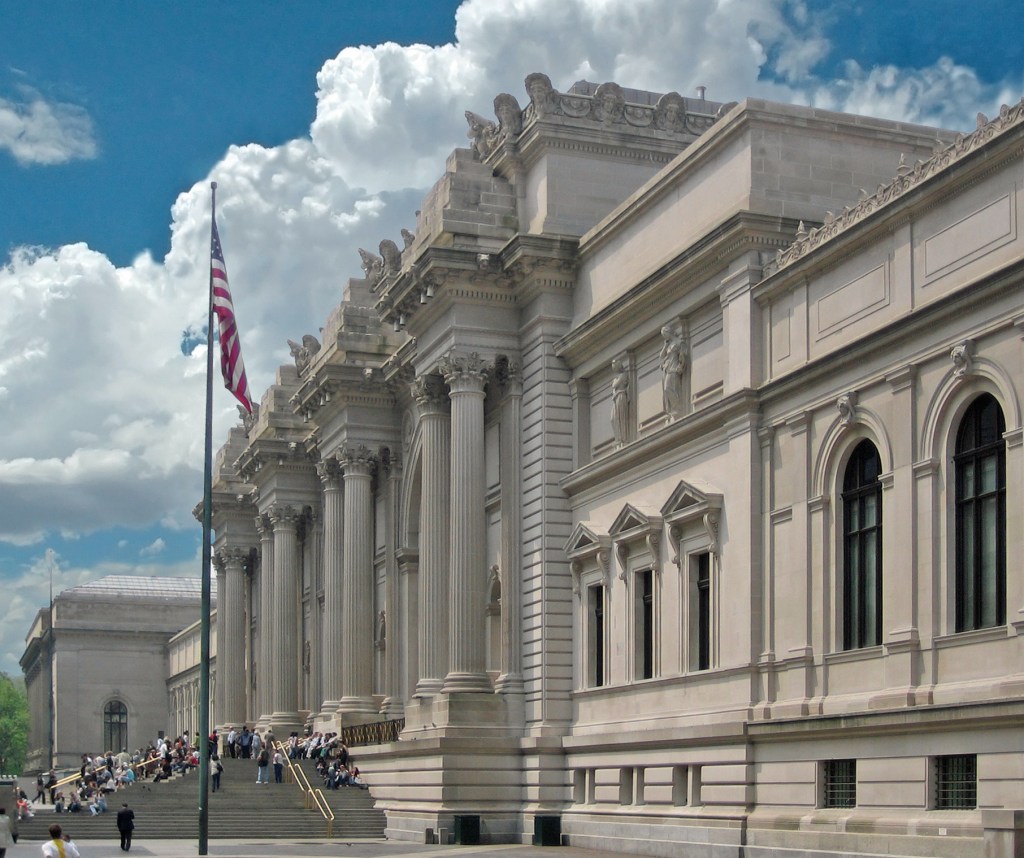
Photo: The Metropolitan Museum of Art, Fifth Avenue entrance, by Arad via Wikimedia Commons, CC BY-SA 3.0.


Leave a Reply