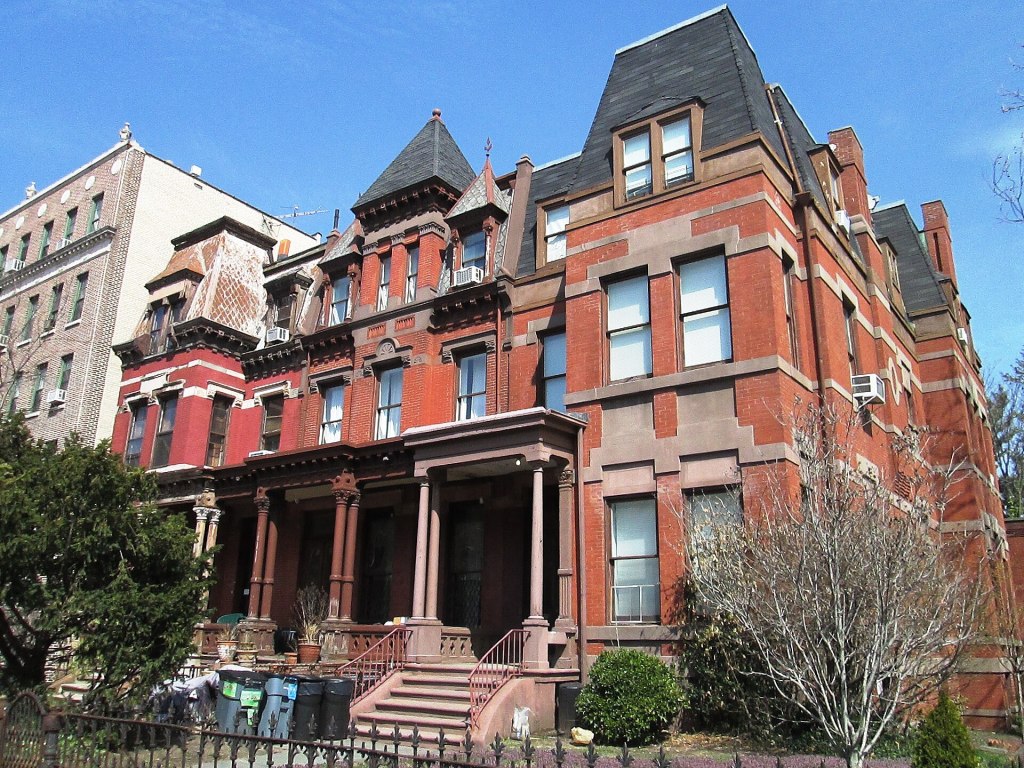
Clinton Hill has always had a slightly complicated relationship with its own grandeur. Its avenues were laid out for the Brooklyn rich of the Gilded Age, the oil, chemical and shipping families who wanted mansions within a carriage ride of the waterfront, and for much of the 20th century those mansions were carved up, institutionalized or quietly forgotten. This month the neighborhood got a fresh reminder of what it used to be, and what it is again: a place where a single family house can cost more than a Park Avenue classic six, twice over.
The house, and the number
According to 6sqft’s Aaron Ginsburg, following a scoop by Curbed, the townhouse at 374 Washington Avenue has sold off-market for $9.4 million, a new record for the neighborhood. The house, built in 1880, is 25 feet wide, has more than 7,000 square feet and five bedrooms, and was represented by Matthew Lesser, Matthew Lipsky and Sophie Smadbeck of Leslie J. Garfield, the townhouse specialists, per 6sqft.
The previous owners bought it in 2014 for about $3.8 million, according to 6sqft, which means the house appreciated roughly two and a half times in a dozen years, a return that would make most hedge fund managers reconsider their life choices. The American Developer, which went looking in public records, puts the figure at $9.396 million and notes a useful caveat: at the time of its report the new deed had not yet been recorded in the city’s ACRIS database, where the 2014 sale, at $3.75 million, still appeared as the most recent transaction. Off-market sales have a way of arriving in the press before they arrive at the Department of Finance.
Dethroning the Pfizer Mansion
What makes the sale delicious, from a neighborhood-gossip standpoint, is the house it displaced. The previous record holder, 6sqft reports, was the so-called Pfizer Mansion at 280 Washington Avenue, built in 1887 for Charles Erhart, Charles Pfizer’s cousin and business partner, which sold for $9.05 million in July 2021. That house returned to market in 2025 asking $10.3 million and, per 6sqft, ultimately sold earlier this year for about $7.8 million. Before the Pfizer Mansion, the neighborhood benchmark was 315 Vanderbilt Avenue, at $7.2 million in 2015.
Put the numbers side by side and you get a small parable about Brooklyn’s top end. The grandest and most storied house on the avenue, with a pharmaceutical fortune in its provenance, lost more than a million dollars between its 2021 sale and its 2026 one. A slightly older, less famous townhouse a short walk away, which had not been on the public market at all, sold for more than either. In other words, the record was set not by history but by condition, privacy and timing. Buyers at this level appear to be paying for the renovation they do not have to undertake and the bidding war they do not have to endure.
Why Clinton Hill, and why now
Clinton Hill’s pull is not mysterious. The neighborhood is home to Pratt Institute, sits within easy reach of Fort Greene Park and the Brooklyn Academy of Music, and has an unusually intact stock of freestanding and semi-detached 19th-century houses, many protected by the Landmarks Preservation Commission‘s Clinton Hill Historic District. Washington and Clinton Avenues, in particular, retain the scale of the era when Charles Pratt was building houses for his sons nearby. You can still see what the money looked like.
What has shifted is who is spending it, and where. For a generation, the eight-figure Brooklyn townhouse was a Brooklyn Heights or Park Slope phenomenon, and an occasional Cobble Hill outlier. Clinton Hill, a few subway stops farther from Manhattan, was where people bought when they wanted the architecture without the price. The 374 Washington sale suggests that discount is narrowing. That is not necessarily a sign of a broad market boom; a single off-market transaction is one data point, and off-market deals by definition tell us less than we would like about competing bids or concessions. But records are records, and brokers will be quoting this one for years.
There is also a Manhattan subplot worth noting. This fall’s real estate conversation across the river has been dominated by the city’s new surcharge on high-value second homes, which The City Politic has covered at length. A primary residence in Brooklyn is, among other things, not a pied-à-terre, and buyers who intend to actually live in a 7,000-square-foot house with a garden may find the outer boroughs’ math more appealing than ever. That is speculation, not reporting, and we flag it as such; nobody involved in the 374 Washington deal has said anything publicly about their motives.
The neighborhood’s long memory
It is worth remembering that many of the neighborhood’s big houses spent decades as rooming houses, school annexes or religious residences before the brownstone revival of the late 20th century began putting them back together. The Erhart house became the neighborhood’s yardstick when it broke the $9 million barrier in 2021, and now it has been surpassed by a house whose sale price was not even publicly listed. Clinton Hill’s founders would, one suspects, approve. They were not in the habit of advertising what things cost either.
For the rest of us, the lesson is less about one house than about a pattern. The ceiling in Brooklyn keeps rising, but it rises unevenly, house by house, and the famous addresses do not always win. The buyer of 374 Washington Avenue paid for a record. The sellers of the Pfizer Mansion, by contrast, learned that a famous name and a storied history do not guarantee a premium. In real estate as in society, provenance gets you in the door; it is the renovation that closes the deal.
The City Politic has reached out to Leslie J. Garfield and its agents Matthew Lesser, Matthew Lipsky and Sophie Smadbeck for comment, and will update this story with any response.
Photo: 301-305 Washington Avenue, Clinton Hill, Brooklyn, by Beyond My Ken via Wikimedia Commons, CC BY-SA 4.0. Not the house discussed.


Leave a Reply